…and in many other ways which have exceeded “1984”
In yesterday’s essay, we provided you with more information on Edward Bernays than I suspect is provided anywhere in a college education. Because if there is any course of study which might include the life and influence of Bernays in our universities, it should at least be found in the Schools of Journalism, Broadcasting, Communication, etc.
Remember, Life magazine listed him among the 100 most influential persons in America in the 20th century! Now that you know the immense influence he has had on our lives, we find the truth of the aphorism: the apple does not fall far from the tree. Edward was the nephew of Sigmund Freud, and now here is the rest of the story of the co-founder of Netflix.
The fact that Marc Bernays Randolph is no longer with the company matters little at this point. Judge the company’s fruit. It continues to do what it was designed to do—to “guide”, i.e., to manipulate or control public opinion, information, knowledge, and beliefs about any issue “they” choose.
At this point, we let the husband-wife team of the Malones inform you on the generational fruit of Edward Bernays. (It seems that Mrs. Malone did the work on this essay.)
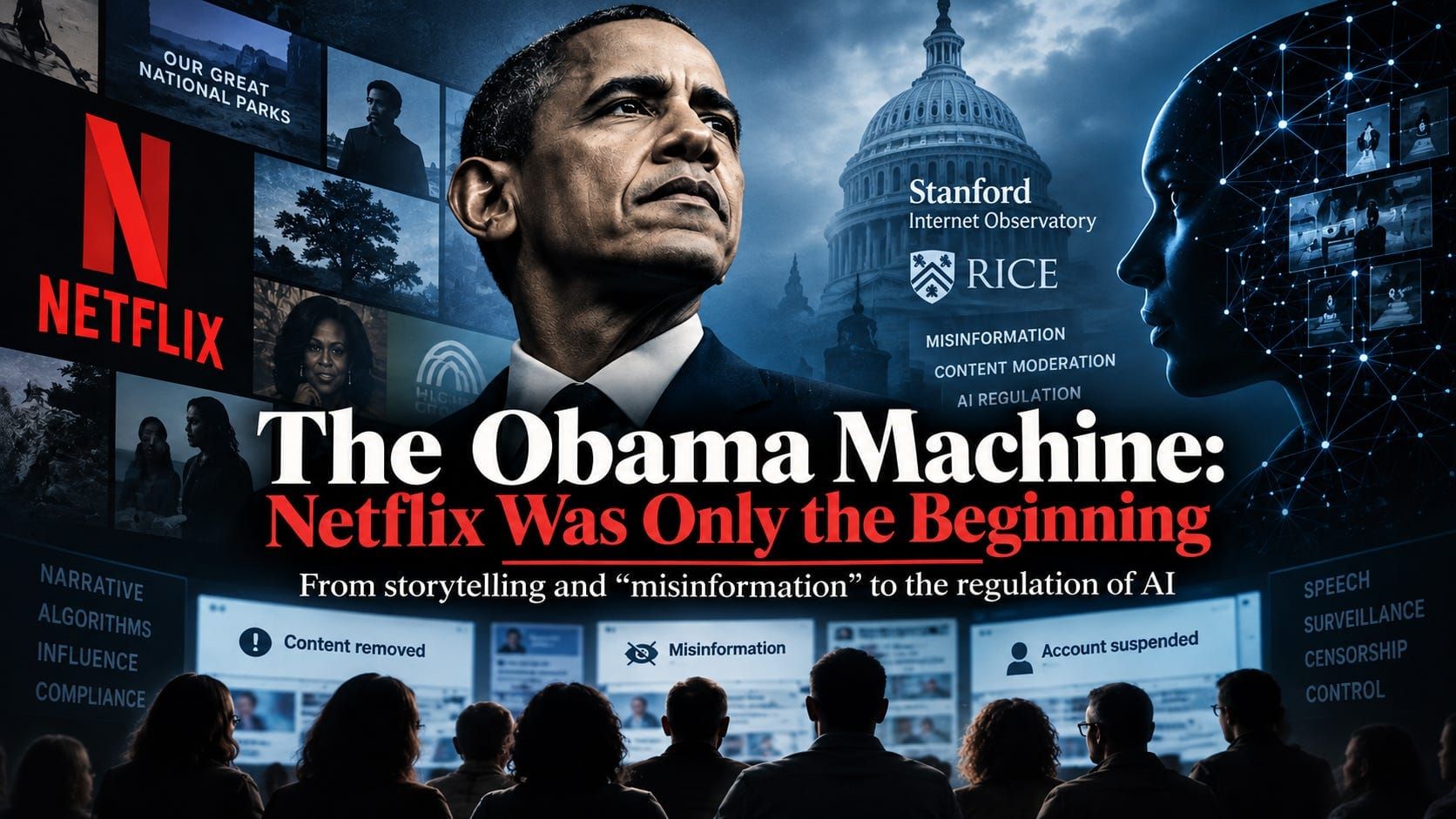
On September 17, 2026, their Substack column was headlined: “The Obama Machine: Netflix Was Only the Beginning,” sub-headlined: “From storytelling and “misinformation” to the regulation of AI.”
Here are some pull-quotes from this highly informative and documented article. This is a fine example of investigative journalism, the real journalism which the fake news eschews. As usual, all emphases and comments within [brackets] are mine, unless otherwise noted. QUOTE:
The deeper story of Netflix is not simply that another American corporation drifted left, adopted DEI, and began producing programming that many Americans find politically tiresome.
It is the story of how entertainment, politics, government, technology, and the management of information have gradually converged, with Barack Obama and the political network surrounding him appearing repeatedly at the intersections.
Once those connections are placed on a timeline, Netflix begins to look less like the story itself and more like one piece of a much larger post-presidential Obama project involving culture, political organization, information management, and now artificial intelligence, all accompanied by an expanding argument for regulation and control of the systems through which Americans communicate and obtain information.
The justification offered again and again is the protection of democracy. The uncomfortable question is what happens to democracy when protecting it increasingly requires someone to decide which information the public should be permitted to hear, and even how "democracy" is defined.
The story begins, strangely enough, with Netflix co-founder Marc Bernays Randolph. Randolph was Netflix’s first CEO and came from one of the most remarkable families in the history of modern persuasion.
Sigmund Freud was a relative, but the more relevant connection was Edward Bernays, Freud’s nephew and Randolph’s great-uncle, commonly described as the father of modern public relations.
Robert and I explored Bernays and the history of modern propaganda in considerable depth in our book PsyWar: Enforcing the New World Order. But the essential point here is that Bernays saw public relations as something far more powerful than simply selling soap or cigarettes.
His famous 1928 book was bluntly titled Propaganda, and his central insight was that human behavior could be influenced by manipulating desires, fears, symbols, and social expectations, often without the people being influenced recognizing what was happening.
Randolph himself has acknowledged the peculiar family connection. His own professional career was built around direct marketing, branding, and consumer behavior, and he has remarked upon how closely his work resembled Bernays’s…
The question is not whether Netflix possesses that power. Obviously it does. The question is what happened when the people running and influencing that institution began explicitly viewing storytelling as a mechanism for changing society.
Netflix formally incorporated “inclusion” into its corporate culture in 2017. This was not confined to the unobjectionable proposition that qualified people should receive equal opportunities to work there.
Netflix explicitly connected representation inside the corporation with representation on the screen: who gets hired, who gets to tell stories, and who tells stories with which stories audiences ultimately see.
The company adopted an institutional philosophy that changing the composition and worldview of the people producing entertainment would change the entertainment itself, and influence culture worldwide.
What critics later called “woke Netflix” was therefore not simply an accidental accumulation of unusually progressive writers and producers. Netflix itself described inclusion as part of the machinery through which content was created.
Then came 2018. On March 28, Netflix appointed Susan Rice to its board of directors. Rice was not a Hollywood producer or entertainment executive. She had been Barack Obama’s ambassador to the United Nations and his National Security Advisor, one of the most powerful foreign-policy officials in the Obama administration.
Less than two months later, on May 21, Netflix announced an extraordinary production partnership with Barack and Michelle Obama. … END QUOTE
The above are snippets just from the opening paragraphs of this investigative report. The whole essay is highly recommended by me as “continuing ed” for the red-pilled and as an eye-opener for those just now awakening.
I have a free subscription to Malone News. Here is a direct link to this Substack article. Excellent work, Dr. Robert (M.D.) and Dr. Jill (Ph. D.) Malone!
~END~