
Bond issues are ubiquitous. There are bond issues of all sorts that appear on local ballots across the nation. For those of our readers in Carthagena, Ohio, (and likewise, possibly a goodly portion of our readership), here is a primer on what they are and how they affect you. After this primer, we get down to business…
Local bond issues in elections primarily authorize governments to borrow money for capital projects with high upfront costs and long useful lives, such as schools, streets, drainage systems, parks, and public safety facilities, because state laws often prohibit creating public debt without voter approval.
Key drivers for these measures include:
Legal Mandates: Many jurisdictions require voter approval for any new public debt or tax-supported borrowing to ensure accountability.
Budget Constraints: Bonds fund projects that exceed the scope of annual operating budgets, allowing communities to spread repayment over time rather than paying immediately.
Infrastructure Needs: Voters are asked to approve funding for aging facilities, such as leaky roofs, failing HVAC systems, which require significant capital investment.
Economic Development: Improved school facilities and infrastructure are used to increase property values and attract businesses to the community.
While bonds are distinct from taxes, they are typically repaid through property taxes, and voters should also consider the long-term financial impact, such as interest costs and potential tax increases, when deciding whether to support the measure.
So, are there any bond issues on the ballot in your locality this November? If so, you might wish to examine them very carefully. Why so? Consider my experience in my allegedly conservative county, reputedly “the most conservative county in the state of North Carolina,” which has 100 counties.
Last Thursday, as an Associate Member, I attended the Henderson County Republican Women’s Club (HCRWC) luncheon meeting. The featured speakers were our Republican candidates for local offices. Each was given five minutes to “make their pitch.”
The final speaker was not a candidate for office, but a man from an organization promoting a bond issue. I wondered how he got on the speakers’ platform without someone speaking in opposition to it.
If voters approve, the bond issue will raise 25 million dollars (i.e., the county will take out a loan) and sock the taxpayers with the bill. The $25 million is to “protect farmland,” or to open the door more widely, “protect open spaces.” So exactly how does that work?
As the promoter began his pitch, “red alert” alarms were ringing in my mind. He was then given a few minutes for Q & A before adjournment of the meeting. It was a large crowd and until then, I had not noticed that my friend, Marilyn, was in attendance. She stood up to voice her strong opposition to the bond, asking the man exactly how this proposal would work.
Who or what group decides who gets money from the bond issue? How much money can a farmer get? What can they do with the money? Answer: anything they want. The more he spoke, the more I could feel my solar plexus tightening into anger.
Upon Marilyn’s questioning, he admitted that the $25 million was just the beginning, a drop in the bucket, that ultimately they (the “conservationists”) would need in excess of 500 million dollars to pay farmers (and others) not to sell their land to big (or small) developers.
It turns out that the cost for the average homeowner in our county would be $40/year added to our already outrageous property taxes. That is per year for the 20 year life of the bond; but it would only be the camel’s nose in the tent.
He admitted they would soon (probably in just a few years) be back with further bond issues to allegedly protect farmland from developers.
As soon as the meeting adjourned, I went over to speak to Marilyn. I began by telling her I was glad she voiced strong opposition, and then I was beginning to share another reason to add to hers when she interrupted me to point out that the bond salesman had just pulled up a chair behind me to (obviously) try to win her over.
But he then addressed me as her heard me agreeing with Marilyn’s point of view. So I said to him in the most pleasant tone I could muster (which was not easy):
“Let’s get to the most fundamental question of all, sir: Where in the U. S. Constitution or the state Constitution of North Carolina does it authorize any group to take money from taxpayers for the benefit of another group—in this case, farmers? And I ask that speaking as someone who grew up on a farm.”
He was unable to cite any Constitutional authority to do so, but responded that the state and federal government has had programs doing this for years.
I responded that is no doubt true, but just because they have been ignoring the Constitution for a very long time does not justify adding to the offenses with this wholly unconstitutional bond issue.
I then took my leave of the room before my (righteous? yes, I think so.) anger boiled over into some very unpleasant words to the bond promoter. Upon returning to my office, I found an email from a lady who has really done a lot of homework on this issue.
I share her work with my national audience to help you in your own community if and when there might be any bond(-age) issues on your local ballot.
Here is the email. QUOTE: [name and email address withheld] Date 9/24/2026
Today’s farmer takes the bribe; tomorrow’s generations wear the chains.
Reasons to vote NO on Open Space Bond Issue
Reason #1. Conservation easements don’t “protect”, they RESTRICT.
Proponents keep you focused on the horror of huge out of state developers. But short-sightedness and good intentions can be fatal. Conservation easements also restrict any “non-agricultural commercial use”. That, my friend, includes small family businesses:
Your daughter loves German Shepherds and wants to build a kennel to raise, train and sell them? Can’t do it!
Son is a bike enthusiast and wants to open a bike shop? Conserving Carolina says NO!
Mom is a great cook who wants to open a local cafe? Or a talented quilter who wants to open a quilt shop? No way! She’s a virus in the earth!
What about a Tai-Kwan-Do academy on the property? A day care center? A Christian School? No, no, HELL NO!
Reason #2. These easements are FOREVER. Today’s farmer receives the bribe money; tomorrow’s generations wear the chains.
Reason #3. Those pushing the bond have a history consistent and similar to the First Plank of Communist Manifesto: Abolition of property in land and the application of all rents of land to public purposes.
- For example, Chuck McGrady [a former County Commissioner]. He’s a past president of the National Sierra Club, Conserving Carolina, and Friends of DuPont Forest:
- The Sierra Club exists solely for public control of land.
- Conserving Carolina has befuddled land owners into giving them 50,000+ acres, with no end in sight.
- Friends of DuPont Forest forced Jim Anthony to sell his land to the State.
- The Trust for Public Land. The name speaks for itself.
Friends, if these people are for it, I’m agin’ it!
Reason #4 - Warnings from our wise Founding Founders:
Thomas Jefferson: “The true foundation of republican government is the equal right of every citizen in his person and property, and in their management.” He added “the defense of private property is the standard by which every provision of law, past and present, shall be judged.”
James Madison: “Government is instituted to protect property. It is not a just government, nor is property secure under it, where [there are] arbitrary restrictions.”
Alexander Hamilton: “In the general course of human nature, a power over a man’s subsistence [i.e., property] amounts to a power over his will.” (Emphasis Hamilton’s)
Legally PROTECTED property rights with their accompanying private enterprise opportunities have been the greatest wealth generator in history. They are the well-spring of America’s freedom and greatness.
Legally RESTRICTED property rights heads us back towards the European serfdom that we fought against 250 years ago.
Earnestly,
[name withheld]
P.S. It’s not for no reason that God says “Thou shalt not covet anything that is thy neighbor’s” and “Thou shalt not steal”. “Easement” is such a gentle, non-threatening term, right? But it’s really coveters easing their way in, gaining control, entangling their way into our lives.
Here’s the ballot measure:
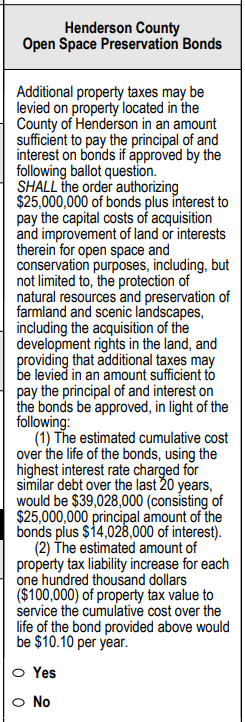
NOTE: The bribe money for farmers to continue farming is coming out of the pocket of other land owners who get nothing. Only globalist NGOs like Conserving Carolina benefit from this deal. I hope people wake up.
Sources:
https://www.sierraclub.org/policy/public-land-exchange “The Sierra Club prefers public acquisition of land”
https://conservingcarolina.org/we-did-it-50000-acres-and-counting/
https://www.tpl.org/ The Trust for Public Land, National Office, 23 Geary St. Ste 1000, San Francisco, California 94108
https://www.biblegateway.com/passage/?search=Exodus%2020%3A17&version=KJV The Bible, Exodus 20:19.
END QUOTE
~END~