Which Bible, Which Version? series
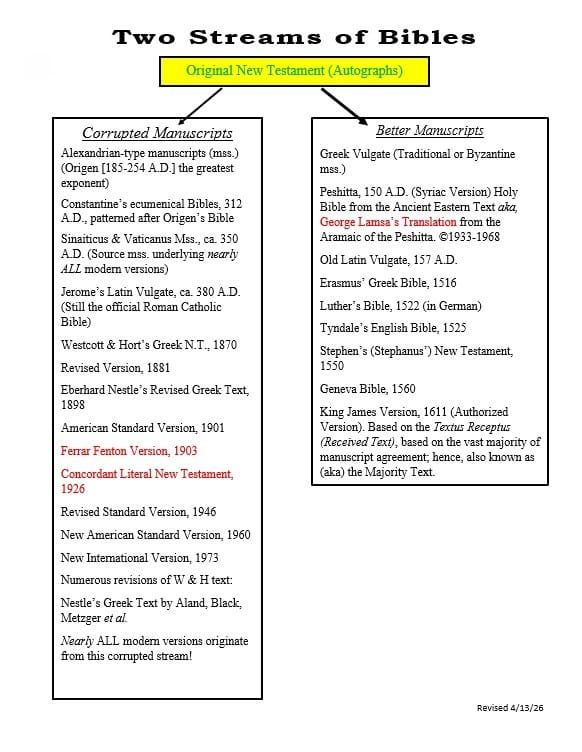
In our previous section in this series, we closed with this: “The theory of Westcott and Hort was merely a pretense of scholarship in order to give Westcott and Hort some alleged basis for abandoning the Received Text and for replacing it with their own creation drawn from the defective Vaticanus and Sinaiticus.
“So, how in the world did they pull this off? How could they get by with that? Here is how they did it.”
We now turn our attention to the work of Westcott and Hort and the Bible Revision Committee of 1871 to 1881. As always, all emphases and comments within [brackets] are mine unless otherwise noted.
In one of the previous chapters, I have already given you some background about the Oxford Movement and how the call for a Bible revision came about, so we are not going to repeat that here. Just remember, though, that the Oxford Movement was a Rome-ward push.
Remember how we learned about the Protestant scholar John Henry Newman and how he became a Catholic and the pope rewarded him by making him Cardinal John Henry Newman …without “going through the ranks?”
Let me give you a bit of information now concerning the members of the Revision Committee. As we discuss the Revision Committee, it will be useful and enlightening to contrast the Revision Committee of Westcott and Hort to the committee who translated the King James Version.
It was 1871 when the Revision Committee began work. They were divided into two companies, a New Testament company and an Old Testament company.
Additionally, they had what amounted to advisory companies over here in America. The key man in America was Dr. Philip Schaff. He was a leader in the American version of the Oxford Movement.
What Newman was in England, Dr. Schaff was in America, except Schaff never officially became a Catholic. However, he was connected with the even-then very liberal Union Theological Seminary in New York City.
And so Schaff was the guy that picked the men for the American advisory groups for the English “revision” of 1881. Curiously, Schaff selected only men who lived in the New York City area.
We are not going to focus on the American companies because they were, in effect, merely rubber stamping the work of the English committee. Besides, they were virtually all of like mind anyhow.
But I did want to introduce the name of Philip Schaff at this time because we will run into him again. Schaff had a revolutionary influence on American theology and was a man who was even tried for heresy by his own denomination. But we shall set that aside for now.
Naturally, all the men who were selected for the English Revision Committee had “recognized credentials.” They were doctors of divinity, they were bishops in the Anglican Church, heads of prestigious schools, etc.
The deck was stacked against the King James Version and the Received Text from the very beginning.
Remember now, in the 19th century, before the work of Westcott and Hort, there were only three Bibles in the English-speaking world of any note: the Catholic Bible, the Protestant King James Version Bible, and the Geneva Bible was still used in some quarters.
Bishop Ellicott was named chairman of the Revision Committee. He was joined by Dr. W.F. Moulton. Dr. Moulton was a key man because he had the greatest influence on who would sit on the Revision Committee.
It would be important for us then to know that Moulton had spent some years translating a Greek grammar from German into English.
Moulton was especially interested in accomplishing this because the higher critic in Germany who wrote this Greek grammar had changed some of the rules of Greek grammar.
When following those new rules, this in turn would produce results different from the King James Version. Isn’t that clever? If you want to change the Bible, there are many ways to do it, but this one is extremely clever.
You see, a hundred or so years after the new Greek grammar has been promoted and accepted as the standard rules of Greek grammar, who will know any better?
Surely Greek students who are just beginning to learn the Greek language, are not going to question the rules that are in the grammar book, are they? Perhaps they should, but it is the rare occasion when students question the rules in the grammar books, especially when it is written by some allegedly great scholar that lived a hundred years ago, and the students know virtually nothing about the “great scholar” except that he was a “great scholar.”
So, Dr. Moulton did that. He translated the higher critic’s Greek grammar textbook into English so it could start influencing the English theological community. Dr. Moulton also favored the Latin Vulgate version of the Catholics, and he was fond of the Jesuit New Testament of 1582, part of the Counter-Reformation of the church of Rome.
Now, with this being the mindset of the man who selects the members of the committee, we are not surprised to see that the deck is stacked.
Another “big name” on the Revision Committee was Bishop George Moberly.
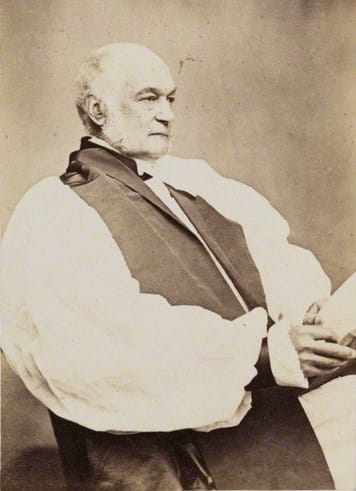
He was closely connected with and quietly prominent in the Oxford (Rome-ward) movement. The Grokipedia article on him says this:
“George Moberly (10 October 1803 – 6 July 1885) was an English cleric renowned for his roles as headmaster of Winchester College from 1835 to 1866 and as Bishop of Salisbury from 1869 until his death, during which he contributed to ecclesiastical reforms and education while aligning with High-Church Anglican traditions...
“Moberly maintained a limited and cautious role in the Oxford Movement's controversies, avoiding the more radical Tractarian positions or public polemics that embroiled figures like John Henry Newman. His participation remained peripheral, focused on quiet support rather than leadership, reflecting a preference for institutional stability over confrontational reform.”
Also on the Revision Committee was the Rev. William Gilson Humphry (1815–1886). He “was an influential English clergyman, biblical scholar, and academic, renowned for his theological writings, pastoral leadership, and involvement in revising the Authorized Version of the New Testament.”
Adding much prestige to the Revision Committee was the respected Dr. J.B. Lightfoot. Joseph Barber Lightfoot (1828–1889) is one of those scholars that “men of the cloth” look to for guidance in the seminary and Bible college libraries today. On many a pastor’s bookshelves you are likely to find among the standard reference works Dr. J.B. Lightfoot’s commentaries.
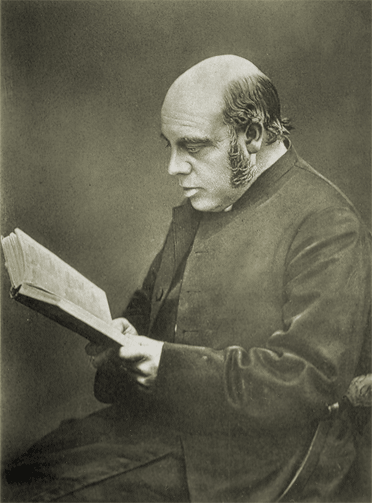
Lightfoot was never married. After he died, he “was succeeded in the episcopate by Westcott, his schoolfellow and lifelong friend.” Source. All these men were peas in a pod. Those three—Moberly, Humphrey, Lightfoot, along with Moulton, Ellicott, Westcott, and Hort made up seven members of the New Testament Revision Committee.
They then sent out invitations which were accepted by 18 others, bringing the total membership of the New Testament committee to 25. John Henry Newman was among those invited to participate, but he sent his regrets due to lack of time.
I will not burden you with the names of all the committee members, but they did also select a small minority of scholars whom they knew would stand by the Received Text.
You see, they wanted to have the appearance of being a balanced committee. A cross-section of the community, right? We hear that all the time, like cross-section of America in the Supreme Court, or in President So-and-so’s cabinet.
Leading the small minority was Dr. Frederick Scrivener. He and his minority were undoubtedly tricked into participating because if they had known the devious plot that Westcott and Hort had hatched, Scrivener and his few allies probably would have declined to take part.
As for the men who made up the King James Version Translating Committee, theirs are names that most of us would not recognize at all today.
There were 54 men appointed, but 57 of them in all by the time they were done, and likewise, I am not going to bore you by listing their names. But although we do not recognize their names today, let me assure you that these men were not only men of tremendous intellectual skill, but also of great spiritual depth as well.
I will not take the time here to back up those statements, which I certainly could do. Instead, if you are interested, I shall point you to a couple of books which go into great detail about these men.
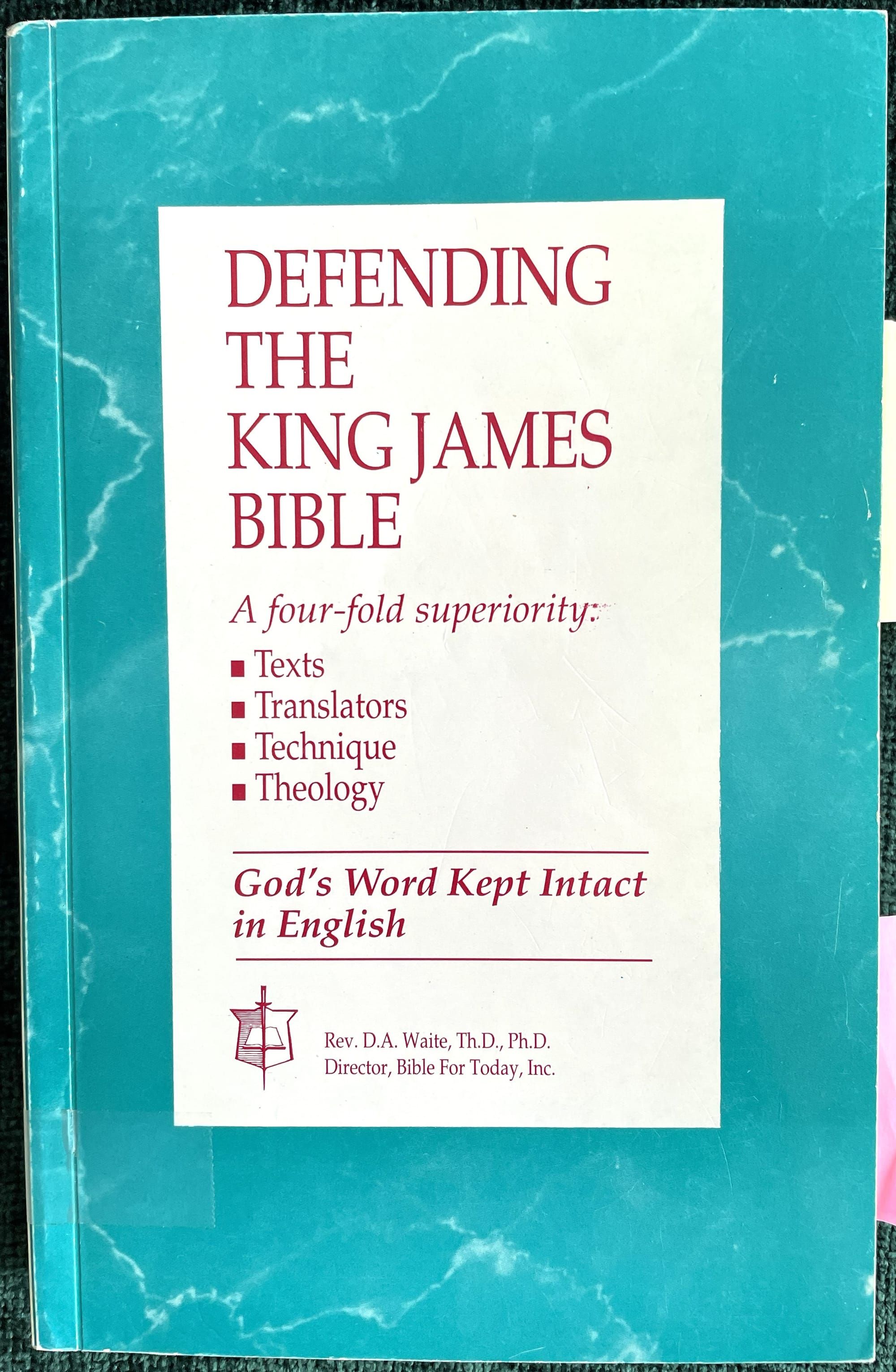
One book readily available is called Defending the King James Bible by Dr. D. A. Waite. He in turn refers to two other men and their books which are much older.
One of them is Translators Revived by Alexander McClure, and the second is The Men Behind the King James Version by Gustavus S. Paine.
Just as a sample, here is Dr. Waite quoting from McClure’s assessment of the superiority of the King James Bible translators. QUOTE:
As to the capability of those men, we may say again that by the good providence of God, their work was undertaken in a fortunate time.
Not only had the English language then ripened to its full perfection, but the study of Greek and of the Oriental tongues had then been carried to a greater extent in England than ever before or since.
It is confidently expected that the reader of these pages will yield to the conviction that all the colleges of Great Britain and America, even in this proud day of boastings [he wrote this in 1857] could not bring together the same number of divines equally qualified by learning and piety for the great undertaking.
Few indeed are the living names worthy to be enrolled with those mighty men.
It would be impossible to convene out of any one Christian denomination or out of all, a body of translators on whom the whole Christian community would bestow such confidence as is reposed upon that illustrious company or who would prove themselves as deserving of such confidence. END QUOTE from Alexander McClure as quoted by Dr. Waite.
Now, is this just some piece of pro-King James Version propaganda? No, because even the chairman of the Revision Committee, a dedicated Hortian, Dr. Ellicott, knew that the members of his committee were far inferior in scholarship to the men of the King James committee of 1611.
Ellicott wrote this. QUOTE: We have certainly not yet acquired sufficient critical judgment for any body of revisors to undertake such a work as this. END QUOTE
So much for the credentials of the King James translators versus the credentials of the men of the Revised Version.
Now, parenthetically speaking, I have probably stated several times already, but it bears repeating that I am not defending the King James Version per se.
I do believe it is the best we have available today, but I do not believe it is perfect, as some do. Nonetheless, there is a lot of King James Version bashing going on, which is both unmerited and, I believe, detrimental to the cause of Christ.
In my first draft of this message, I had a considerable amount of material to discuss concerning the KVJ bashing. But it would have been far too much to include at this time, so we shall have to set it aside and return to it in a later message.
So let me instead focus now on the methods of translating used by the respective committees, because here, there is a very stark contrast apparent between the King James Version committee and the Westcott and Hort Revision Committee.
Here is how the King James committee worked. First of all, a little bit of background. Here’s how it came about.
(To be continued.)
~END~