Which Bible, Which Version?
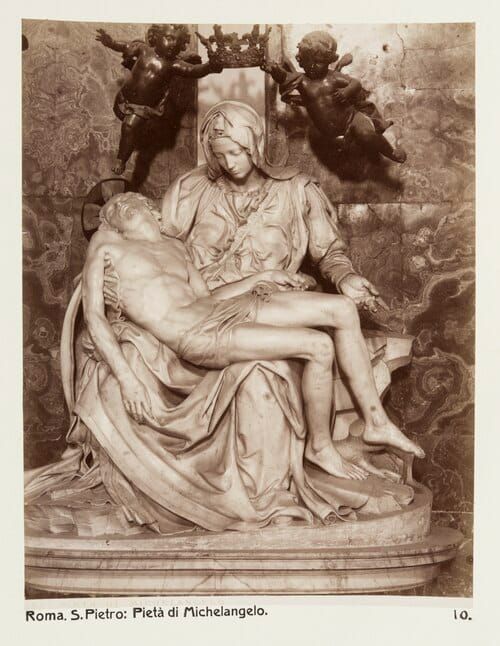
See Supplemental Material at the end of this Section for further information on Michelangelo’s famous sculpture. We left off in the last chapter giving some background about the Oxford Movement in England. It was a movement which resulted in leading some Protestants back to Roman Catholicism.
We noted how the Bishop of Oxford, Samuel Wilberforce, that his own two brothers converted to Roman Catholicism, and that Samuel Wilberforce became the man with high standing who was persuaded to take the lead position in calling for the Bible revision.
We also mentioned how Hort, soon after arriving at Cambridge University, left his Protestant evangelical faith behind. He was under the spell of the Unitarian (later Anglican) Reverend F. D. Maurice, admittedly Hort’s spiritual guide.
Now, as you know from previous blogs, I grew up as a Roman Catholic, being schooled in Catholic grade school and minor seminary (high school), and that one of the doctrines of Rome is the worship of Mary, the mother of Jesus.
Catholics deny it is worship, calling it veneration instead, and as a young Catholic lad, I would never have admitted that I was worshiping Mary, of course, but, in practice, that is what it was (and is).
Let me give you now some excerpts from The Life of Hort concerning this subject. This is from volume 2, pp. 49-51, a letter to Reverend Brooke Foss Westcott, Hort’s bosom buddy, November 1865. As always, any emphases and comments within [brackets] are mine, unless otherwise noted.
QUOTE: I am very far from pretending to understand completely the ever-renewed vitality of Mariolatry, but is not much accounted for on the evil side by the natural revertence [sic] of the religious instinct to idolatry and creature worship and aversion to the Most High, and on the good side by a right reaction from the inhuman and semi-diabolical character with which God is invested in all modern orthodoxies, Zeus and Prometheus all over again?
In Protestant countries, the fearful notion, ‘Christ the believer’s God,’ is the result. In Romish countries, the virgin is a nearer and more attractive object, not rejected by the dominant creed, and the divine Son retires into a distant cloud world with the Father.
The whole speculative tendencies of Latin theology (and much of the later Greek from Ephesus onwards) aiding in the result, being in fact Apollinarian in spirit. PAUSE QUOTE
Apollinarianism was a fourth-century Christological heresy proposed by Apollinaris of Laodicea which asserts that Jesus Christ had a human body and animal soul, but lacked a human rational mind, with the Divine Logos replacing the latter. More information on this and Mariolatry in the Supplemental Material at the end of this blog.
Continuing to QUOTE:
Another idea has lately occurred to me. Is not Mariolatry displacing much worship of scattered saints, and so becoming a tendency towards unity of worship? This is all very crudely expressed; but I think it is substantially true, though probably by no means the whole truth. END QUOTE.
Let me repeat one line because I know the writing style is somewhat difficult to understand as we read it, but Hort said, “In Protestant countries, the fearful notion, Christ the believer’s God.” This much seems clear: that Christ as your God is a fearful notion to Mr. Hort.
Then in another letter to Westcott, dated October 17, 1865.
QUOTE: I have been persuaded for many years that Mary-worship and ‘Jesus’-worship have very much in common in their causes and their results. Perhaps the whole question may be said to be involved in the true idea of mediation… PAUSE QUOTE
What he is talking about is a mediator. Well, Bible believer, we ask you: Biblically, Who is the mediator?
1 Timothy 2:5 For there is one God, and one mediator between God and men, the man Christ Jesus;
To repeat the last partial sentence for context as we continue, QUOTE: Perhaps the whole question may be said to be involved in the true idea of mediation, which is almost universally corrupted in one or both of two opposite directions.
On the one hand, we speak and think as if there were no real bringing near, such as the New Testament tells of, but only an interposition between two permanently distant objects. On the other, we condemn all secondary human mediators. PAUSE QUOTE
I’ll stop for a moment again and explain what he’s talking about here. “Secondary human mediators,” like Mary, an obvious reference because the Catholic Church teaches that Mary is the co-mediator (co-mediatrix) along with Christ. In other words, in Catholic doctrine, Mary is a mediator, also. I know that because I was taught as a child, and I did in fact pray to Mary for her to intercede (mediate) with Jesus for us for whatever end result I was praying to her to accomplish.
Then Hort continues, QUOTE: “On the other, we condemn all secondary human mediators as injurious to the One, [meaning Christ], and shut our eyes to the indestructible fact of existing human mediation, which is to be found everywhere. But this last error can hardly be expelled till Protestants unlearn the crazy horror of the idea of priesthood. END QUOTE.
Again, I know that is a little bit hard to follow, so let me continue to explain what Hort is expressing here.
He says, “This last error,” in other words, the error that Protestants don’t see Mary as another mediator along with Christ, “This last error can hardly be expelled” out of Protestantism until Protestants unlearn what he calls “the crazy horror of the idea of the priesthood.”
Everyone knows in that in the Roman Catholic religion, they have a priesthood, but that is hierarchical in nature and is limited to those with many years of special training. One gets ordained as a priest and one can be advanced from there to higher ranks. In contrast, the Protestant doctrine of priesthood is contained in the phrase, the priesthood of all believers.
If I may paraphrase Hort, he is essentially saying, “We’re not going to be able to understand how Mary is our mediator in addition to Christ, until we get rid of this horrible idea that all of us Christians are priests as well.
In other words, Hort wants Protestants to discard the priesthood of all believers doctrine so that we can all have Mary as our secondary mediator. There we have it: Back to Rome we go.
Then there’s Westcott saying, Hort, Hort, wait for me! Because here’s an excerpt from The Life of Westcott, volume 1, page 81, this is Brooke Westcott writing, “My dearest Mary,” to his fiancée, in early 1847. Westcott talks in the first part of the letter about a trip he made to France, and then how he was visiting a monastery, a Carmelite settlement, called Grace Dieu. Then he says, QUOTE,
After leaving the monastery, we shaped our course to a little oratory, which we discovered on the summit of a neighboring hill. [An oratory was a little, somewhat sheltered place to pray.] We discovered it on the summit of a neighbouring hill, and by a little scrambling, we reached it. Fortunately, we found the door open.
It is very small, with one kneeling place, and behind a screen was a Pieta, the size of life (i.e., a Virgin and dead Christ.) END QUOTE.
The pieta is a carved statue of Mary, the mother of Christ, holding the dead Christ with his head on her lap.
And as though recalling his reverie, Westcott writes to Mary: QUOTE: Had I been alone, I could have knelt there for hours. END QUOTE.
Back in the days of my Catholic youth, we called that the adoration or the veneration of the Blessed Virgin Mary. Today, I would call it Mary worship, or as Hort says, Mariolatry.
Yet, 18 years later, Westcott writes to Professor Lightfoot. This is in The Life of Westcott, Volume 1, page 251, “I wish I could see to what forgotten truths Mariolatry bears witness.”
Well, if Westcott and Hort are pro-Catholic, then they must be anti-Protestant. That should be becoming clear to all of us by now, but here are some of their own statements.
From The Life of Westcott, Volume 2, page 53. This is Westcott’s letter to the Archbishop of Canterbury, E. C. Benson in 1887. Remember that name, E .C. Benson, as he figures prominently in our later chapters.
QUOTE: As to the second question, the Vaudois [See Supplemental below.] are doubtless interesting. And it does not seem to me that the Vaudois claim an ecclesiastical recognition. The position of the small Protestant bodies on the continent is no doubt one of great difficulty. But our church can, I think, only deal with churches growing to fuller life.” END QUOTE.
Now, if you recall from one of the previous chapters in this series, the Vaudois were that group of very devout Christians who in the early centuries were persecuted by the Catholic church for not accepting the Latin Vulgate of Jerome. The Vaudois rejected Jerome’s Bible version because they had the Old Latin version which was essentially what was later called the Textus Receptus.
These devout Christians lived in the Alpine valleys of northern Italy, southern Switzerland, and in east-southeastern France where all those countries’ borders converge. {I mistakenly said northwestern France in the audio lecture.}
By the time of the 1800s, the Vaudois were still very Protestant and now of the Calvinist-leaning doctrines.
And so what Westcott is saying here is that the Vaudois evidently had written to the Archbishop of Canterbury, E. C. Benson, and they pleaded to the Archbishop, saying in effect, "Hey, Anglican brethren, we need some help over here."
What the nature of the needed help was, I don’t know. But Westcott is writing back to the Archbishop and recommending that this very good body of Protestants on the continent of Europe be ignored and not be given any help. (!)
(To be continued.)
SUPPLEMENTAL MATERIAL
Further information from Wikipedia regarding The Pieta, the featured image at the top of this post. “The venerated image with its original canonical crown from 14 August 1637 by the Pontifical decree of Pope Urban VIII. Photo circa, 24 May 1888. Urban VIII granted the venerated Marian image a decree of canonical coronation via his Papal bull Domina Coronatum Est signed and notarized on 14 August 1637…
“The levitating diadem was manufactured by the Italian artisan, Fantino Taglietti… The official rite of coronation was executed on 31 August 1637. The cherubic angels were added in 1713.”
_________________
The following is from AI-generated information. Although it is edited by me, it should not be assumed that I vouch for or agree with every statement herein. As always, any emphases and comments within [brackets] or {braces} are mine, unless otherwise noted.
Mariolatry is a term used to describe the veneration or worship of Mary, the mother of Jesus, which critics argue surpasses the honor Scripture assigns to her and enters into adoration reserved for God alone. The word derives from "Mary" and the Greek word latreia (λατρεία), signifying worship.
The term emerged primarily during the Protestant Reformation as a critique of Roman Catholic and high-church traditions. Critics contend that practices such as praying to Mary, kissing her icons, or attributing to her roles like Mediatrix or Co-redemptrix blur the line between honor and idolatry, violating the biblical command that worship (latria) belongs solely to God.
In response, Roman Catholic and Eastern Orthodox traditions deny the charge of Mariolatry, asserting a theological distinction between latria (divine worship due to God alone) and dulia (veneration given to saints). They teach that Mary receives hyperdulia, the highest form of veneration, which is distinct from and inferior to the adoration owed to the Creator.
[But that is not what happens in practice, as I can attest. Moreover, the whole doctrine of praying to, and “venerating” so-called “saints” is wholly false. Obviously, this not the place to enter into detail on all that.]
_________________
Apollinarianism is a fourth-century Christological heresy proposed by Apollinaris of Laodicea which asserts that Jesus Christ had a human body and animal soul, but lacked a human rational mind, with the Divine Logos replacing the latter.
Developed as an over-reaction to Arianism to protect Christ’s divinity and sinlessness, it was condemned as heretical by the First Council of Constantinople in 381 AD for denying the full humanity of Jesus, which orthodox theology holds is necessary for the efficacy of the atonement.
Key Characteristics:
Theological Error: Apollinaris argued that two complete natures (human and divine) could not coexist in one person, leading to the view that Christ was a hybrid rather than fully God and fully man.
Soteriological Failure: Opponents like Gregory of Nazianzus famously argued, "What is not assumed is not healed," meaning that if Christ did not assume a complete human mind, he could not redeem the human rational soul.
Modern Echoes: Contemporary theologians like William Lane Craig have proposed "Neo-Apollinarianism," suggesting the Logos supplies the rational faculties to Christ’s human body, a view that remains debated among scholars regarding its orthodoxy.
________________________
The Vaudois [pronounced Vode- {as in code} wah] (also known as Waldenses or Valdesi) were a Christian religious movement that originated in Lyon, France, around 1173 under the leadership of Peter Waldo (Pierre Valdo). [Others disagree saying they originated long before Peter Waldo, to which opinion I subscribe. See below.]
Initially, under and after Waldo, they were a group of lay preachers advocating for apostolic poverty and the vernacular reading of the Bible. They were excommunicated by the Catholic Church in 1184 and declared heretics.
Beliefs: They rejected clerical hierarchy, the cult of saints, purgatory, indulgences, and the authority of the Pope, insisting on the Bible as their sole authority. [Good for them!] They were among the earliest groups to embrace Calvinist doctrines in the 16th century.
Persecution: Facing centuries of brutal persecution, including crusades and massacres ordered by Popes and secular rulers, many Vaudois fled to the Alpine valleys of Piedmont (northwestern Italy) and Provence, France.
Survival: In the remote Vaudois Valleys (such as Pellice, Luzerna, and Angrogna), they preserved their faith and established a resilient community that often successfully defended itself against larger armies.
Modern Status: The Vaudois are considered precursors to the Protestant Reformation.
Today, Waldensian churches still exist in Italy, Germany, Uruguay, Argentina, and the United States. [There is a town just off Interstate 40 in North Carolina called Valdese, where I once did some construction work. There is a community of Waldensian believers there.]
Pre-Waldensian Groups: Sources mention “Valdenses” or similar “heretical” groups condemned by the Roman church as early as 1144. There are references to proto-Protestant beliefs in Northern Italy dating back to the 4th century, but these are distinct from Peter Waldo’s specific founding.
Note: The term “Vaudois”should not be confused with inhabitants of the Canton of Vaud in Switzerland, which is a distinct geographical region
~END~