

3 John 1: 2 Beloved, I wish above all things that thou mayest prosper and be in health, even as thy soul prospereth.
In twenty places in the Old Testament, the promised land is described as a place which has an abundance of milk and honey. Here is a typical example:
Numbers 14:8 If the LORD [Yahweh] delight in us, then he will bring us into this land, and give it us; a land which floweth with milk and honey.
Question: Do you suppose that when the Israelites came into and inherited that divinely-promised land, that any of them suffered from lactose intolerance?
Personally, I doubt it very much. But yet probably every reader of this essay-blog knows someone who has either lactose intolerance or lactose malabsorption. What is the difference? Here is an AI-generated answer: Emphases mine. QUOTE:
Estimates for the number of people in the USA with lactose intolerance vary significantly depending on whether the metric is lactose malabsorption (the biological inability to digest lactose) or lactose intolerance (the presence of clinical symptoms).
Lactose Malabsorption: The National Institute of Diabetes and Digestive and Kidney Diseases (NIDDK) estimates that 36% of people in the United States have lactose malabsorption. Given the U.S. population, this translates to approximately 120 million people.
Clinical Lactose Intolerance: Estimates for those who actually experience symptoms are lower. Some sources cite that 30 million to 50 million American adults have some degree of lactose intolerance. A 2009 study based on self-reported data suggested a lower prevalence, with an overall rate of 12% (approximately 40 million people), varying by ethnicity (e.g., 7.7% of European Americans vs. 19.5% of African Americans). END QUOTE
What is the reason why there are such high numbers of people who are totally or somewhat prevented from enjoying milk and milk products? My own (non-professional and non-scientifically-proven) opinion is that it has to do with the fact that almost no one has access to raw, unpasteurized and unhomogenized milk.
The high heat of pasteurization likely kills all the good bacteria along with the bad. Then, Big Dairy processing companies add in chemically-isolated quantities of vitamin D, calcium, etc. which in my opinion are not necessarily the right way for the body to obtain those nutrients.
I am criticizing our American way of dealing with milk even though my dad worked most of his life in jobs with Borden Dairy and later with the Sealtest Dairy corporation. But I also grew up as a farm boy in Ohio. However, that farm was primarily a hog-raising operation, not a dairy farm.
Nevertheless, I did get to spend weeks in the summers (from about age 7 to 16) at the farm where my mother grew up, and it was a dairy farm. Hence, I enjoyed raw milk, butter, etc. for at least part of my formative years at the now-fifth generation family farm.
My (Catholic) godmother aunt (mom’s sister) and her husband inherited the farm and I learned first hand the dedication and very hard work it takes to make a living from a small-herd dairy farm. (40-50 cows, as opposed to a large, corporate farm.)
My aunt and uncle worked very hard all their ninety-plus year lives to make a living for their 11 children, plus my two youngest sisters whom they adopted after our mother passed away at age 44.
As I know from first-hand experience, dairy operations are hard work. Up every morning at 4 a.m. to do the milking. Repeat in the evening. Do this 365 days a year. I have often wondered whether it is possible for the cows to have a weekly day of rest which would not cause their udders and mammary glands to be overloaded and painful.
As a child and teenager, I noticed that my aunt and uncle could almost never go anywhere because of the need to milk the cows every single day. I always wondered when they got a day of sabbath rest.
They went to Mass on Sunday, but still they milked the cows on Sunday morning and evening. Perhaps a reader can enlighten me on this dilemma. Did the ancient Israelites simply refuse to milk their herds on the sabbath?
All the above personal experience is why I found this recent column by Dr. Robert Malone quite informative. I had no knowledge of this history. We are omitting the pages of documentation and the hyperlinks, but here is a link to the whole article on Substack. QUOTE:
Raw Milk: The Wrong Lesson
A scandal of corruption and filth became a permanent case against fresh milk. It was the wrong lesson.
New York distillers poisoned thousands of infants with filthy milk, and the politicians paid to stop them took bribes instead. Then the government drew exactly the wrong lesson.
Rather than remove the conditions that caused the disaster, it treated the symptom, protected the system, and taught generations of Americans that the cow was the problem. She was not.
In the spring of 1858, a New York publisher named Frank Leslie received milk at his door that was blue, watery, and contaminated with pus. He ordered an analysis, disliked what he found, and sent reporters and illustrators to trace the milk to its source. What they uncovered was not a quality control failure. It was an industrial scandal that had become a business model.
The distilleries of Manhattan and Brooklyn produced enormous quantities of spent grain mash. Disposing of it cost money. Feeding it to cattle produced profit. Distillers built cow sheds against their whiskey operations and packed them with animals standing in filth, tethered over troughs and fed steaming waste from the stills.
The diet destroyed the animals. Teeth loosened. Sores opened. Udders became diseased. Cows too weak to stand were suspended in slings and milked until they died. That milk was sold to the public.
Because it was thin and blue, it was adulterated first. Chalk and plaster for color. Flour and starch for body. Molasses for appearance. Water for volume. Wagons labeled “Pure Country Milk” carried it through the city while families believed they were buying fresh milk from the country. Contemporary estimates attributed thousands of infant deaths a year to it.
The corruption that protected the trade should sound familiar. When public outrage forced an investigation, inspectors warned the operators before arriving. The barns were cleaned. The conditions were staged.
The committee toured the sanitized sheds, declared the danger exaggerated, and recommended better ventilation. One member, Charles Haswell, filed a dissent describing the fraud and warning that children were dying. He was ignored. Years of pressure passed before the state acted.
The story is usually told backward. Nothing about the swill milk scandal shows that milk was inherently dangerous. The deaths came from confinement, diseased animals, contaminated feed, adulteration, and political corruption. The milk was dangerous because the system producing it was dangerous.
There were two ways to respond. One was to fix the source. Take the cattle out of the distillery sheds. Clean up the conditions. Test the animals. Keep the herds healthy. Produce milk under conditions that do not cause disease.
The other was to leave the industrial system in place and try to neutralize the result after the fact. The second path won. Pasteurization was not the choice made in 1858. It did not yet exist as a practical milk intervention.
Pasteur’s early work was on wine; milk pasteurization did not take hold in the United States until decades later. The officials who inspected the swill dairies were not choosing heat over reform. They were choosing corruption over reform.
That distinction matters. Decades later, when the federal government did push pasteurization, it conceded that the method was not ideal, only practical under existing conditions.
In plain terms, restructuring the production system was harder than heating the final product. The industry was already large, centralized, and politically connected. Heating the milk was easier than fixing the barn.
There is another part of this history that deserves the same scrutiny, and it cuts against the regulators as much as against anyone else. There was a genuine disease that traveled in milk. It was tuberculosis.
But the historical record blurred two organisms. Mycobacterium tuberculosis is primarily a human pathogen, spread person-to-person. Mycobacterium bovis is primarily a cattle pathogen that can infect people, most often through raw milk.
The two diseases can look identical, and for most of this history, physicians could not tell them apart. Species-level identification was usually impossible. Cases were classified by symptoms, by age, and by the site of disease rather than by direct proof.
Extrapulmonary tuberculosis in a child was often assumed to be milk-borne and therefore bovine. That assumption is not the same as demonstrating M. bovis, and the reasoning frequently ran in a circle.
This is why the old body counts should be read with caution. The round figures still quoted today, such as fifteen thousand American deaths in 1917, are contemporaneous official estimates, copied forward for a century with little hard counting beneath them. The confidence with which they are repeated now exceeds the evidence that produced them.
None of that makes bovine tuberculosis imaginary. Where investigators actually typed the organism, by culture and animal inoculation, they found it. Park and Krumwiede did this work in New York in 1910. Fraser showed in 1912 that much of the bone and joint tuberculosis in Edinburgh children was bovine.
Three British Royal Commissions, working between 1890 and 1911, settled that the cattle organism does infect people. In those studies, the bovine type accounted for roughly a quarter of childhood tuberculosis cases and about half of tuberculous neck gland cases before milk was made safe.
The honest reading is that the disease was real and laboratory confirmed in children and in the non-pulmonary forms, while the sweeping national totals were not.
Modern data argues for the same restraint. Across much of the world, raw milk and informal dairy remain common, yet zoonotic tuberculosis is generally estimated to be a small share of human tuberculosis, often one to two percent, and likely undercounted in some regions.
WHO [World Health Organization]-linked figures put it at near 140,000 human cases per year, out of millions of total cases. That is real. It is not nothing. It is also not the blanket case against fresh milk that regulators imply.
So the honest statement is narrow. M. bovis was a real risk where infected cattle were present, and milk was drunk untreated, and it was most dangerous to children. The remedy was not to heat all milk and restrict the alternative.
The remedy was to clean up the herds, and where that was done thoroughly, the disease collapsed. The United States tested and removed infected cattle and largely eliminated it. Countries that relied on pasteurization alone and left their herds infected kept the problem for decades.
The lesson is not that raw milk causes tuberculosis. The lesson is that diseased herds are dangerous. Test the animals. Remove infected cattle. Document herd health. Maintain clean production.
Raw milk from a tested, healthy herd is a different product from milk drawn from animals of unknown disease status. The deciding factor is not temperature. It is the health of the animal. Tuberculosis testing. Brucellosis testing. Clean conditions. Real surveillance, proven rather than assumed.
The real lesson of the swill milk scandal is not that milk is dangerous. It is that any system, industrial or otherwise, becomes dangerous when corruption, convenience, and profit replace accountability. The cow was never the central problem. The conditions were. The fraud was. The corruption was. END QUOTE
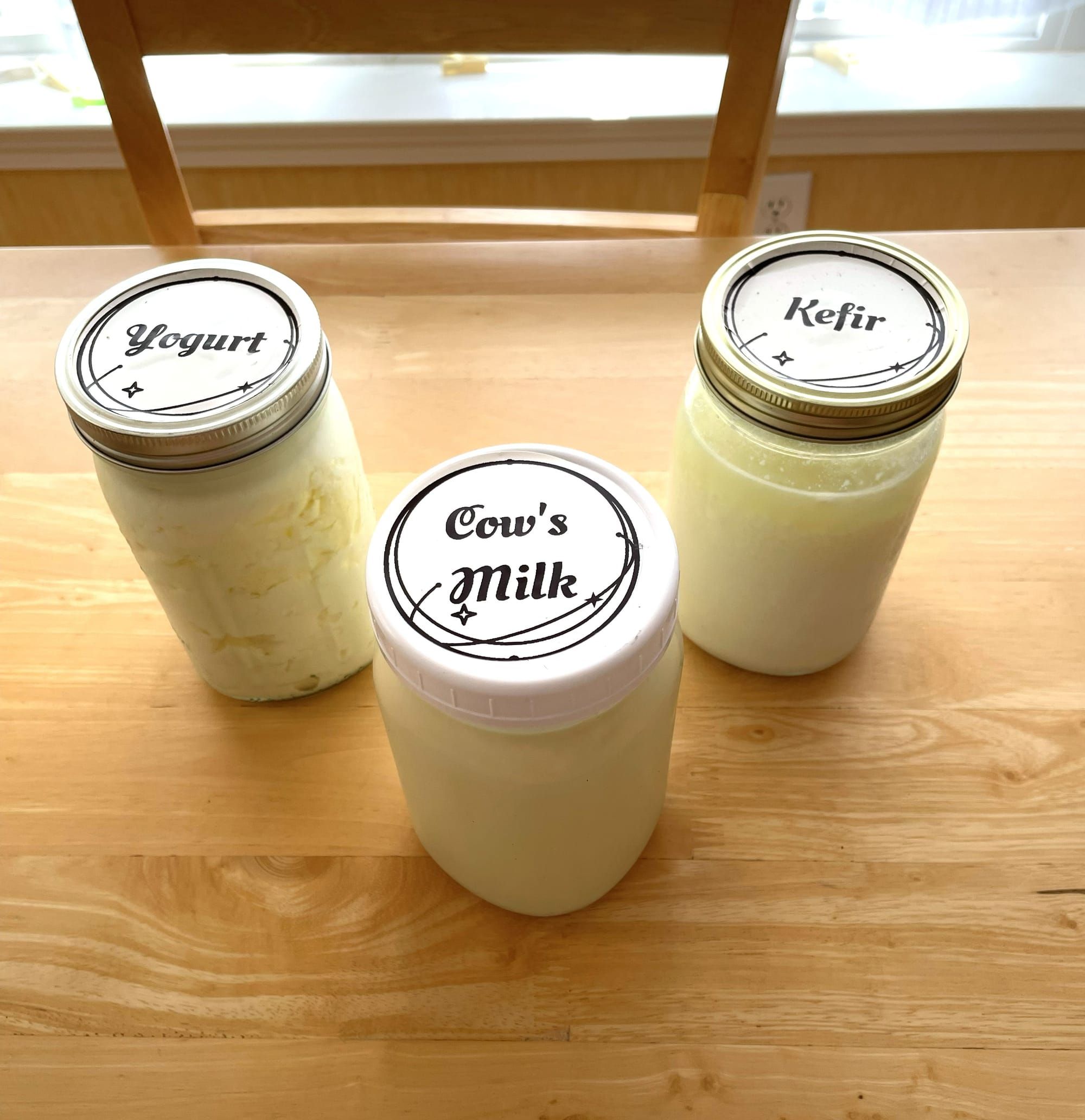
I enjoy raw milk and its products. But my source is from very dear, farmer friends of mine. I trust them completely, but caveat emptor [let the buyer beware] always applies. If, God forbid, I opened a quart of milk and it smelled foul or looked “weird,” I would not consume it. But I would bring it to the attention of my dear friends immediately and discuss it. They would certainly want to know.
Meanwhile, I enjoy unadulterated, natural, raw milk and other dairy products from them with nothing added to “fortify” it, but with all the life-giving vitamins, minerals, enzymes, etc. left intact.
~END~