
Chapter 3, Section 3: Textual Criticism of Manuscripts
Previously, we displayed a chart showing the evolution through history of essentially two streams, branches, or families of Bible manuscripts. We concluded Section 2 of Chapter 3 with these two paragraphs:
Our job is to try to determine if either of these two streams carries the true and inerrant Word of God. Or, if we find that the copies might have some scribal errors, we still want to determine which of these two branches or streams is the most reliable and trustworthy.
This will help us choose the version we ought to be using today. The way this is done by scholars is called “the science of textual criticism.” Now, we must turn our attention to that.
Frankly, I think that to call it a “science” is a misnomer because the scientific method is to construct and perform various repeatable tests or experiments in order to discover God’s law governing the nature of that about which the scientist is endeavoring to learn.
When dealing with the various forms of manuscripts, however, the textual critic is not typically dealing with the material piece of parchment, so much as he is dealing with the characters that are written upon it; i.e., the symbolic representation of what is on that material.
And from that, in comparison with other manuscripts, he seeks to determine what the original text must have been. Therefore, I believe that textual criticism is more an art than a science. I could show you that the so-called laws or rules of textual criticism are not like scientific laws at all, such as Newton’s laws of gravity.
The laws of textual criticism are, at best, mere guidelines. Who writes these “laws?” The fact is that whichever scholar can attract the greatest number of other scholars to agree with him what the rules are is what becomes “the laws of textual criticism.” The rules are certainly not set in concrete nor are they actually scientific in nature.
Textual criticism of the Scriptures has been going on since the earliest time of the New Testament church and actually centuries back into the Old Testament. However, because we are dealing with the New Testament at this juncture, we will confine our discussion to it.
To illustrate for you how the process of textual criticism works, imagine that I am a textual critic, and I have five Greek manuscripts. Each is a slightly different from the others, and I am trying to determine what this verse must have said in the autographs.
We find this same verse in all of the manuscripts, and in manuscript number one, this particular verse reads, “Thr boy kicked the red ball.” The second manuscript reads, “The boy kicked the rod bill.” The third manuscript says, “The bay kicked the red bull.” In manuscript number four, the same verse says, “The boy kicked the red bell.” Manuscript number five says, “The boy kvcked the red ball.” In chart form:
Simple Example of Textual Criticism
Ms. #l: The boy kicked thr red ball.
Ms. #2: The boy kicked the rod bill.
Ms. #3: The bay kicked the red bull.
Ms. #4: The boy kicked the red ball.
Ms. #5 The boy kvcked the red ball.
Looking at those options and considering context, we can come to some logical conclusions. “The boy kicked” is easy to see as valid because there is only one manuscript that does not say “The boy,” and it does not make any sense in the context of the sentence to use “bay” instead of “boy.”
It is obvious that “kvcked” is a misspelling, and the “Thr” should be “The,” but perhaps it could read, “The boy kicked the red bell.” However, “bell” appears in only one manuscript, “bull” appears in one, “bill” appears in one, but the word “ball” appears in two.
We thus surmise that the original Greek text probably read:
“The boy kicked the red ball.”
That is a very elementary example of what the textual critic does. Obviously, there is a lot more to it than that, but it will give you a brief glimpse into how the critics work.
It is important to note here (and will be repeated for emphasis elsewhere in this series) that this is what is called in scholarly circles “lower criticism.” It has much validity as a tool to ascertain what the true Word(s) of God were and are.
This is in sharp contrast to what is known in theological circles as “higher criticism,” about which we shall have much to say later on, and concerning which we have many problems. The tentative bottom line at this stage is: do not trust anything which emanates from “higher critics.”
More definitions are needed at this point and these will better equip us to have a fuller understanding when we review some history of manuscripts. The following are terms for the various types of manuscripts:
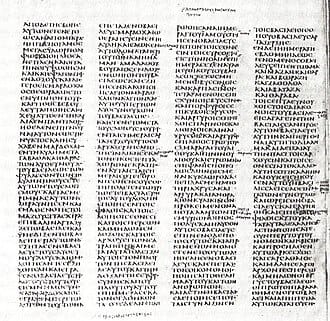
Codex, plural Codices: An early form of a book, which was made by sewing together the leaves of the writing material. For example, we will use the term “Codex Vaticanus,” or “Codex Sinaiticus, “which means that the Vaticanus was a manuscript that was in book form: it was sewn together. In the plural form, we might encounter the term, the “Vaticanus and Sinaiticus Codices.”
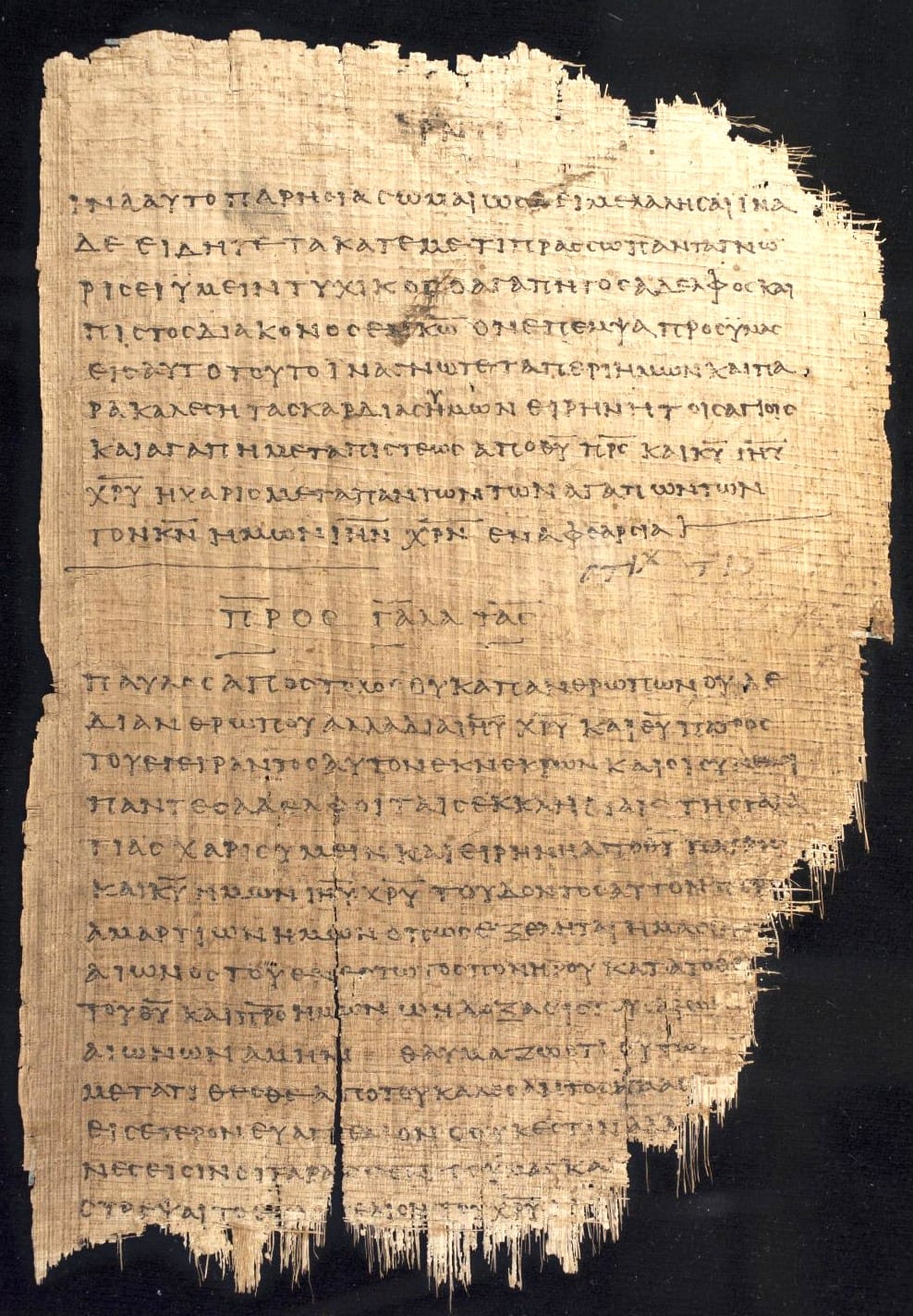
Papyrus, plural Papyri were manuscripts made out of this early form of paper. A sheet of papyrus was made by weaving strips of the stems of the papyrus plant and then beating it, trimming it, and finishing it so that the woven sheet was smoothed out enough to be written upon. The sheets could then be pasted together, end to end, so that one could have a papyrus roll or scroll. However, not all scrolls were made of papyrus.
Velum or parchment: Velum or parchment was often used for the same purpose. Velum or parchment was a fine-grained lambskin, pigskin, or calfskin, which was dried and polished with pumice to the point where one could write upon it.
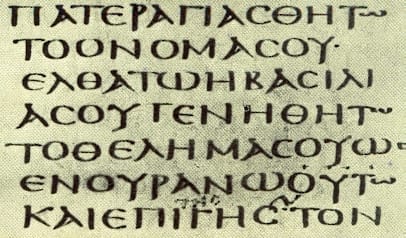
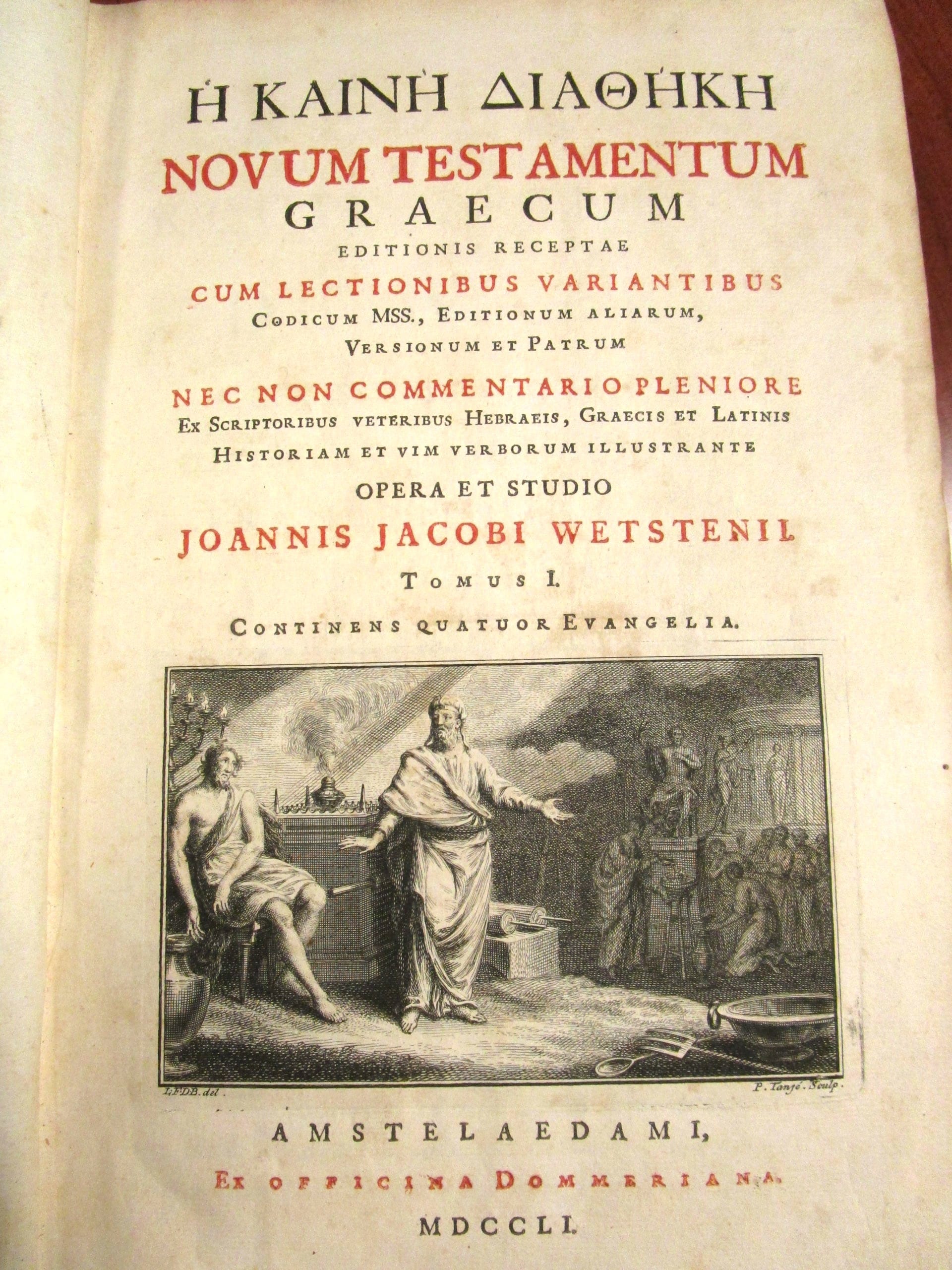
Uncial manuscripts: (See example above.) Usually written on leather, which is a velum or parchment, and they were distinguished from other types of manuscripts because the uncials were all in capital letters in the Greek language. It does not apply to the Hebrew Old Testament. Another feature of Uncials which add to difficulties is that all the words in Greek capital letters run together; no spaces, no punctuation.
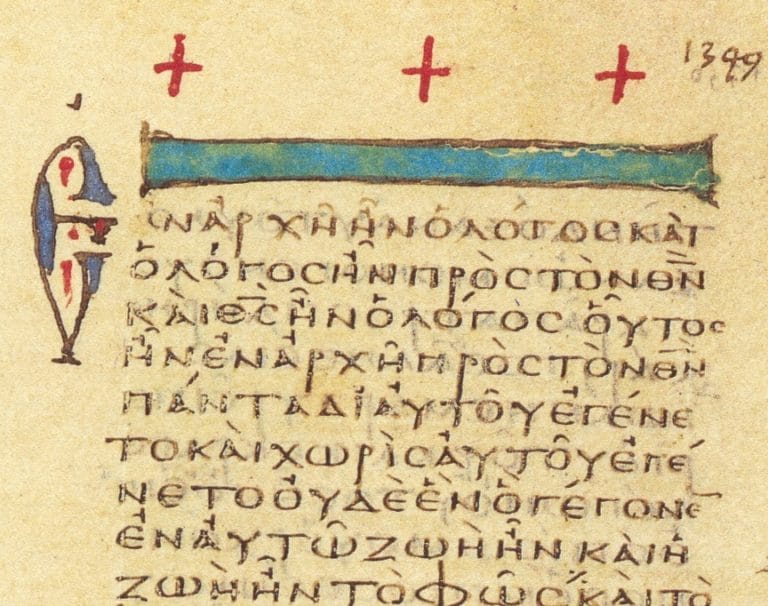
Miniscules: They were written in flowing Greek script. These are also known as “cursives.” It looks like our modern handwriting.
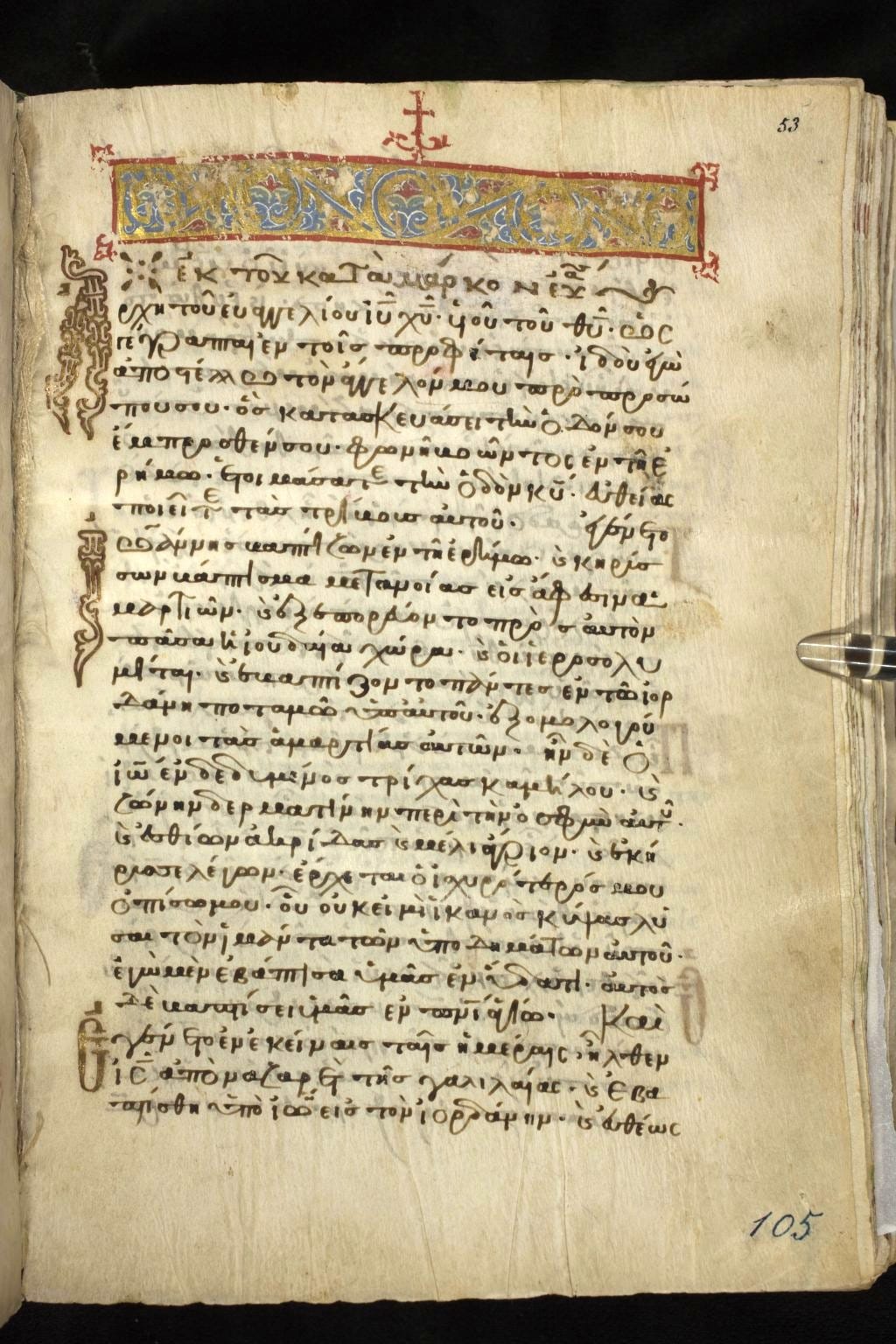
Minuscule manuscripts are handwritten copies of texts of the New Testament, written in a small, cursive script that emerged in the 9th century A.D. This style replaced the earlier uncials and became dominant due to its efficiency and space-saving nature, allowing scribes to write more quickly and conserve parchment. Like uncials, the earlier minuscules also had no spaces between words.
By the 10th century, minuscule had largely supplanted uncial for literary and religious texts. Nearly 90% of extant New Testament manuscripts are minuscules. They contain commentaries, summaries, and additional material (e.g., lists of miracles, apostolic biographies).
As of 2010, the Institute for New Testament Textual Research (INTF) has catalogued 2,911 minuscule codices. Although minuscules are of later dates than papyri and uncials, they are nonetheless very helpful for textual criticism. They help show the historical streams of the transmission of the Bible.
Confusing to neophytes is the development of jargon among the great and learned Bible scholars. (Of course, the same can be said of any field of professionals, from all sorts of groups within the military “Roger that; we’re five-by-five,” to medical professionals, “stat,” to the world of sports, “Look at these diaper dandies on the Duke roster…” (famous sports announcer, Dick Vitale). It is simply a fact, not a criticism.)
In the field of Bible textual criticism scholars have originated a shorthand jargon of designating specific manuscripts. For example, we might read of “Codex Aleph,” aleph being the Hebrew word for the letter “A.” Codex Aleph is jargon referring to Codex Sinaiticus, the Sinai Codex.
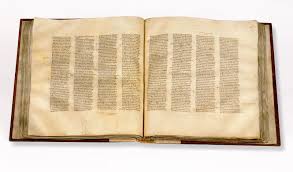
Codex B, is simply “B.” It is not the Greek Beta; it is not the Hebrew Bet, it is simply Codex B. It refers to the Vatican Codex (Codex Vaticanus).
Codex Alexandrinus is from Egypt, aka (also known as) the Alexandrian Codex. There are others; e.g., C, D, and F and Papyri that are designated by numbers. We shall explain those on an ad hoc basis later, if necessary.
But the preceding are the various types of manuscripts and definitions with which we will become more familiar as the terms are used henceforth in our study. Now let us consider the quantity of New Testament manuscripts extant as compared with other famous (secular) historical works from the same biblical-historical period.
QUOTE: Known worldwide as the “Dean of Evangelical Scholarship,” F.F. Bruce (1910-1990) was a biblical scholar who supported the historical reliability of the New Testament. Trained in classics, he taught at the universities of Edinburgh, Leeds, and Sheffield, and was for almost twenty years the Rylands Professor of Biblical Criticism and Exegesis at the University of Manchester. END QUOTE
F. F. Bruce wrote this in his book, The New Testament Documents. This will help us appreciate how wealthy and substantial the New Testament is in manuscript attestation as we compare the textual material extant for several other ancient historical works. (Emphases are mine.)
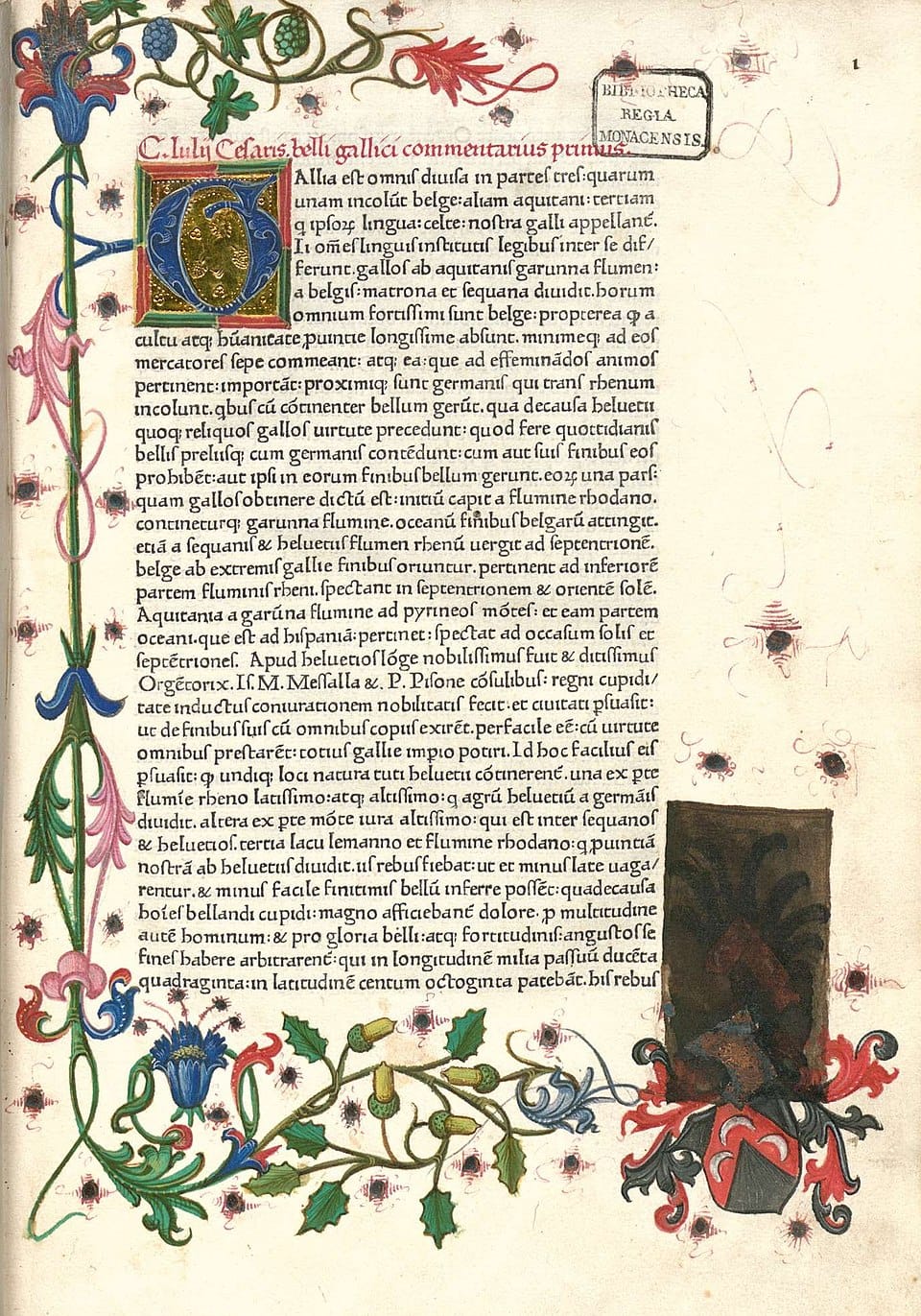
“For Julius Caesar’s writings concerning his Gaelic War, composed between 58 and 50 B.C., there are several extant manuscripts but only nine or ten are good, and the oldest is nine hundred years later than Caesar’s day.
“Of the 142 books of Roman History by Livy, 59 B.C.–A.D. 17, only 35 survived. These are known to us from not more than twenty manuscripts of any consequence, only one of which—and that containing fragments of books Three to Six—is as old as the fourth century.”
To elaborate further on the number of manuscripts of secular works from the time periods parallel to the Bible, we have this response to my internet inquiry. Emphases and comments within [brackets] are mine:
QUOTE: Julius Caesar’s Commentarii de Bello Gallico (Commentaries on the Gallic War) survives in a significant number of medieval manuscripts, reflecting its enduring importance in classical literature and education.
Over 250 manuscripts of the Gallic War are known, with the majority dating from the 15th century, though some early copies exist from the 9th century. [But how many are complete copies vs. partial or fragments at those late dates?]
The oldest surviving manuscripts date to the 9th century, including Paris, BnF, Latin 5763 and Vatican Library, Vat. lat. 3864, both from France.
The text was transmitted in two forms—either as part of the broader corpus Caesarianum (collective works attributed to Caesar) or as an independent text. About 75 independent manuscripts are known, with roughly a quarter ending at a disputed passage from Book VIII (51.1–53.2), which was later recognized as misplaced. END QUOTE
We hope you do not find this material boring—which is one nice feature of blogs being relatively brief writings. I have no doubt that the average reader—even among Christians—would find a couple of ten-page chapters in a book with these comparative statistical data regarding manuscripts to be dry and boring. But anyone should be able to digest this information in our “teaspoonful-size” blogs.😊
In our next installment, we will have just a bit more of this and then our summary of the importance of all these facts vis à vis Which Bible? Which Version?
(Series to be continued.)
~END~