
Chapter 3, Section 4: The Four “Families” of Manuscripts
We are continuing our exposition concerning ancient manuscripts—both secular and biblical. The comparisons and contrasts strengthen the case for the reliability of the Bible as we see the weight which secular scholars give to certain secular documents.
We have mentioned the manuscripts of the works of Julius Caesar in the last installment. We now continue with a brief mention of several more ancient authors and how many of their manuscripts are still extant.
We are quoting once again from the book, The New Testament Documents, by the noted evangelical scholar, F. F. Bruce. Boldface emphases are mine. QUOTE:
Of the 14 books of The Histories of Tacitus, another Roman historian about 100 A.D., only four-and-a-half survived. Of the sixteen books of his Annals of History, ten survived in full and two in part, and the texts of these extant portions of his two great historical works depends entirely on two manuscripts—one of the ninth-century and one of the eleventh.
The extant manuscripts of his minor works, Dialogus de oratoribus, Germania, and Agricola (De vita et moribus Iulii Agricolae), all descend from a codex of the tenth century.
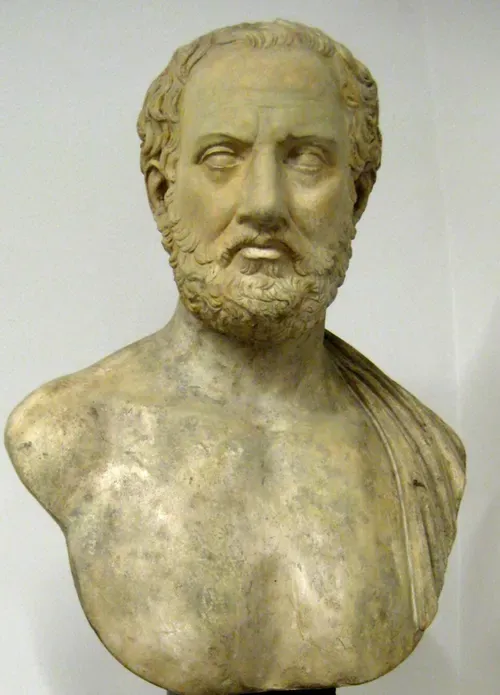
The historical works of Thucydides, who lived circa 460 – 400 B.C., is known to us from a mere eight manuscripts, the earliest belonging to around A.D. 900 and a few papyrus scraps belonging to about the beginning of the Christian era.
For readers not acquainted with ancient Greek history, here is an AI-generated summary about Thucydides. Again, boldfacing is mine. QUOTE:
Thucydides was an Athenian historian and general, widely regarded as the father of scientific history and political realism. He authored The History of the Peloponnesian War, a detailed, contemporary account of the conflict between Athens and Sparta from 431 to 404 BCE.
His work is celebrated for its rigorous methodology, emphasis on eyewitness testimony, and analysis of human nature, power, and fear as drivers of political behavior.
Born around 460 BCE, Thucydides was a member of a wealthy Athenian family with interests in Thrace, including gold mines that likely funded his historical research. He served as a general during the war and contracted the plague that devastated Athens, which he described in clinical, harrowing detail.
In 424 BCE, he was exiled for failing to prevent the Spartan capture of Amphipolis, a pivotal event in the war. This exile allowed him to travel freely among both Athenian and Peloponnesian forces, giving him unique access to perspectives from both sides.
He began writing his history at the war’s outbreak, aiming to create a “possession for all time.” His work includes influential passages such as Pericles’ Funeral Oration and the Melian Dialogue, both of which remain foundational in political theory and international relations.
The history ends abruptly in 411 BCE, likely due to his death—estimated to have occurred around 400 BCE, though the exact circumstances are unknown.
Thucydides’ legacy endures: his approach to evidence, cause-and-effect analysis, and critical examination of power continues to shape modern historiography, political science, and military strategy. END QUOTE
The point of the foregoing quote? It illustrates the considerable weight and credibility by historians given to the works of Thucydides based on just a few manuscripts (eight) which date back to circa 900 A.D.—about 1300 years after Thucydides wrote them!
We continue with F. F. Bruce again as he speaks of the man generally known as “the father of history.” Boldfacing is mine. QUOTE:
The same is true of the History of Herodotus, about the same time, 400 B.C. Yet no classical scholar would listen to an argument that the authenticity of Herodotus or of Thucydides is in doubt because the earliest manuscripts of their work which are of any use to us are over 1,300 years later than the originals. Scholars do not question their authenticity even though it is that far removed.
How different is the situation of the New Testament in this respect? In addition to the two excellent manuscripts of the fourth century… PAUSE QUOTE.
Look at our chart here. Bruce is talking about the stream of manuscripts on the left-hand side, specifically, the Vaticanus and Sinaiticus.
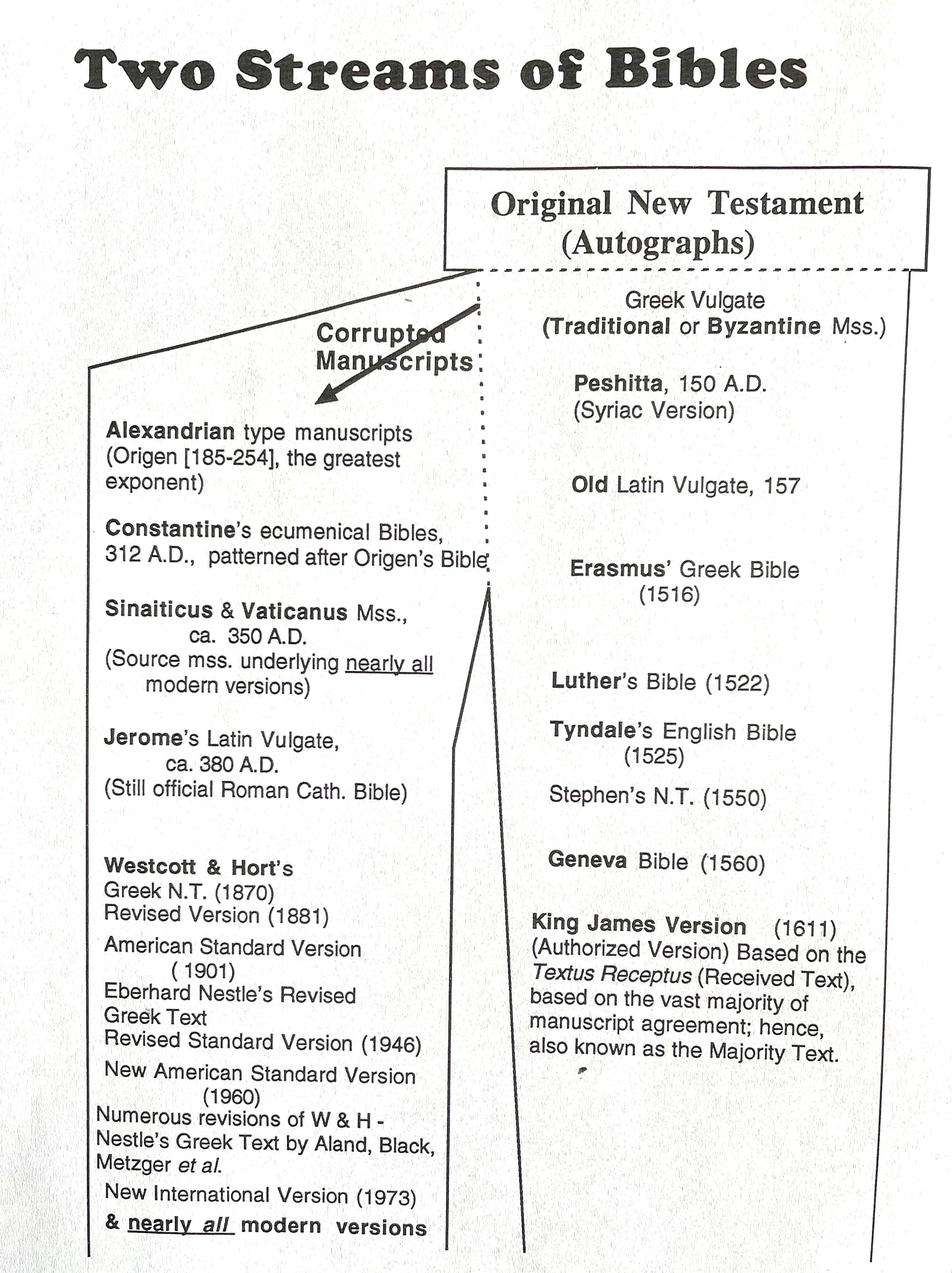
He is referring to these “two excellent manuscripts of the fourth century.” Admittedly, these manuscripts are “excellent” in terms of their condition. But are they excellent in terms of their reliability of the transmission of the words of God? We say “no” and we shall give much evidence as we continue in this series. RESUMING QUOTE OF F. F. BRUCE:
In addition to that, which are the earliest of some thousands known to us, considerable fragments remain of papyrus copies of books of the New Testament dated from 100 or 200 years earlier still.
The Chester Beatty Biblical Papyri, the existence of which was made public in 1931, consist of portions of eleven papyrus codices, three of which contain most of the New Testament writings. One of these containing the four gospels, with the Book of Acts, belongs to the first half of the third century.
Another containing the Apostle Paul’s letters to churches and the Epistle to the Hebrews was copied at the beginning of the third century. The third, containing the Book of Revelation, belongs to the second half of the same century. END QUOTE
I believe that at the latest count, there are over 5,000 New Testament manuscripts extant in the Greek writings. There are approximately an additional 8,000 of various translations into other languages.
Yet according to everything I have read and studied on the subject of Bible versions—which is literally a bushel basket full of books and documents—apparently it is true that out of all these vast numbers of manuscripts, no two of them are identical in every detail.
The textual critic is not going to starve for lack of work!
Our chart depicting the two streams of Bible versions is necessarily thin on details. It would be helpful to fill in some details on the history of manuscripts. Our approach will be from the geographical perspective. There is disagreement among Bible scholars whether there are three or four so-called families of text (manuscript) types.
In fact, some even question whether it is proper and intellectually honest to categorize the vast quantity of manuscripts into neat little families at all. There is considerable merit to their argument.
However, for the sake of simplification where I am trying to communicate these rather obscure, complex, but yet vitally important matters to you, I will employ the neat little text family categories. Nevertheless, I want you to understand that I am not necessarily agreeing that such categorization is entirely valid.
I will list the four geographic areas, and then we will discuss the corresponding text type associated with those areas.
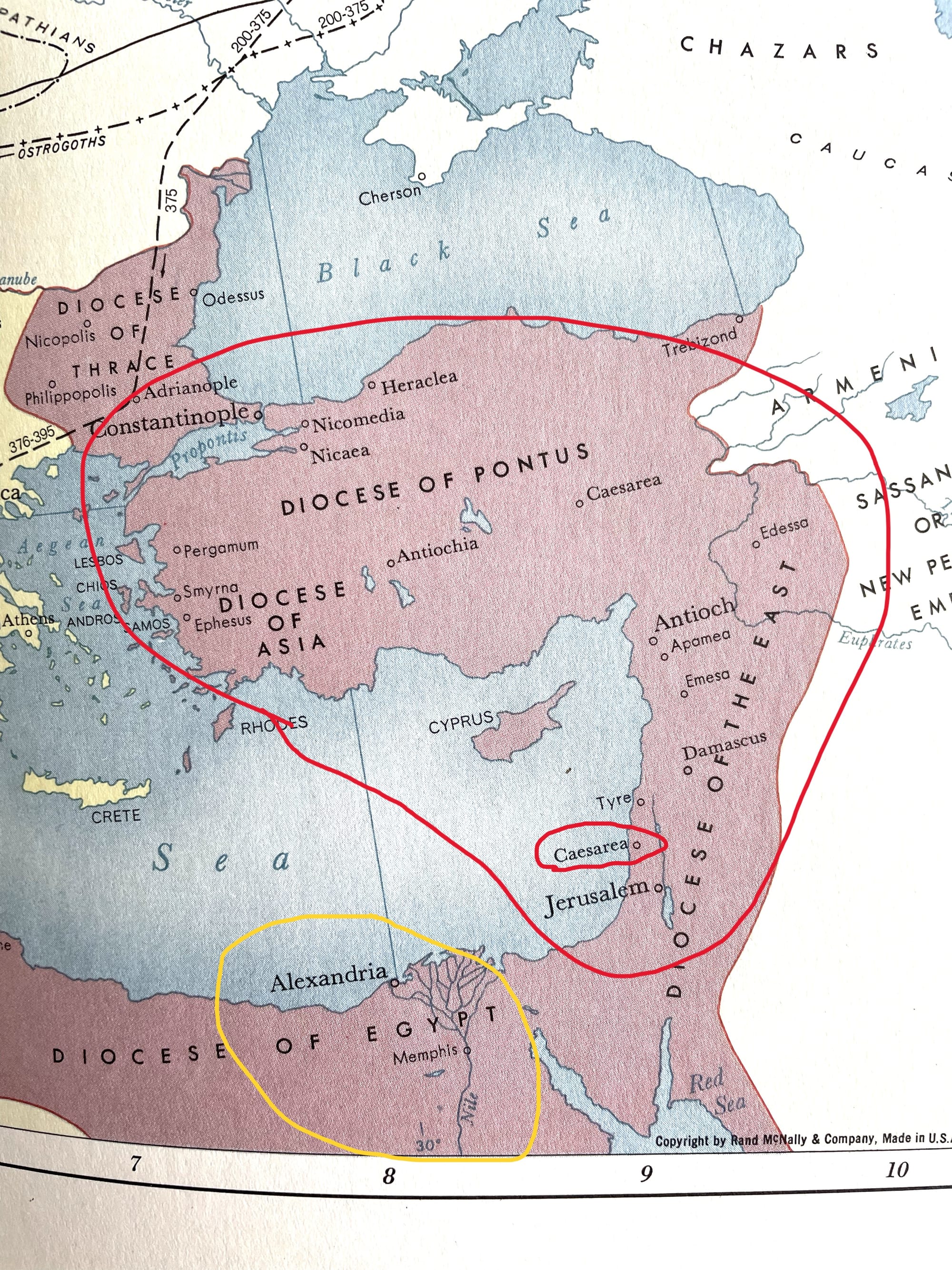
The map above and the one below are both taken from my book, Rand McNally Atlas of World History, published 1947. (Copyright expired.) pp. 42-43, Roman Empire about 400 A.D.
First is the Byzantine area of Antioch, Syria, and Asia Minor, now called Turkey. (Large area which I encircled in red.) This is one geographical area where we will be discussing the text types that originated in this area.
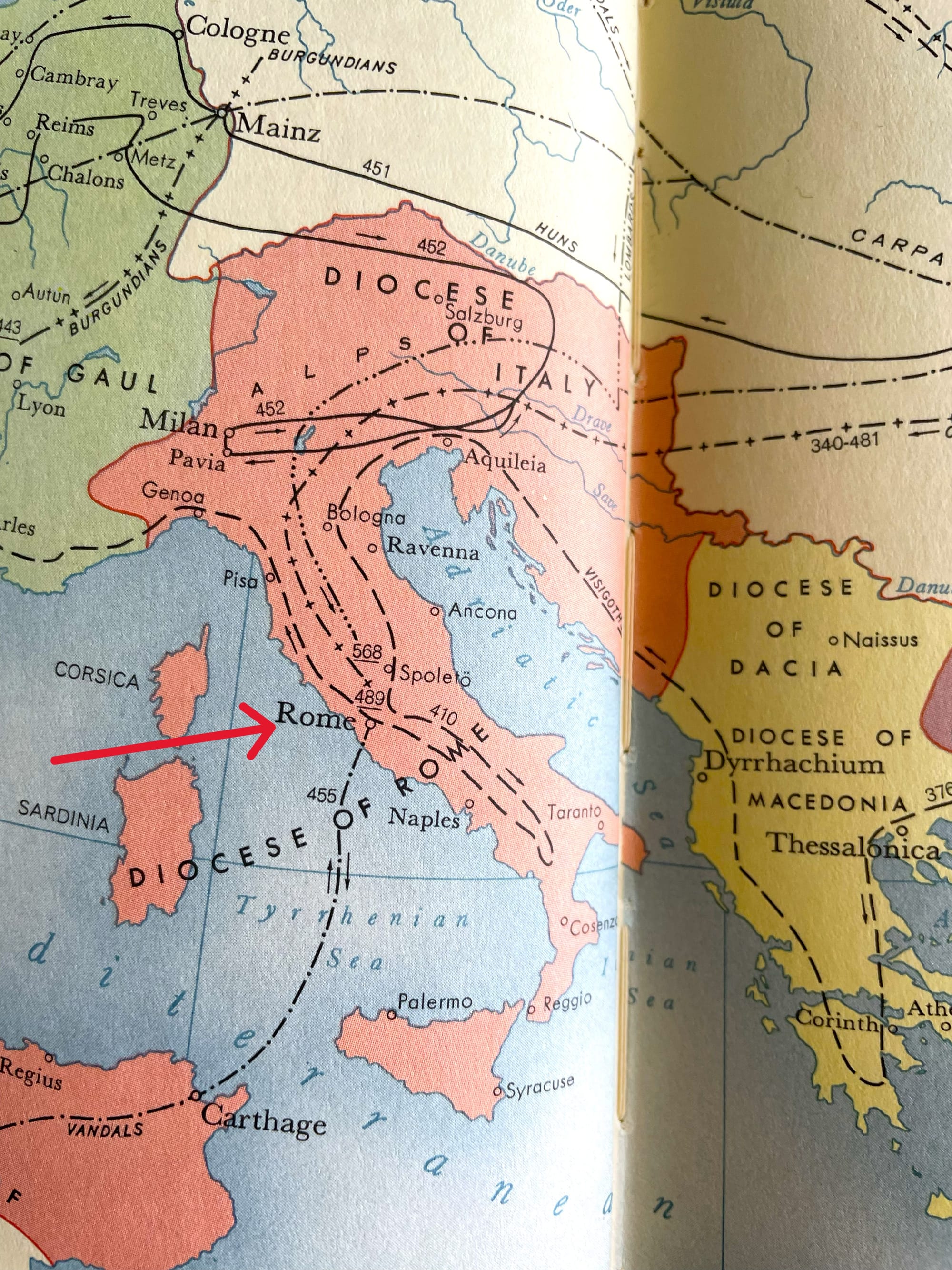
The second is the city of Rome itself. Do not include all of Italy because we must distinguish Rome itself from northern Italy later.
The third, which is very questionable as a “text family,” is Caesarea in Palestine. (Tiny area encircled in red within the larger red circle.)
The fourth is Egypt. (Encircled in yellow.) It is obvious that the Alexandrinus, the Alexandrian type of manuscript comes from this area.
Here is a brief synopsis of the text types associated with each of these regions. This is from Dr. D. A. Carson’s book, The King James Debate: A Plea for Realism. Comments in [brackets] and all emphases are mine. QUOTE:
The Byzantine Text [the Antioch, Syrian, Asia Minor area]. This is the textual tradition which in large measure stands behind the King James Version. It was largely preserved in the Byzantine Empire, A.D. 312 – 1453, which continued to use Greek.
These people from earliest times right through the Byzantine Empire until its fall in 1453 A.D., continued to use Greek. END QUOTE
To stress the point Carson is making, unlike the Western Roman Empire and its offshoots where Latin was the common language, those in the Byzantine Empire had original language manuscripts, which meant they did not have to make many translations.
Carson goes on to state that, There are far more manuscripts extant in this tradition, the Textus Receptus stream, than in the other three combined. “On the other hand, most of these manuscript witnesses are relatively late.”
Yes, “late”—maybe a hundred years…which in the study of manuscript history does not count all that much. Remember Thucydides and the credibility which scholars give to his works.
Concerning the “western text,” focused on Rome and that which came out of Rome, Carson comments. QUOTE:
There is considerable scholarly dispute about this text type. Some scholars hold that the western text is the creation of a group of scribes whose work developed in more or less confusion as each generation of scribes toiled without knowledge and care.
A few contend for an individual scribe at the heart of the tradition. Others argue that the text type is not homogenous enough to be considered a true textual recension and postulate that the manuscript classified under the western rubric sprang from fairly wild and undisciplined scribal activity.
Three: The Caesarean Text. This text type probably originated in Egypt and may have been brought to Caesarea by Origen. It boasts a unique mixture of western, meaning Roman, and Alexandrian, meaning Egyptian, readings prompting some scholars to question the value of calling it a text type.
Four: The Alexandrian Text. This text type was probably prepared by trained scribes, most likely in Alexandria and its regions. Fenton John Anthony Hort calls this prime exemplar “the neutral text.” [Do not let that fool you. The Alexandrian text certainly was not “the neutral text.” We shall prove that in due course in this series.]
Hort ascribed to them, [those texts on the left stream in our chart above], a preeminence that has been somewhat mitigated by subsequent research. Nevertheless, this Alexandrian Text has excellent credentials, far better than its harshest critics have been willing to concede. END QUOTE
We shall see about that.
That is a quick overview of the four types of texts (families of manuscripts) You will appreciate the value of understanding these text types as we proceed.
(To be continued.)
~END~