

Chapter 2, Section 6: Plenary and Verbal vs. Conceptual Inspiration (cont’d)
It has been a while since we last posted in this series. Here is the immediately previous one in this series. To find them all from the beginning, first, click on the “Blogs” tab.
Then find the search tool in the upper right corner. It is the little icon which looks like a magnifying glass. It opens a Search box. Type in: # Bible Versions. You will find all of them brought up for you, beginning with Chapter 1, Section 1, dated November 5, 2025.
We now continue where we left off in Chapter 2, Section 5. The “higher critics” claim that Matthew 19 is among the passages that contain Bible errors. But what did Christ teach? Did He believe the Old Testament accounts were inerrant and infallible?
The story of Adam and Eve in Genesis, Chapters 2 and 3 is familiar to most readers, but Bible critics cite the account as being not literally true, but merely allegorical. What did Christ think?
Matthew 19: 4 And he [Jesus the Christ] answered and said unto them, Have ye not read, that he which made them at the beginning made them male and female,
5 And said, For this cause shall a man leave father and mother, and shall cleave to his wife: and they twain shall be one flesh?
The critics point out that the words “Adam and Eve” do not appear in those verses. Another verse is Matthew 23. Christ is talking to Jewish Pharisees, and He brings attention to Abel, son of Adam and Eve:
Matthew 23: 35 That upon you may come all the righteous blood shed upon the earth, from the blood of righteous Abel unto the blood of Zacharias son of Barachias, whom ye slew between the temple and the altar.
There is no question here that Jesus is referring to the individual, historical person Abel, son of Adam and Eve. Therefore, if Abel was an actual individual person, then this is unassailable—even if indirect proof—of the historical existence of Abel’s father and mother. Remember, the Apostle Paul, in 1 Timothy 2 speaks of the literal Adam and Eve:
1 Timothy 2: 13 For Adam was first formed, then Eve.
Paul said he received his information directly from the risen Christ. Here following is another example that the critics find “unscientific,” and therefore, untenable. It is the story of Noah’s ark and the flood. However, in Matthew 24, we find that Jesus confirmed the historical accuracy of it in His Olivet discourse:
Matthew 24: 37 But as the days of Noe [Noah] were, so shall also the coming of the Son of man be.
38 For as in the days that were before the flood they were eating and drinking, marrying and giving in marriage, until the day that Noe entered into the ark,
39 And knew not until the flood came, and took them all away; so shall also the coming of the Son of man be.
Here Christ is predicting, prophesying a future historical event, which is an anti-type to a past event. Obviously, He regarded the flood and Noah’s salvation from the flood in the ark, as literal history. The story of Sodom and Gomorrah is also often ridiculed as fanciful but not literal. What did Christ think about it?
Luke 10: 11 Even the very dust of your city, which cleaveth on us, we do wipe off against you: notwithstanding be ye sure of this, that the kingdom of God is come nigh unto you.
12 But I say unto you, that it shall be more tolerable in that day for Sodom, than for that city.
The scholars who deny the inerrancy of Scripture probably ridicule the story of Jonah and the great fish the most of all. However, what did Christ think about the accuracy of Jonah being swallowed by the great fish?
Matthew 12: 39 But he answered and said unto them, An evil and adulterous generation seeketh after a sign; and there shall no sign be given to it, but the sign of the prophet Jonas [Jonah]:
40 For as Jonas was three days and three nights in the whale’s belly; so shall the Son of man be three days and three nights in the heart of the earth. 41 The men of Nineveh shall rise in judgment with this generation, and shall condemn it: because they repented at the preaching of Jonas; and, behold, a greater than Jonas is here.
Christ said that Jonah was in that whale’s belly for three days and three nights. Do you believe it?
There are other examples that we could cite, but these should be sufficient to demonstrate the point. A thorough study of the New Testament will reveal that in no case of the recorded words of Christ, or of any of the writers of the New Testament, can we find even the slightest implication that there was any inaccuracy in the Old Testament in matters of historical events or of science.
Therefore, if Christ Jesus Himself believed in the inerrant truth of the Scriptures, then what justification does anyone who calls himself a Christian have for believing anything less?
The inspiration of the Scripture guarantees its inerrancy. God is, by definition, inerrant; therefore, to be consistent, we must logically believe that His revealed written Word is also inerrant.
To believe otherwise results in double mindedness. To believe otherwise results in the condition known as “cognitive dissonance,” which is manifested in spiritual and mental confusion and instability.
Therefore, we conclude that the Bible is true and inerrant. However, we must add that this does not mean that the way that we personally understand the Bible is necessarily true.
To get the audience’s attention, a speaker I once heard said this: “All (true) Christians claim to believe the Bible; but I tell you no one actually believes the Bible. What we believe is our own understanding and interpretation of the Bible.” Point made.
We must always be careful when we discuss biblical inerrancy that we not confuse someone by leading them to think that the Bible is literally true in every instance, because it is not literally true in every instance.
We must allow for figures of speech. They appear on almost every page of the Bible. To take an example, some modern scientists have scoffed at the Bible because of the unscientific statement in 1 Samuel 2.
1 Samuel 2:8 …for the pillars of the earth are the LORD’s, and he hath set the world upon them.
That is, of course, a figure of speech. The Bible writers knew that it was a figure of speech because Isaiah wrote:
Isaiah 40:22 It is he that sitteth upon the circle of the earth, and the inhabitants thereof are as grasshoppers; that stretcheth out the heavens as a curtain, and spreadeth them out as a tent to dwell in:… [Emphasis added]
There is reference to God’s creative work in the Book of Job.
Job 26: He stretcheth out the north over the empty place, and hangeth the earth upon nothing. [Emphasis added]
Obviously, when it states that there are four pillars holding up the earth, it is a figure of speech. Moreover, we speak figuratively about the four winds or the four corners of the earth.
Actually, one of the Hebrew words for “corners” (Strong’s # 3671) comes from “wings” or “winged tips” such as the tips on the compass points. Instead of saying the four corners of the earth we sometimes speak of the “four points of the compass,” a figurative way to mean “from all directions,” or “in all directions.”
If you take that verse containing the word “pillars” literally, then it appears that the Bible is in error. However, such a figurative statement should not cause even a scientist to stumble because the scientists themselves employ the same literary devices.
For example, National Public Radio has an early morning news program that contains a daily segment of about three minutes called “Star Date,” which is nationally syndicated and comes out of the McDonald Observatory at the University of Austin, Texas.
McDonald Observatory is one of the world’s leading astronomical research facilities. On this program, they will say things like this (hypothetical): “Now to view the plant Venus, just look out in the morning sky, just before sunrise.” Or, they might say, “Now then the stars come out on a cloudless night …”
Any fifth grader can tell you that the stars do not “come out.” They remain in the heavens. Additionally, these children can tell us that the sun does not actually rise and does not actually set.
Scientists and laypersons alike use figures of speech such as these, and no one expects anyone to take it literally. Why do we stumble on figures of speech in the Bible? Perhaps it is because there are so many different kinds.
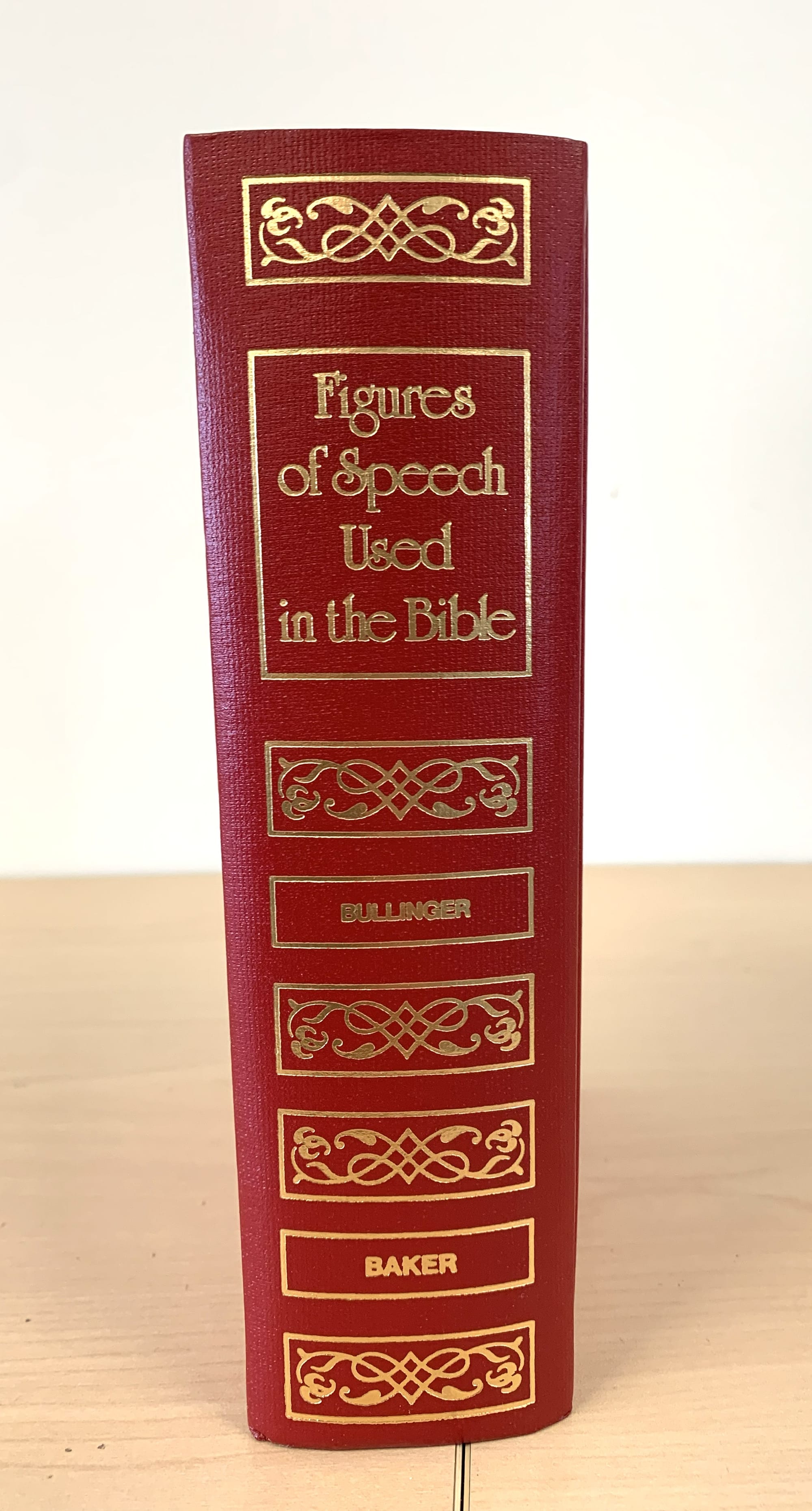
There are so many figures of speech in the Bible that Ethelbert Bullinger, who wrote the Companion Bible, wrote Figures of Speech Used in the Bible about 100 years ago. In my 1,100 page edition of this important “helps” book, Dr. Bullinger explains about 217 distinct figures of speech!
When we speak of the doctrine of the inerrancy of the Bible, we often hear it stated in this manner, “The Bible does not contain the Word of God; the Bible is the Word of God.”
That needs some explanation. If that means God spoke every word in the Bible, and hence every word is true, that is not correct.
However, if that means that God caused every word in the Bible—both the true and the false—to be recorded infallibly and inerrantly, then, yes, that is correct.
After all, there are many lies recorded in the Bible beginning with the temptation of Eve in the Garden of Eden. The serpent lied to her by distorting and twisting God’s words. “Well, what God really meant was…let me interpret that for you, Eve.”
The Bible is the Word of God, but that does not mean that every statement contained within it is true. However, we believe that God caused every statement, every verse, every word, whether it is true or false, to be recorded inerrantly and infallibly.
There is much more that could be said about the doctrine of the inspiration of Scripture, its plenary and verbal inspiration, its inerrancy and its infallibility, but this is enough to lay a foundation for the material that will follow.
It is necessary for the reader to be familiar with the terms plenary and verbal inspiration, inerrancy, infallibility, and autographs because they will be appearing in the chapters to follow.
This study will show that the doctrine of the inspiration and inerrancy of Scripture is inextricably linked with the doctrine of the Deity of Christ. Without both of these most fundamental doctrines, the Christian faith is a toothless tiger. It is an exercise in superstition and the most monumental fraud of all time.
But, praise be to Yahweh, He does not call us to blind faith, which is nonsense. His Word is eminently credible and reasonable when we diligently apply ourselves to its study.
This ends chapter two. In the next chapter, we will begin to delve into Bible versions themselves and the texts and manuscripts underlying them.
(To be continued.)
~END~