Which Bible, Which Version?
We left off in yesterday’s installment, with this: Consider this excerpt from The Secrets of Mount Sinai, which reveals not only James Bentley’s bias, but also reveals a very telling fact about Westcott and Hort. All emphasis mine.
QUOTE: When Westcott became bishop of Durham, the Durham University Journal described him in words that could have equally applied to his colleague Hort, as “Before all things, a biblical student bringing to the text of the Bible all the habits and resources of most accurate linguistic scholarship, along with a reverential affection to which no detail, however slight, was insignificant, unsurpassed in his command of all the statistics of text and matter, yet never mastered by them, never mechanical or dry, free from all verbal or mechanical ideas of inspiration, yet treating every syllable of Scripture with reverent care which no maintainer of verbal inspiration could excel.” END QUOTE
Surely, you arrogant writers in the Durham University Journal do not expect us “maintainers of verbal inspiration” to take you seriously, do you? Did you hear that? Westcott and Hort are described accurately here, so says their admirer, Mr. Bentley. They are described as men who are not bound to any such idea as verbal inspiration of the Scripture. Continuing from Bentley. QUOTE:
And these two men revered Codex Sinaiticus. Alongside Codex Vaticanus, it was the basis of their great great Greek text which undergirded the 19th century revision of the English Bible. [And has caused a host of perversions of the Bible ever since then!]
They believed that the combined witness of Vaticanus and Sinaiticus should be accepted as true readings unless strong internal evidence is found to the contrary.
[“Strong internal evidence.” In other words, never mind what the majority texts state. The true readings, say Westcott and Hort, are whatever the Vaticanus and Sinaiticus say, unless it is contradicted somewhere else within those two manuscripts.]
They insisted that no readings based on these two great manuscripts can be safely rejected absolutely, although it is sometimes right to place them only on an alternative footing. [In other words, where they differ, you can take your pick, either-or; whichever you choose, it is correct! What nonsense!]
Not everyone agreed with these two Cambridge professors of divinity; [Pay close attention now to Bentley’s characterization of those who righteously opposed Westcott and Hort.] but those who disagreed were chiefly slightly bizarre.
(More than slightly bizarre was Dean J. W. Burgon of Chichester, who described Sinaiticus and Vaticanus as being among, “the most scandalously corrupt copies extant.”)… [emphasis by Bentley]
As witness to the authentic words of Holy Scripture, Westcott and Hort marginally preferred Codex Vaticanus over Sinaiticus. But here, too, Caspar René Gregory had some astute words of comment. “It used to be the fashion to say that the Sinaitic manuscript was very badly written, was full of clerical errors, and therefore less trustworthy.
And the Vatican manuscript was supposed to be very correctly written. When, however, the Vatican copy came to be better known, it was found that in this respect there was not much choice between the two.”
What really outraged men like Dean Burgon was principally that, however learnedly Codex Sinaiticus was edited, it revealed a text of the Bible that again and again differed from what they had reviewed and loved as the Holy Writ. END QUOTE from Bentley’s Secrets of Mount Sinai.
Dean John Burgon will be a major contributor to our evidence later on in this series, and I think you will be as impressed as I am with this man and his scholarship and his love of the Word of God and his irrefutable logic as he battled Westcott and Hort.
Meanwhile, here is yet another telling statement by Bentley that I found quite astonishing. After writing about how both the Vaticanus and the Sinaiticus omit entirely the story found in John, chapter 8 about the woman caught in adultery, Bentley says.
QUOTE: Scholars like Tischendorf, Westcott, and Hort were not, however, daunted by what they found. [In other words, it did not bother them that this whole story was left out of the Sinaiticus and Vaticanus.]
All three, Tischendorf, Westcott, and Hort, and many like them, had sufficient faith that what they were doing would ultimately uncover divine truth. Even so, they made assumptions about the transmission of the text of Holy Scripture, which Codex Sinaiticus ought to have led them to abandon.
One was that all scribes and theologians had been as scrupulously honest about the text as they were. Tischendorf, Westcott, and Hort believed that the alterations in the biblical witness had all occurred accidentally.
[Remember how many alterations Tischendorf found? ...by nine separate correctors? 14,800! All of them were accidental, they think!]
Scribes had misread words, perhaps, or they had misheard them. Occasionally, they would have mistranslated from the Hebrew. They might have subconsciously harmonized differences between the Gospels, but they would never have deliberately altered anything in the Holy Writ. END QUOTE
So even after it is plainly seen in Codex Aleph that numerous changes or omissions or alterations were made to the text because of theological bias, that is what Bentley was saying, yet Westcott and Hort refused to believe even what their eyes could see.
Could it be that they knew full well that textual scholars do tamper with the texts, but they wanted to deflect any such suggestion because they themselves were creating one of the most monumentally fraudulent texts in the entire history of Christendom. They would say, Who? Us? Tamper with the text? Why, we would never do a thing like that.
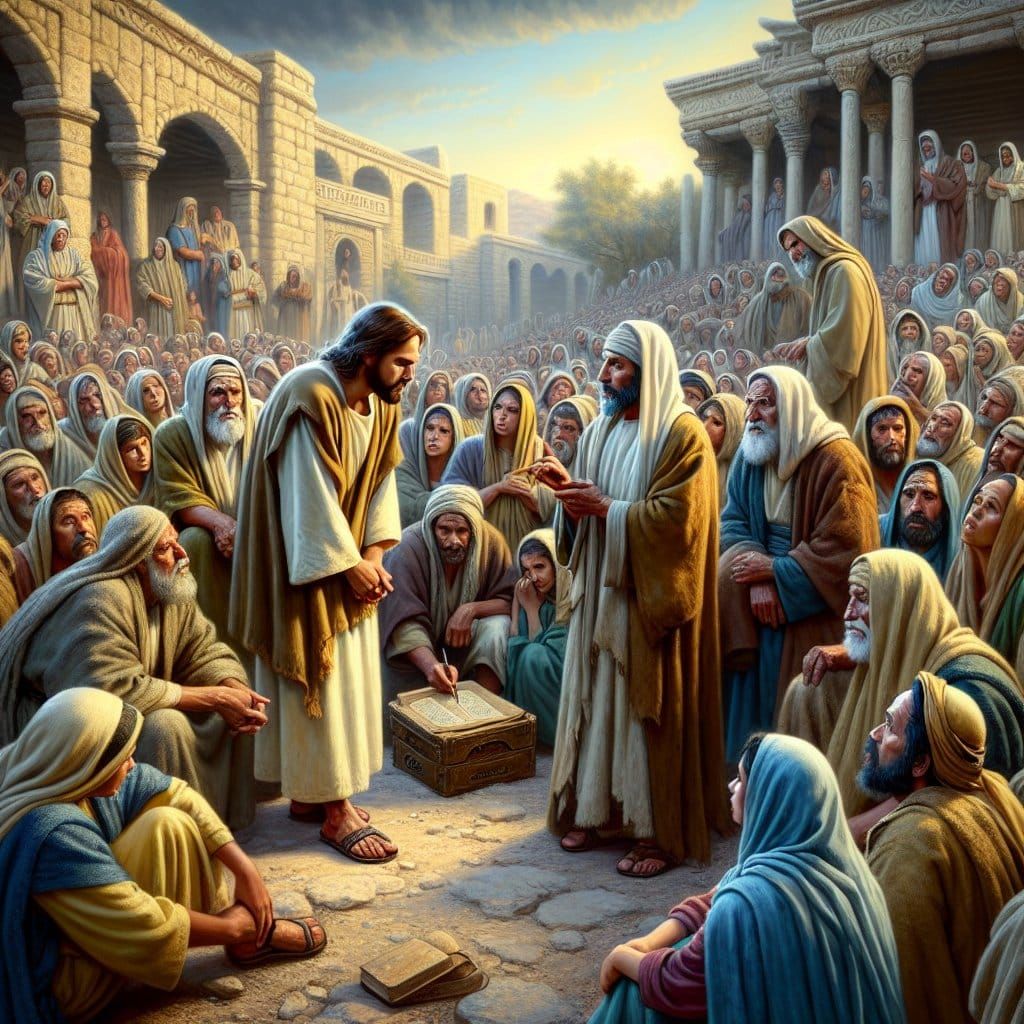
Now what about the passage in John, chapter 8? Let’s read it… In the King James Version. We have read this in one of our previous lectures, but we must have the text in front of us as we discuss it here also.
KJV John 8:1 Jesus went unto the mount of Olives.
2 And early in the morning he came again into the temple, and all the people came unto him; and he sat down, and taught them.
3 And the scribes and Pharisees brought unto him a woman taken in adultery; and when they had set her in the midst,
4 They say unto him, Master, this woman was taken in adultery, in the very act.
5 Now Moses in the law commanded us, that such should be stoned: but what sayest thou?
6 This they said, tempting him, that they might have to accuse him. But Jesus stooped down, and with his finger wrote on the ground, as though he heard them not.
7 So when they continued asking him, he lifted up himself, and said unto them, He that is without sin among you, let him first cast a stone at her.
8 And again he stooped down, and wrote on the ground.
9 And they which heard it, being convicted by their own conscience, went out one by one, beginning at the eldest, even unto the last: and Jesus was left alone, and the woman standing in the midst.
10 When Jesus had lifted up himself, and saw none but the woman, he said unto her, Woman, where are those thine accusers? hath no man condemned thee?
11 She said, No man, Lord. And Jesus said unto her, Neither do I condemn thee: go, and sin no more.
Although other Bible difficulty type handbooks answer many of these same challenges, I want to share with you how Dr. Peter Ruckman answers it. He is so colorful. Here is his answer to this, after he quotes the whole passage. And I am going to shorten up this answer, for sake of time. QUOTE:
Although the apostate fundamentalists and evangelicals connected with the New American Standard Version and the NIV, did not dare delete the passage, they did put a footnote down to the effect that, “Most of the ancient authorities omit John 7:53 to [chapter] 8, verse 11.”
[He was copying that from his New American Standard Version.]
Well, one ancient authority, Jerome, 380 A.D., says the King James text is right. Another one, Pacian, 370 A.D., says it is right.
Another one, Augustine, 396 A.D., says it is right.
And another one, Faustus, 400 A.D., says it is right.
And the Old Latin [version], written between 150 and 200 A.D., 200 years before Vaticanus and Sinaiticus, reads with the King James.
It is also found with partial changes in manuscripts D, M, and S, and Gamma, uncial manuscripts from the 5th, 8th, and 9th centuries.
Do “most of the ancient authorities” omit it? Of course not. It is missing only in Sinaiticus, Vaticanus, and T, from the 5th century. You see, Tischendorf didn’t tell the truth about two Greek uncial manuscripts.
He forgot to tell you that L and Delta, 8th and 9th century, both have a vacant place in their manuscripts at John 8 for something that should have been there.
Furthermore, two leaves of A, the Alexandrinus, 5th century, were lost at this place, and unless the passage was originally in A, something is out of whack, because if one reckons the passage should not be there, it would leave eight blank lines between the lost pages at John 8.
Evidently, saying “most ancient authorities” is a sort of gimmick you cook up at the last minute to try to get rid of embarrassing evidence. But in a scientific age of scientific texts, where the scientific method is used, what else would one expect?” END QUOTE from Dr. Ruckman.
There are some 9,000 or so places where the Sinaiticus manuscript differs from the Textus Receptus, and we will be citing some other examples later on in the series.
But before I close this section, which has been meant to familiarize you with Codex Aleph-Sinaiticus, I want to discuss what is perhaps one of the strongest threats to the Christian faith which could result from following Bibles of the Westcott and Hort variety.
(To be continued.)
~END~