


Which Bible, Which Version?
(Regarding my caption on the Darwin photo above, yes, we know it appears to be a prank by those who enjoy the Steampunk genre, but we offer the blinder thought as befitting this idol of atheists.)
Let us move on to a subject which filled Hort’s letters for many months, that being Darwin’s theory of evolution. Here is what Arthur Hort wrote about his father in volume 1, Life of Hort, page 374.
QUOTE: For one who, like Hort, combined with his devotion to theology and ever-fresh enthusiasm for science and criticism, the year 1860, in which fell the controversies aroused by the publication of The Origin of Species and of Essays and Reviews, was to a very high degree exciting.
Discussion of these two books fills a large part of his letters for some months, and on the subjects of both, he burned to speak openly. END QUOTE.
So what the son, Arthur, is saying here about his father is that he was enormously influenced by Darwin’s Origin of Species and that other book he mentions, Essays and Reviews, and really would like to have spoken openly, but he did not. He kept it mainly confined to these letters.
Remember how the son admitted that the letters were never intended for publication? Hort writes to his close companion, the Reverend Westcott, on March 10, 1860. This is in Life of Hort, Volume 1, page 414,
QUOTE: To the Reverend B.F. Westcott, Have you read Darwin? How I should like a talk with you about it. In spite of difficulties, I am inclined to think it unanswerable. In any case, it is a treat to read such a book. END QUOTE.
Then, to the Reverend John Ellerton, he writes, on April 3, 1860, this is Volume 1, page 416.
QUOTE: But the book which has engaged me most is Darwin. Whatever may be thought of it, it is a book that one is proud to be contemporary with. I must work out and examine the argument more in detail, but at present, my feeling is strong that the theory is unanswerable. END QUOTE.
Then, in October 1860, Hort chides Westcott, for not seeing the light of Darwin. Those are my words, but here are Hort’s words. This is Volume 1, page 431, to the Reverend B.F. Westcott, October 15, 1860.
QUOTE: It certainly startles me to find you saying that you have seen no facts which support such a view as Darwin’s.
But I do see immense difficulties in his theory, some of which might by this time have been removed if he had understood more clearly the conditions of his problem and made experiments accordingly.
But it seems to me the most probable manner of development and the reflections suggested by his book drove me to the conclusion that some kind of [evolutionary] development must be supposed. END QUOTE
I mentioned earlier in this series that Westcott and Hort did not fundamentally or substantially change their views once those views were set during their undergraduate days at Cambridge. Well, here is one exception. Westcott later came around and accepted Darwin’s theory of evolution.
In 1881, Westcott said, QUOTE: And here again, nature illustrates the lesson of the Bible. No result has been established more certainly by recent investigations than that the gradual passage from lower to higher types of life in the natural world through enormous intervals of time. END QUOTE
Well, my friends, it has now been, what, 135 years since Darwin? [now in 2026, 167 years.] And still, nothing is more certain than that the theory of evolution is still missing its missing links. There has still been no proof for the theory. In fact, honest scientists on both sides of the question have admitted that.
Then Hort wrote to Mr. McMillan, the publisher, on November 9, 1860, the following. This is from volume 1, page 433.
QUOTE: Another last word on Darwin. I shall not let the subject drop in a hurry, or to speak more correctly, it will not let me drop. It has completely flung me back into natural science. Not that I had ever abandoned it either in intention or altogether in practice, but now there is no getting rid of it any more than a part of oneself. END QUOTE
Well, on that he was quite right. There is no getting rid of Darwin and his humanistic theory until the saints possess the kingdom and cast out of it all things that offend, and especially including Darwin and his pseudo-scientific garbage. Those would be near the top of the list of things to be taken out with the trash.
There is an interesting parallel between Darwin and Westcott and Hort in that what Darwin did in the scientific world, Westcott and Hort did in the religious world. Namely, they were able to deceive the vast majority of “experts” to follow their bogus theories.
We have yet to examine the theory of Westcott and Hort in detail, but the final area of their doctrinal views that we are going to look at now will give us a bridge into our scrutiny of their vaunted theory.
Let us now examine their views on the doctrine of inspiration. Would anyone care to hazard a guess? Do you think that these overgrown schoolboys believed in the plenary and verbal inspiration of the Bible? Not on your life.
From the life of Westcott, volume 1, page 94-95, we find him writing this to his fiancée, Mary, in 1847. He is talking about Dr. Hampton.
QUOTE: All stigmatize him as a heretic. If he be condemned, what will become of me? The battle of the inspiration of Scripture has yet to be fought, and how earnestly I could pray that I might aid the truth in that. END QUOTE
Well, as it turns out, Westcott got his prayer answered. He did aid the truth in the battle for the inspiration of Scriptures, because in my studied opinion, God had him play the side of the devil, the adversary.
I am sure Westcott himself would not appreciate my characterization, but by the time we are finished, you be the judge.
Many orthodox Christians spoke out against the heretical stands of Westcott and Hort, and we find Arthur Westcott defending his father after his death in 1903, when he is compiling his Life and Letters.
Here is what Arthur Westcott says of his father (Volume 1, page 218). QUOTE: He believed that the charges of being “unsafe” and of “Germanizing” that were brought against him were unjust… END QUOTE.
Now, the charge of Germanizing, of course, refers to the importation into England of the heresies of the German higher critics, whom, you will recall, took as their very starting point a disbelief in the inspiration of the scriptures.
Hort wrote this to Reverend Roland Williams in October 1858. (Volume 1, p. 400, Life of Hort) QUOTE: The positive doctrines, even of the evangelicals, seem to me perverted rather than untrue. There are, I fear, still more serious differences between us on the subject of authority and especially the authority of the Bible. END QUOTE
Now finally, on this point, I will quote to you from the very excellent book entitled, Which Bible? edited by David Otis Fuller.
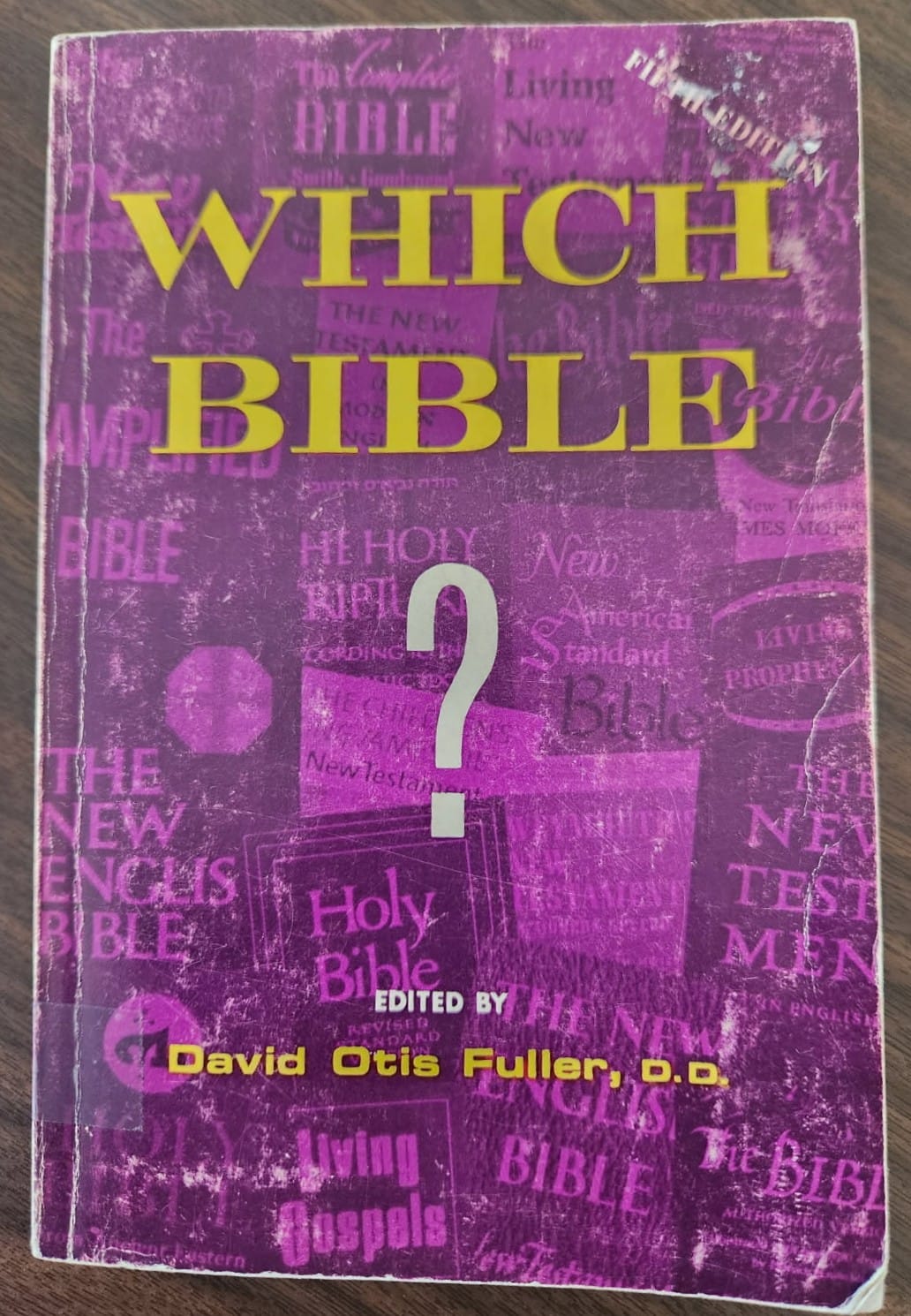
This is from the fifth edition, page 149, in the middle of a discussion of the theory of Westcott and Hort. Fuller states:
QUOTE: One cannot say that the Textus Receptus, for example, is verbally inspired. It contains many plain and clear errors, as all schools of textual critics agree. But it embodies substantially the text which even Westcott and Hort admit was dominant in the church from the middle of the fourth century on.
The text was used by the church fathers from Chrysostom’s time on, and was not materially different from the text of Erasmus and Stephanus. This is not a conclusive proof of the superiority of that text, far from it.
But, taken in connection with other factors discussed in this dissertation, does it not present a strong presumption in favor of the reliability of this text, namely the Textus Receptus?
It is hard to see how God would allow the true text to sink into virtual oblivion for fifteen hundred years, only to have it brought to light again by two Cambridge professors who did not even believe it to be verbally inspired.
A Bible-believing Christian had better be careful what he says about the Textus Receptus, for the question is not at all [about] the precise wording of that text, but rather a choice between the two different kinds of texts, a fuller one and a shorter one. END QUOTE.
I wanted to open our examination of Westcott and Hort by showing you from their own pens their positions on some very fundamental doctrines of the Christian faith.
This is the theological baggage that they carried with them throughout their lives. These beliefs, which I have just demonstrated to you, have everything to do with their work in devising a new Greek text and the subsequent revised version of the Bible and literally hundreds of English versions of Bibles based on that since that time.
As you all know by now, almost all of the modern Bibles are based either directly or indirectly on the Greek text of Westcott and Hort. Protestant America has a Golden Corral buffet of Bible versions.
As justification for their pick-and-choose Greek text, Westcott and Hort came up with what is now known as “the textual theory of Westcott and Hort.”
So next, we shall turn our attention to scrutinizing that textual theory of Westcott and Hort. You will wonder how they were able to get away with such trickery and dishonesty.
(To be continued.)
~END~