God’s Laws on Theft
Towards the end of the previous installment, we stated that Mayer Amschel Bauer is quoted as saying, “Let me issue and control a nation’s money and I care not who writes the laws.”
This man changed his name to Mayer Amschel Rothschild and he was the founder of the Rothschild banking dynasty back in the mid-1700s, a dynasty which today is as strong as ever, and is certainly at or near the top of the cabal of Mystery Babylon. Now to continue…
We shall get to the substance of his alleged quotation in a minute, but first I want to answer any critics who allege that there is no proof that the original Rothschild ever made that statement.
And along with that, they make the same charge about an alleged quotation by his son, Nathan Rothschild, who essentially took over the Bank of England in the early 1800s. He supposedly stated or bragged:
“Who controls the issuance of money controls the government! – Source: [accessed 6-2-25]
As far as I can tell, the critics are correct, because I and other researchers have searched in vain for primary sources for those alleged quotes. I have followed the work of G. Edward Griffin since the late 1970s, and most of you know that we carried his book, The Creature from Jekyll Island, for well over a decade.
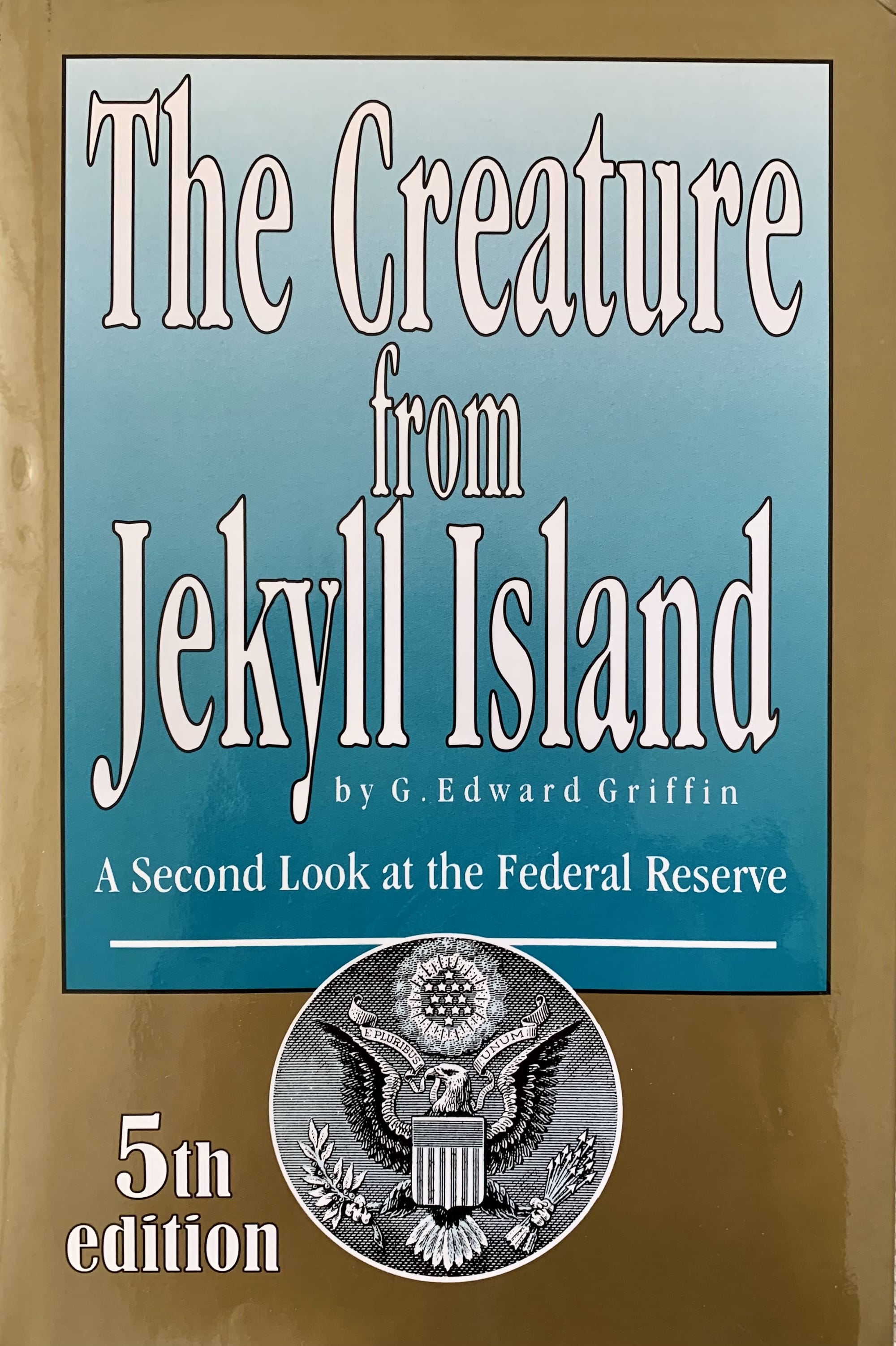
In that book, Mr. Griffin gives the quotation which I just read to you and then in a footnote gives his source. “Quote by Senator Robert L. Owen, former Chairman of the Senate Committee on Banking and Currency and one of the sponsors of the Federal Reserve Act,…” and Griffin provides his source from the U.S. Government Printing Office, and then Griffin states:
“This quotation could not be verified in a primary reference work. However, when one considers the life and accomplishments of the elder Rothschild, there can be little doubt that this sentiment was, in fact, his outlook and guiding principle.”
By the way, if one is looking for primary sources, one would have to be fluent in the German language, wouldn’t one? Or in the Austrian language 😊if you are Barack Hussein Obama. Remember that? …When he thought the people of Austria spoke a language called Austrian?
And so the bottom line is that whether old man Rothschild ever uttered those exact words is not a critical issue because we judge by the fruit, and history shows the fruit of that family to be what we would expect from a family whom we suspect are descended from the biblical characters named Amalek, Eliphaz and Esau-Edom.
In any case, the substance of that statement is absolutely true. Whoever controls the issuance of money in a nation-state is the absolute master over that state or nation.
Let us create a very simple example to help us understand the enormity, (and that word does not mean big; it means the atrociousness or the viciousness) the enormity of the crime against all people by those who have usurped the right to issue and control our money and currency.
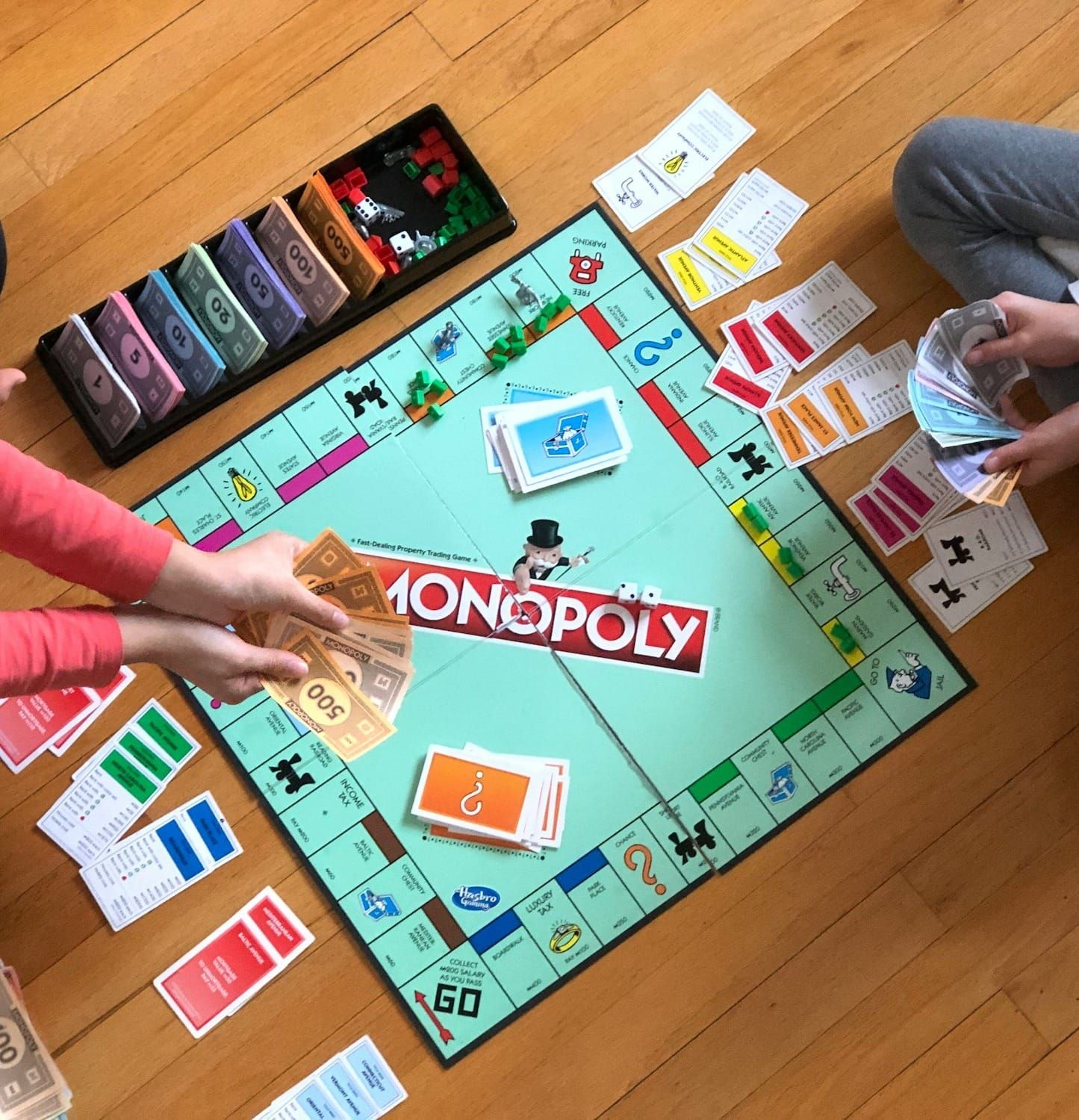
We begin by recalling the board game Monopoly. Is there anyone here who has never played that game? If not, don’t fret; we will use another illustration shortly.
To have any kind of game there have to be rules, whether it is a sports contest, or a card game, or a simple board game like Monopoly. In Monopoly, the players take turns rolling the dice to see how many spaces their token can advance around the board. The spaces represent properties such as real estate and utility companies.
On whatever space his token lands, the player has the option to buy that property unless another player has already bought it. In that case, the person landing there must pay rent to the owner.
But if it is available, it can be bought and then, when another player lands on his property, he gets to charge them a fee or rent for landing on the space he owns, is my memory correct so far?
Eventually, one of the players gets control over the choicest pieces of property and thus his wealth increases until the other players see that he has a virtual monopoly and they have no way to get ahead.
But we have to remember that each time a player makes the circuit all the way around the board and crosses the finish line or the starting line, he receives what was it…? Two hundred dollars? And of course, there was one player who volunteered at the beginning of the game to be the “banker.”
It was his job to issue the initial amount of money to each player. Everyone received an equal amount, of course. And each time the player passed Go, the starting line, it was the banker’s job to issue that player his due, which as we said was another $200.
Now, what if the banker-player is a sly person, who cheats the other players by dealing himself an extra couple hundred dollars whenever the other players are not looking? He never runs out of money; he never goes bankrupt. So who is going to end up with the monopoly? Who is going to win the game?
And equally important, what are the other players going to do if they discover that the banker has been cheating the rest of them? [One witty audience member yelled out, “String him up!” Laughter ensued because we all recognize the rule of God’s law.]
Now we don’t want to drag out the Monopoly illustration too long. But that leads us to our next thought experiment. For the sake of this illustration, we need to forget about all modern forms of money such as checking and credit cards, and digital money of all kinds.
Let us return to the early to mid-20th century when all currency was so-called “paper money.” In other words, all the one dollar bills, five dollar bills, ten dollar bills, etc., they all bore an inscription across the top of the bill which said Silver Certificate.
And just below that it said: “This certifies that there is on deposit in the Treasury of the United States of America,” and then at the bottom, just under the portrait of George Washington (we’re talking about the $1 bill here), it said, “One dollar in silver payable to the bearer on demand.”
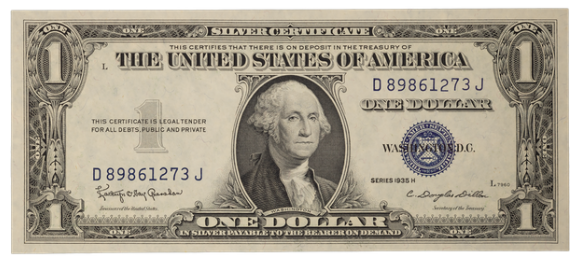
And to the left of the portrait, it said, “This certificate is legal tender for all debts, public and private.”
Now I have here in my fingers a piece of paper which we call one dollar, and what does this paper dollar have printed on it? Instead of Silver Certificate, it says, Federal Reserve Note. At the bottom it says One Dollar. And off to the left of George’s portrait, it says “This NOTE is legal tender for all debts, public and private.”
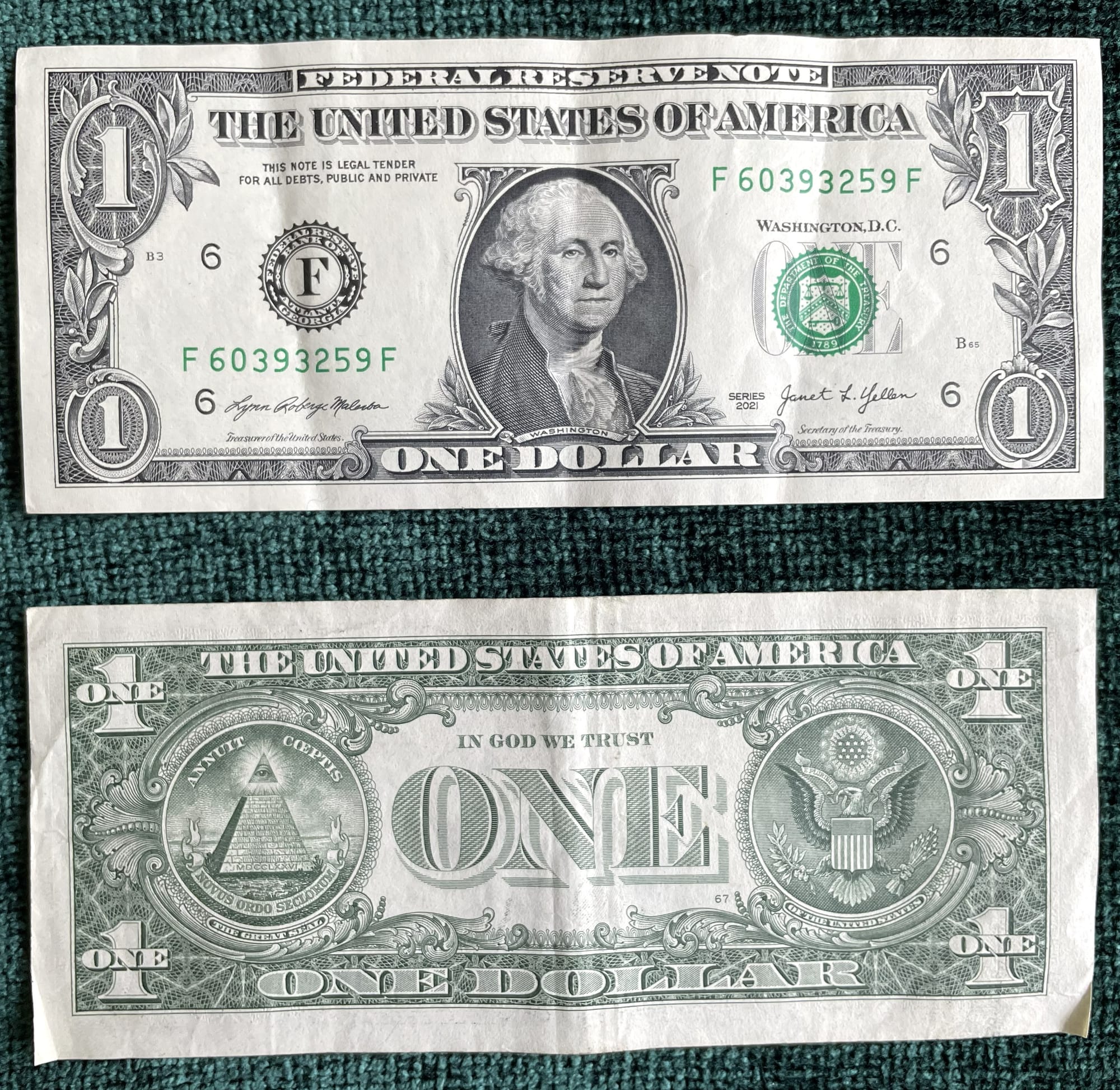
So what are the key differences? First, the earlier dollar certified that the U.S. Treasury had silver in its possession and through the neighborhood banking system of those days, the bearer of the dollar could go into a bank and demand and receive actual silver for the paper.
In other words, our money, our currency in the form of paper dollars was backed by the precious metal called silver. There were also gold certificates but we’re trying to keep it simple here.
However, for the record, at one time and for only a short time, we in America had a bi-metallic system of currency where both silver and gold were backing the so-called “paper money.”
But ever since 1971, the United States currency has been fully fiat, where no one can redeem any “paper money” for silver or gold. Our present Federal Reserve Notes say nothing about having any metals on deposit or that the Notes are redeemable.
They are redeemable for nothing except for other paper notes. That is called fiat money. Fiat is a Latin term which I would loosely translate as “Let it be so,” or “Let it be made.” It is simply a decree and the ordinary citizen simply presumes that the person or entity making the declaration has the authority to do so.
In other words, the government says, this piece of paper, issued by the Federal Reserve System (the central bank) is current money. It is worth one dollar because we say so.
You cannot swap it for any precious metals, and it is legal tender for all debts, public and private. Which means that everybody in the nation must accept this fiat money in payment for whatever goods or services we wish to purchase or to pay off any debt we might owe. (That has been slowly changing in recent years where some merchants refuse to accept the Fed notes form of our fiat money.)
Finally, there is the matter of the difference between a certificate and a note; as in a silver certificate and a Federal Reserve Note. The word “note” in a financial context is almost always related to a debt.
Whereas the silver certificate dollar clearly states that what you hold in your hand is not a debt but a store of wealth, for the simple fact that you can exchange it for actual silver.
As we close this section, here is a verse from the Word of God which all Christians should bear in mind.
Haggai 2:8 The silver is mine, and the gold is mine, saith the LORD [Yahweh] of hosts.
(To be continued.)
~END~