

Mystery Babylon and the Stone Kingdom, part 81—Identifying the mount of olives in prophecy
This is lecture/chapter number 29 in our series entitled Mystery Babylon and the Stone Kingdom. The title today is Israel, the Mount of Olives and God’s Great Deceptions.
I am beginning this lecture by addressing a question I left hanging in the last lecture. If I can talk football for a moment, it’s all about Jesus making a touchdown on the mount of olives. In all seriousness, it is a passage concerning the second coming of our Lord.
Actually, I only mentioned it in passing last time, but it does deserves an answer and I simply could not take the time to address it last time. So let me set the stage by repeating just a couple sentences from my previous lecture.
If you recall, we were discussing the parable which Jesus told His disciples concerning the nobleman who took a journey and then returned. Then I stated this:
“So when the nobleman returns, it does not necessarily have to mean that He returns to the same geographical place, but it could be just as correct to say that He returns to His people who would, by that time, be in a different and distant geographical location!”
I know that many Christians will object to my interpretation because they have been taught that Jesus is going to return to the ancient land of Israel, the place now inhabited by the Jews as the modern Israeli state. And these Christians believe their interpretation in large part because of Acts, chapter 1 and Zechariah 14.
In the first chapter of the book of the Acts of the Apostles, we know that by this time Jesus had died, been buried, and had risen from the dead. He then spent 40 days teaching and now He is with His apostles just moments from “lift-off,” as it were.
Regular listeners and readers will recall the significant amount of time we spent in several lectures in this series dealing with the very last question which the apostles addressed to Jesus. It is found in verse 6, where they asked: “Lord, wilt thou at this time restore again the kingdom to Israel?” I hope that by now we all recognize the tremendous importance of that verse, so let’s drop down to verse 9:
Acts 1:9 And when he had spoken these things, while they beheld, he was taken up; and a cloud received him out of their sight.
10 And while they looked stedfastly toward heaven as he went up, behold, two men stood by them in white apparel;
11 Which also said, Ye men of Galilee, why stand ye gazing up into heaven? this same Jesus, which is taken up from you into heaven, shall so come in like manner as ye have seen him go into heaven.
12 Then returned they unto Jerusalem from the mount called Olivet, which is from Jerusalem a sabbath day's journey.
Let us stop there. Now, among those who call themselves Christian, there is a certain percentage who do not even believe that Jesus will return. But among those of us who do believe He will return, the overwhelmingly vast majority believe that He will return to and touch down upon the literal mount of olives in the Israeli state.
But I am not among the majority. I do not believe that. “But, but... but James...,” they say, “can’t you see that is clear from verse 12 that Jesus ascended from the mount of olives, and in verse 11 in tells us that He will return “in like manner?”
Yes, I see that, and I agree with those Scriptures 100 percent! They would then add Zechariah 14:4 to nail the case completely. So let’s examine that verse. In my view, this verse is totally misinterpreted by almost all Christians and their ministers. It reads thus:
Zechariah 14:4 And his feet shall stand in that day upon the mount of Olives, which is before Jerusalem on the east, and the mount of Olives shall cleave in the midst thereof toward the east and toward the west, and there shall be a very great valley; and half of the mountain shall remove toward the north, and half of it toward the south.
This verse certainly appears to be strong evidence that when Jesus returns, it will be to the same physical location from which He ascended, namely, the mount of olives outside the old city of Jerusalem.
But... as we have seen in many instances throughout this series, when a Bible student does not understand the modern identities of the various families and people groups in the Bible, then it becomes very easy and very likely that they will misunderstand Bible prophecy for today.
So without getting into an exhaustive analysis of this entire verse, let me just focus in on the key aspect vis à vis our present topic. We have already learned that a mountain in Bible symbolism represents a great nation.
So when Christ returns, we could say that His feet will stand on the great nation of olives. Of course, this immediately puts this in a symbolic context and so we see that Christ will return to His great nation of olives. But what do the olives symbolize?
Well, just as sheep are an animal symbol of Israel, so, too, olives are a symbol of the combined nations of Israel, all 12 tribes. Look at Jeremiah 11. This is a passage in which both houses, the House of Judah and the House of Israel, are condemned by God for breaking the covenant. Nonetheless, notice what God calls them.
Jeremiah 11:16 The LORD [Yahweh] called thy name, A green olive tree, fair, and of goodly fruit: with the noise of a great tumult he hath kindled fire upon it, and the branches of it are broken.
Next, look at Jeremiah 33.
Jeremiah 33:24 Considerest thou not what this people have spoken, saying, The two families which the LORD hath chosen, he hath even cast them off? thus they have despised my people, that they should be no more a nation before them.
So we see that the two tribes and the ten tribes are called two kingdoms, two houses, and here, two families. It is also worthwhile to note this from the book of Judges.
Judges 9:8 The trees went forth on a time to anoint a king over them; and they said unto the olive tree, Reign thou over us.
The point made here is simply that trees are symbolic of people. That’s an easy one to understand because even today, when we talk about our genealogy, we use the term our family tree, don’t we?
The lampstands in the tabernacle and in Solomon’s temple were designed to resemble trees, and since the lamps were fueled with olive oil, guess what kind of trees they were supposed to represent? That’s right, olive trees.
Now as with many things in the Bible—perhaps everything in the Bible—there are multiple levels of meaning. We already know from our 30-lecture series on The Tabernacle in the Wilderness, that everything in the Tabernacle represents God or Christ in some way. (See page 4 in the Master Order Form, albums: A-105, A-106, A-107 & A-108.)
Nonetheless, as olive trees, the lampstands also represent the two houses or two families of Israel. But now in Zechariah 4, we see that in addition to the lampstands themselves symbolizing olive trees, that Zerubbabel sees a vision in which he sees two olive trees on either side of a single lampstand.
That single lampstand clearly represents Christ in His capacity as the firstborn Son, the pre-eminently anointed Son. And so Zerubbabel asks the angel what the two olive trees represent, and the angel teases him for a while and does not seem to directly answer the question at first.
Zechariah 4:2 And said unto me, What seest thou? And I said, I have looked, and behold a candlestick all of gold, with a bowl upon the top of it, and his seven lamps thereon, and seven pipes to the seven lamps, which are upon the top thereof:
3 And two olive trees by it, one upon the right side of the bowl, and the other upon the left side thereof.
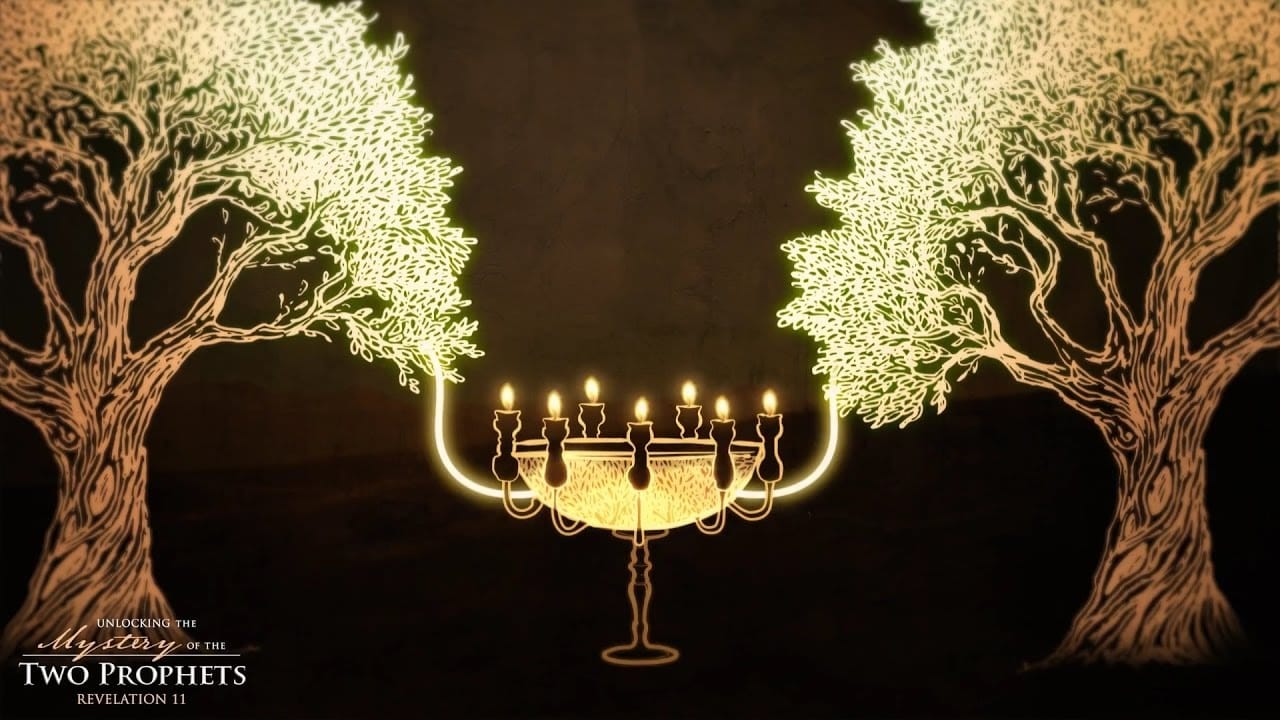
4 So I answered and spake to the angel that talked with me, saying, What are these, my lord?
5 Then the angel that talked with me answered and said unto me, Knowest thou not what these be? And I said, No, my lord.
And so the angel gives Zerubbabel a rather obscure answer which Zerubbabel apparently does not understand at all, and so he asks again.
11 Then answered I, and said unto him, What are these two olive trees upon the right side of the candlestick and upon the left side thereof?
12 And I answered [asked] again, and said unto him, What be these two olive branches which through the two golden pipes empty the golden oil out of themselves?
Alright, so Zerubbabel calls them olive trees several times and then in verse 12 he calls them two olive branches, but he is still puzzled as to what they represent.
13 And he answered me and said, Knowest thou not what these be? And I said, No, my lord.
14 Then said he, These are the two anointed ones, that stand by the Lord of the whole earth.
We need to understand here that the anointed ones is literally anointed sons! (The Hebrew word is ben, pronounced bane.) There are numerous references which refer to Israel as God’s son, or anointed one, and all this leads us to conclude that the two anointed ones are the two houses, the two families of Israel.
And therefore, the “mount of olives” in Bible prophecy refers to the great nations of Israel in the latter days, which are none other than the British Commonwealth and the United States of America.
So when it says in Zechariah 14:4 that his feet shall stand in that day upon the “mount of Olives,” it is referring to God’s Christianized Israel people in the modern Christian nations.
It is not referring to that non-Christian nation in the Middle East which has committed identity theft on a grand scale by usurping the name “Israel.” And by the way, the word “Jerusalem” in that same verse refers to the new Jerusalem, not the old city. How this situation came about is a most fascinating story, and we shall explore that later in this chapter.
(To be continued.)