Mystery Babylon and the Stone Kingdom, part 119—2020 was nothing new. Rockefeller, Morgan and Carnegie installed presidents 120 years ago!
We left off in part 1 quoting historian William Manchester in his book, Rockefeller Family Portrait. Revealing another devious and deceptive practice by John D. Rockefeller, Sr., Manchester stated:
“For a long time the public didn’t realize how powerful he was because he kept insisting he was battling firms that he secretly owned outright. His real rivals were forever discovering that their most trusted officers were in his pocket. The tentacles of the octopus were everywhere.”
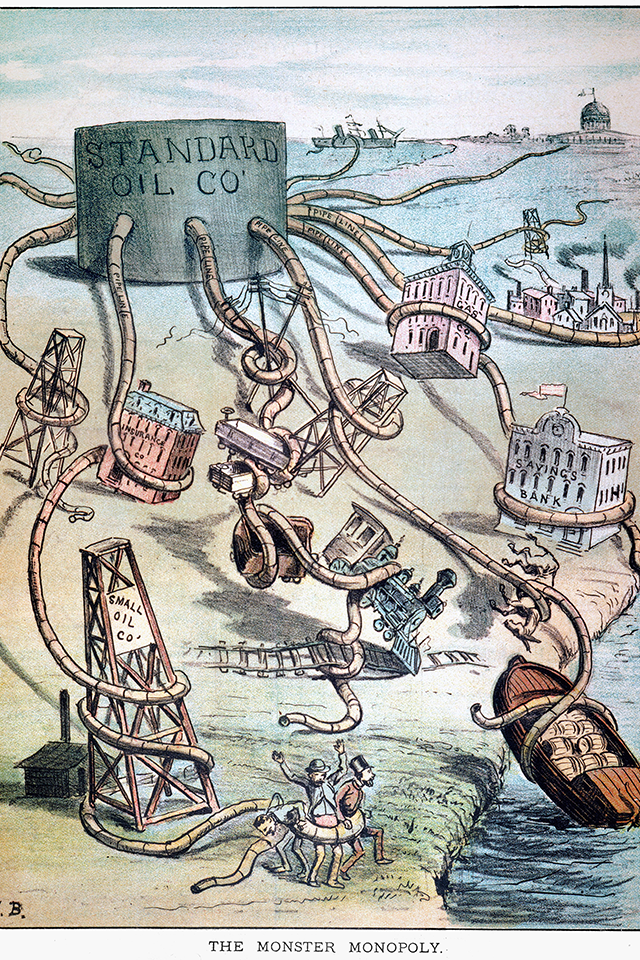
Gary Allen remarked that in later years, the Wizard of Oil tried to disguise his piratical business operations with the protective coloration of his religious practices. “God gave me my money,” he piously proclaimed. Many wryly mused that if that were true, God had a very strange code of ethics.
Let’s pause to ponder about that for a minute. I would have to agree with old John D. that God did give him his money, and you know what else? To the average Christian, God does have a very strange code of ethics, because Christians, by and large, do not understand that God creates evil. That’s in Isaiah 45, verse 7.
That God creates evil is one of the sacred secrets of the sovereignty of God which I wrote about in my book by that name. My book is 353 pages and is available from our offices for $26 postpaid.
So yes, it was God’s plan that old John D. Rockefeller become one of the key players in the hierarchy of Mystery Babylon in this end of the age, because as you know from a previous lecture in this series, from the oil business, John D. moved into international banking.
Thus, by 1890, the Standard Oil Trust was refining 90 percent of all crude oil in the United States—a virtual monopoly—and thus, William Jennings Bryan and Teddy Roosevelt did have an evil target to rail against in their political campaigns.
To Mr. Bryan and the so-called “trust-busters” of that era, those huge monopolistic corporations needed to be busted up. I do not disagree with Mr. Bryan that the so-called trusts were evil. They were an abuse of true capitalism, an abuse which goes by any number of names. While it could be called monopoly capitalism as opposed to free enterprise capitalism, it is more accurate to leave out the word “capitalist” altogether.
Let me mention just a few of the dozens of so-called “trusts” (monopolies) that were dominating American business in those decades of the latter 19th and early 20th century.
In chemicals, it was the DuPont family. In railroads, it was Gould, Vanderbilt, and Harriman. (We will explore much more about Harriman later in this series.) In steel, it was Andrew Carnegie. In tobacco, the Duke family—yep, the same Duke family that gave the money to endow Duke University.
In finance, of course, it was J. P. Morgan in the forefront of public attention, but there were others closely allied with him, such as Kuhn, Loeb and Company, National City Bank and others. Those are just a few, but you get the idea.
The sinful tactics that Rockefeller had employed in the oil industry, others had utilized in theirs. All were fake capitalists (thus giving capitalism a bad name). Like John D., they were all monopolists, period.
Another evil tactic of John D. worked like this. If you were an independent, mom-and-pop kerosene oil dealer and Rockefeller decided you were competition, he would simply set up a Rockefeller-owned kerosene oil dealership across the street from you.
That dealership then cut its prices below yours (and took temporary losses) until you could not cut any further. If you had not taken his pennies-on-the-dollar offer at the first, you now lost everything and got nothing.
In 1900, William Jennings Bryan was the Democrat Party nominee a second time running against William McKinley. But McKinley had Teddy Roosevelt as his running mate.
Meanwhile, the once-rival powers of Rockefeller, Carnegie and J. P. Morgan decided to cooperate with each other and make sure that their man, McKinley, was reelected. They poured massive amounts of money into his campaign.
It was a conspiracy of the greatest magnitude. Remember, Rockefeller had begun in business in Ohio. McKinley had been the governor of Ohio.
Do you think there might have been some quid pro quo (from Latin, literally means: this for that.) helping McKinley’s career back in Ohio before he ran for the White House? Just speculating…
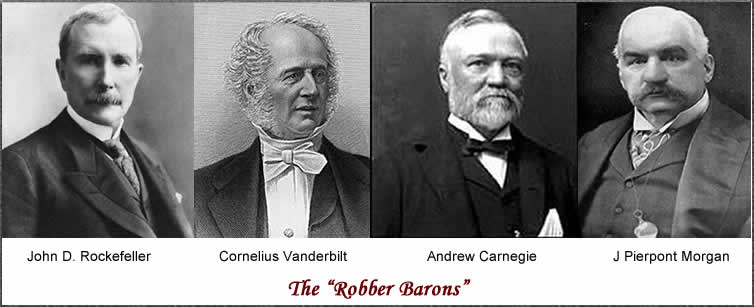
I do not recall if the term “conspiracy” was used, but the fact that it was a conspiracy, that those three men joined forces to put their man in the White House was confirmed in a History Channel documentary series called The Men Who Built America. I have seen various segments of it over several months this year (2013). It is quite intriguing from many perspectives.
I saw a two- or a three-hour segment on Henry Ford. Another was a three-hour biopic on John D. Rockefeller, Sr., and this latest one I saw began with an hour or two biopic on the life of J. P. Morgan.
That was immediately followed by segment on Andrew Carnegie and then it segued into explaining how the three of them (Rockefeller, Morgan and Carnegie) conspired to control the White House. In this connection, I remind you that Jesus told His followers:
Luke 12:2 For there is nothing covered, that shall not be revealed; neither hid, that shall not be known.
With television—and especially with the internet—our Lord’s prophecy is certainly in the realm of possibility now. Via the internet, the whole world can know everything about everybody.
Considering the recent revelations about the massive spying and surveillance upon all Americans by the NSA—which some of us have been aware of for decades, dating back to the once-secret Echelon program (which later morphed into the Five Eyes program)—one might surmise that at a minimum, the NSA already knows everything about everybody. (Note: This was in 2013 when the Edward Snowden revelations were being made public.)
But leaving that aside, it is a fact that every person with an internet connection, now has more than the entire Library of Congress available to them at the click of a mouse. In fact, what is available on the web would make the massive Library of Congress look like a pre-school library in comparison.
By the way, let me explain that word, biopic. A biopic is a film or television documentary that is biographical in its general nature, but which includes fictionalized episodes or segments. That is what those History Channel documentaries are. Biopic is a contracted word derived from “biographical picture.” That tells you how to pronounce it. Or, playing with words, we could pronounce it “bi-opic,” as in myopic, only it’s a double dose.
In my view, they give some truth, but then they often shade and shield the deeper truths from the viewers. Oh, to be sure, the truth is out there, but you are not going to get the whole truth from the History Channel. Hence, watch the biopics with your critical thinking caps on.
Therefore, concerning some of the men of Mystery Babylon, I find the biopics to be revealing in some respects, yet they are covering up other aspects. For example, some people might have found it surprising to see the History Channel airing a documentary which comes right out and states how Rockefeller was utterly ruthless in destroying his competition; as was J. P. Morgan, of course.
Surprising because, as you might have suspected, the History Channel is merely one of the cogs in the propaganda machine of Mystery Babylon, the Babylonian Media, or the BM, for short. I know that to be the case, both from observation of their products—the biopics and other programs—but to me it is most obvious when you investigate who owns the History Channel.
It is owned by the A & E Network, which in turn is jointly owned by the Hearst Corporation and Disney-ABC Television Group. The bottom line is that they are giving part truth and part lies. (Note: This was 2013. I did not take the time today to investigate if the corporate ownership has changed, but it would hardly make a difference. It would still be part of the BM.)
Be a discerning viewer of these biopics because one of the techniques used by the producers of the biopics when protecting the higher-ups is to sometimes reveal or confirm something negative about, say, Mr. Rockefeller or Mr. J. P. Morgan, but then that exposure of one particular lesser evil serves to deflect or distract attention from something far worse.
On the other hand, I am convinced that sometimes the-powers-that-be simply like to brag about their evil accomplishments, and to rub it in the public’s faces; as if to say, “Look here, this is what we did to you and we’re still doing it and you can’t do a thing about it.”
So with the heavy financing from the monopolists—Morgan, Rockefeller and Carnegie—William McKinley won a second term. However, within a few weeks of his inauguration, he was dead of an assassin’s bullet and Vice President Teddy Roosevelt stepped into the White House.
The History Channel biopic portrayed Morgan, Rockefeller and Carnegie as having been very fearful of Teddy Roosevelt, because he, too, like Bryan, had railed against the so-called trusts, the cartels, the monopolistic robber barons.
But was Teddy Roosevelt really an enemy of the monopolists or was he simply another tool in their toolbox? Portrayed as their enemy, but in reality, working for them? Remember the old Hegelian dialectic?
Just think about it. If these titans of finance and industry had the power to put McKinley in the White House, are we to believe that they were impotent to keep Roosevelt off the ticket? If you believe that, I’ve got some beach property on the dark side of the moon I would like to sell you.
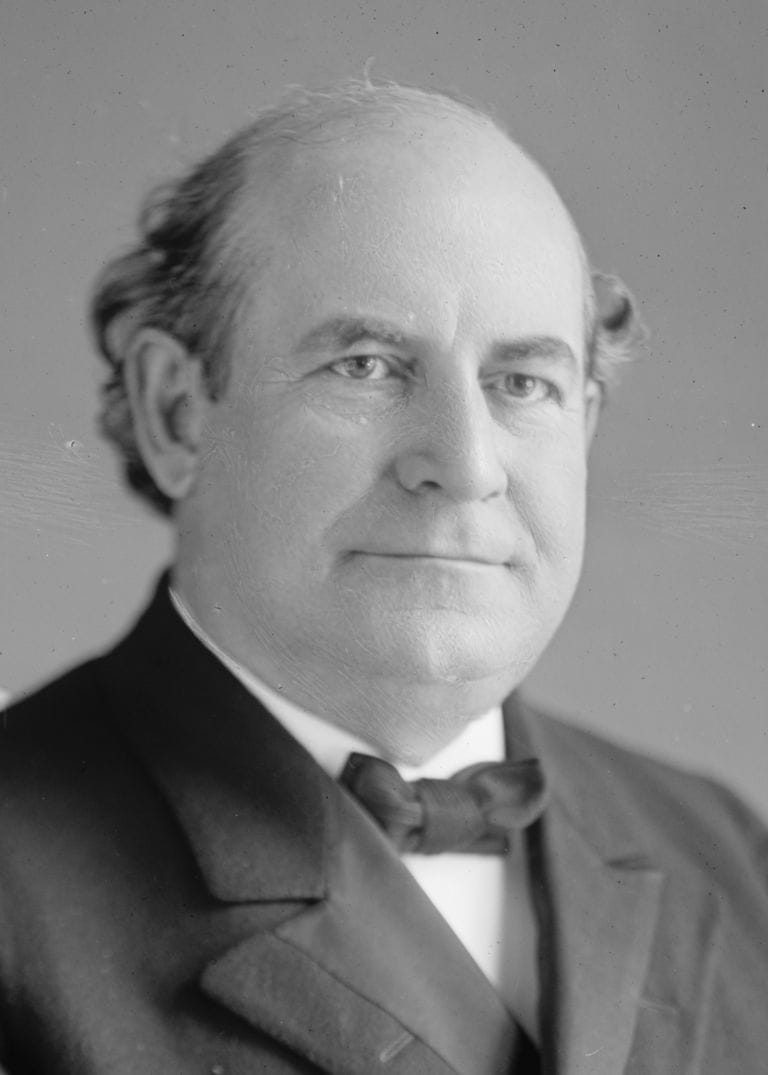
The common fact about Teddy Roosevelt and William Jennings Bryan is that both of them were allied with the early Progressive movement. It is important to understand about the Progressives because we are hearing that term more and more again in recent years.
You need to know that the type of “progress” they advocate is not what you and I would mean by progress. Their idea of “progress” is to bring us the modern equivalent of feudalism, with the wealthy elites being the lords of the manor and all the rest of us being the serfs and slaves.
It is essentially the cry being heard in the present-day Occupy Wall Street movement about the 1% versus the 99%. Except, if you recall my two lectures on that topic, the Occupy folks are being deceived into playing the same Hegelian dialectic game that the Progressives were used for a century ago.
So let me repeat just a few paragraphs about Progressivism from one of the very early lectures in this series and then add to it. I had said this:
Common sense tells us that any person, or any group of people, who want power to rule over and enslave you cannot be honest about their intentions. They must lie; they must deceive the people. Collectivists cannot go around calling themselves collectivists or totalitarians, so they always disguise themselves under nice-sounding names.
Gee, didn’t Jesus warn us about wolves in sheep’s clothing? Yes, He did! In this nation, the collectivists called themselves Progressives a century ago. Woodrow Wilson was a Progressive Democrat. Teddy Roosevelt, however, was the candidate of the actual Progressive Party.
In the presidential race of 1912, Wilson consulted with the progressive lawyer named Louis Brandeis, on how to beat progressivist Teddy Roosevelt. Later, as president, Wilson then appointed Brandeis to the Supreme Court.
So, with the word “progressive” having been exposed as nothing more than an agenda to steal our liberties, the collectivists usurped another nice-sounding word, one that actually sounded a lot like “liberty.” It was the word Liberal.
Both words come from the same Latin root word meaning “free,” “freedom,” “liberty,” etc. So the Progressives all went outside in front of their offices and changed the signs on the front door and they all became... Liberals.
But over the past four or five decades of national elections now, almost all Liberals will shun the Liberal label and pretend to be conservatives. The collectivists have now so perverted the name Liberal that in common parlance, it means exactly the opposite of its original true meaning.
Today, we have some of the collectivist-Liberals trying to resurrect the progressive label and probably not one voter in a hundred is acquainted enough with American history to know the evils of progressivism. Such is the fruit of our modern educational system.
Hillary Clinton is one who tries to hide her Marxist-socialist-communist beliefs by calling herself a progressive. During the Democrat primary debates of 2007, Hillary Rodham Clinton was asked if she would define herself as a Liberal.
Her answer was quite revealing, and it illustrates how the Reds attempt to deceive people by changing names. Regarding the name or label of Liberal, Mrs. Clinton answered: “You know, it is a word that originally meant that you were for freedom...”
To that point, she is 100 percent truthful, isn’t she? But now notice, if we read between the lines, how she very cleverly goes on to define it in terms of class warfare, pitting the rich and powerful against the little guy. Class warfare is a classic propaganda tactic of the Reds. From the beginning of the quotation again, Hillary talks about the Liberal label.
“You know, it is a word that originally meant that you were for freedom, that you were for the freedom to achieve, that you were willing to stand against big power and on behalf of the individual.
“Unfortunately, in the last 30, 40 years, it has been turned up on its head and it’s been made to seem as though it is a word that describes big government, totally contrary to what its meaning was in the 19th and early 20th century.
“I prefer the word ‘progressive,’ which has a real American meaning, going back to the progressive era at the beginning of the 20th century.”
What she does not reveal, however, is who turned the meaning of Liberal on its head. It was people like her. It was her political ancestors of the past 40 years whose policies and programs are always for big government, for more and more government, collectivism—which effectively and stealthily destroys the freedom and the liberties of the people that she claims to be for.
The word “progressive” itself had become such an odious and rotten word in the public consciousness of the first half of the 20th century that that is why they discarded the name “progressive” and started calling themselves Liberals in the first place.
Thomas Jefferson was a Liberal in the classic and true and original meaning of the word, because he was in favor of a federal government which was small and limited to only those few responsibilities and powers delegated to it by the states.
The Progressives simply hijacked the name, liberal, and they indeed were the cause of its meaning being turned on its head because the Progressives always work for more and more government.
For example, Democrat Party Platforms under the leadership of three-time Presidential candidate William Jennings Bryan, consistently included a plank demanding an income tax! Of course, the progressive wing of the Republican Party also pushed for the income tax.
In his third attempt to win the presidency in 1908, William Jennings Bryan, the so-called populist, the supposed champion of the little people, even sent a special message to Congress, in which he called for a federal income tax and inheritance taxes. That doesn’t sound like a friend of the little people to me, does it to you?
Some people in the Progressive movement were idealistic dupes, but others knew exactly what they were doing, and so the Progressives got their way and in 1913 Americans were saddled with the federal income tax. The modern era of inheritance taxes began at nearly the same time.
“So, take that, you Rockefellers! We, the 99-percenters in the Progressive movement, are going to have the government tax a big chunk of your wealth when you die, ha, ha ha!” To use a modern, sarcastic cliché: How’s that working out for you? Here is how it worked out.
(To be continued.)