


Which Bible, Which Version? series
This is chapter 10 in the series which I have entitled Which Bible, Which Version? We are in a sub-series (chapters 7-12) which we could call: Westcott and Hort, Wolves in Sheep’s Clothing.
For those perhaps who are just now finding this series on line, we assert its importance to all Christians; namely, that if we are using an English translation whose New Testament is based upon error-laden manuscripts, then we will have a faulty understanding of what the Word of God actually says and is. False doctrines will proliferate.
At this juncture, we are continuing our scrutiny of the theory of Westcott and Hort and their Greek text. Let us proceed now to the final premise of Hort’s theory. This concerned what Hort perceived as the fact that the Vaticanus and Sinaiticus manuscripts were older than the Textus Receptus and therefore were more reliable.
Recall how while still a college student, Hort was imbued with a preconceived malice toward that, “vile Textus Receptus leaning as it does on such late manuscripts.”
I have said this before but it bears repeating, that if you will examine the marginal notes of many of the modern Bibles, you will frequently find such comments as this.
Referring to the Vaticanus and the Sinaiticus, some of them say: “the oldest and best manuscripts read…” such and such. Or it will say, “the most reliable and ancient witnesses have…” this reading, whatever it is. It is very common.
And almost without exception, these are, in fact, value judgments which are elevating the Vaticanus and Sinaiticus text of Westcott and Hort in its various incarnations (through subsequent followers such as Nestle, Aland, Metzger, et al.).
Let us now see if the Vaticanus and Sinaiticus are “the oldest and best, the most ancient and reliable witnesses” or does that distinction belong to the Traditional Text, i.e., the Majority Text, the Received Text (Textus Receptus).
Since the time of Westcott and Hort, there have been many discoveries of papyri, about 88 in all. They have been dated as originating anywhere from the 2nd century to the 8th century A.D., with many of them apparently being from the 2nd century.
Most of these papyrus manuscripts, these papyri, are very small, some of them just a fragment, so that sometimes they only find a few words to a line or two on them.
But there are some that contain a considerable amount of text. Through valid textual criticism techniques (which we discussed in the early chapters of this series), scholars are reasonably able to determine, at least in the longer passages, whether or not the text is more like the Received Text, or if it is more like the Vaticanus or Sinaiticus.
There was a scholar named Dr. Harry Sturz. I was unable to learn online whether he is still alive, but I would assume he has passed, based on what some of his acolytes have written about him (writing as though he has passed).
He wrote a book called The Byzantine Text Type and New Testament Textual Criticism. It was published in 1984 and was based upon his doctoral thesis from 1967.
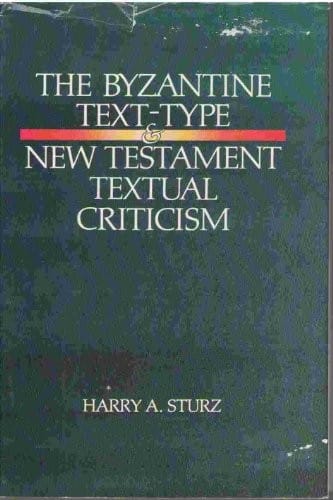
In it, he showed that a large number of readings in the papyri favor the Textus Receptus. Or, as he said, they are “distinctively Byzantine.”
Given that the extant papyri are available for only about 30 percent of the New Testament, Sturz’ work and the work of other scholars allows us to make a reasonable projection that if we were to find papyri for the missing 70 percent, that those readings would also favor the Received Text.
As one reviewer (J.K. Elliott) wrote in a scholarly journal: Dr. Sturz demonstrates that “Westcott and Hort were wrong to dismiss the validity of the Byzantine text-type as a legitimate claimant alongside the other text-types to possess the original text.
“One of the most valuable aspects of Sturz’s work is to show how former distinctively Byzantine readings now have the support of early papyri.” (From Novum Testamentum, An International Quarterly for New Testament and Related Studies.)
What is even more remarkable about this finding is that the vast majority of these papyrus fragments were discovered in those areas of the world (north Africa) where the Alexandrian text, that is, the shorter text, was prevalent.
The evidence of the papyri is 2nd century, therefore, it predates Codex B (the Vaticanus), and predates Codex Aleph (the Sinaiticus) significantly.
The Codex Vaticanus is generally dated to the early fourth century (ca. 300–330 A.D.) or mid-fourth century (ca. 325–350 A.D.), while the Codex Sinaiticus is dated to the mid-fourth century (ca. 330–360 A.D.). This evidence from the papyri shows that, in fact, the Received Text is the more ancient!
Another strong witness which confirms that the Textus Receptus, the Majority Text, is the oldest and best, would be in the early versions of the Bible. In other words, in languages other than Greek.
We shall not delve into detail on this, but I will simply tell you that the three primary early versions, those which predate Codex B and Codex Aleph, are the Old Latin (not Jerome’s Latin Vulgate, but the Old Latin), the Syrian Peshitta, and the Egyptian Coptic.
If you recall, way back in the early chapters where we had a chart showing the two streams of Bibles, you will remember that the Old Latin and the Syrian Peshitta versions were in use by 150 A.D., very early. The Egyptian Coptic dates from about 200 A.D.
And as you might expect, the Coptic tends to favor the Alexandrian text. After all, it is in Egypt. But yet, in a significant number of places, the Coptic version was found to agree with the Textus Receptus, as opposed to the Vaticanus and Sinaiticus.
So, here again, the early translations of the Bible point to the Textus Receptus, as the oldest and best, not the Vaticanus and Sinaiticus idealized by Westcott and Hort.
Finally, there is evidence provided by the patristic quotations. The writings of the early church fathers are frequently saturated with quotations from the New Testament.
Westcott and Hort were fully aware that in the matter of the patristic quotations, that the Received Text was at an immediate disadvantage. Now, why was that?
Well, the disadvantage stemmed from the fact that most of the writings of the early church fathers which are available today, are, once again, like the papyri, from areas of northern Africa and the west, which were places where the shorter Alexandrian text was prevalent.
Thus, Westcott and Hort, in their theory, asserted with great confidence that the church fathers before 350-400 A.D. did not quote from the longer type of text, but they quoted from the shorter.
Still, knowing what we discovered about how Hort audaciously claimed that the genealogical method proved the inferiority of the Received Text, and yet Hort never applied the method!
And when it was applied, even his “cohorts” 😊 could not make it work, but found themselves actually agreeing with Hort’s opponents that it could not work.
The point here is that Hort’s real method was what? Chutzpah. Just say it. Simply state something as fact strongly enough, and people will believe it.
And so it was with Hort’s claim about the support from the patristic writings. Apparently, no one had ever compiled the patristic writings and analyzed them for that purpose.
So, Dean John Burgon took on the Herculean task. He sifted through the scripture quotations of the early church fathers and indexed them. It was a colossal task.
Burgon cited 4,383 quotations from 76 different writers who died before the year 400 A.D. Unfortunately, Burgon himself died before he could complete the work.
But Edward Miller carried on the work and tabulated the number of times that a church father witnessed for the Received Text versus the number of times that the early church father quotation was witnessing against the Received Text.
He found the Received Text was favored by a margin of 3 to 2. The exact count was 2,630 citations for the Received Text and 1,753 citations against the readings of the Received Text.
Now, once again, in view of the fact that so many of these 76 church fathers were from the Alexandrian and the western areas, this is quite a remarkable piece of evidence in favor of the Received Text.
Had the writings of more of the Antiochian area fathers been available, you can imagine that the balance scale would have tipped even more decisively in favor of the Received Text.
So, once again, we find that the oldest and best, the most ancient and reliable text is the Received Text, not the Vaticanus and Sinaiticus of Westcott and Hort.
Even though new Bible version editors continue to reject the Textus Receptus, as Wilbur Pickering said, “no one can now reasonably or responsibly characterize the Byzantine text as being late.”
So, if you ever see that in your Bible again, the “oldest and best manuscripts,” they are most likely talking about Vaticanus and Sinaiticus, but just remember what we have just shown. They were not the oldest and best. They were/are not the most reliable.
True, the Received Text was not put together until Elsevier and Stephanus and others, but it is attested to and proved by the earliest writings. Therefore, it is factually the oldest and best.
To summarize concerning the textual theory of Westcott and Hort, we have found that at every major premise, Hort’s theory is found to be defective, and even admitted to be so by prominent Hort followers like Ernest Colwell, Bruce Metzger, and Kurt Aland.
Pickering sums it up well in one of his extensive footnotes in The Identity of the New Testament Text, page 215, footnote 9:
QUOTE: The Westcott-Hort theory is much like a multi-storied building. Each level depends on the one below it. Thus, Hort’s simplistic notion of genealogy absolutely depends upon the allegation that there was no deliberate alteration of the text.
And his notion of text types, in other words, families, absolutely depends upon genealogy. And his arguments concerning conflation and the Syrian readings before Chrysostom absolutely depend upon those text types.
The foundation for the whole edifice is Hort’s position that the New Testament was an ordinary book that enjoyed an ordinary transmission. With its foundation removed, the edifice collapses. END QUOTE
So, indeed, the theory of Westcott and Hort, which underlies their Greek New Testament text, is nothing more than a figment of their own dark imagination.
The theory of Westcott and Hort was merely a pretense of scholarship in order to give Westcott and Hort some alleged basis for abandoning the Received Text and for replacing it with their own creation drawn from the defective Vaticanus and Sinaiticus.
So, how in the world did they pull this off? How could they get away with that? Here is how they did it.
(To be continued.)
ADDENDUM
Edward Miller (1825–1901) was a close associate of John William Burgon (1813–1888) who posthumously edited and completed Burgon’s major works on New Testament textual criticism. This book, (in photo at top) published in 1896, is available for free download here.
~END~