


Which Bible, Which Version?
It has been nearly a month since we last presented a blog (linked here) in this series. With that previous installment we had reached precisely the halfway point in this 20-lecture/20-chapter series.
We are now commencing chapter 11. In this series, we are not studying from the Bible so much as we have been studying about the Bible and how we got our English versions.
By making these lectures available in this format on the web, we thereby have the ability to include additional material which was left out of the audio lectures for lack of time. Thus, those who have already heard our entire lecture series on tape (originally, or later on CDs) might find the additional information herein to be of benefit.
The whole purpose of this series has been, and still is, to assist our listeners and readers to understand what the differences are between the various—literally scores of—English versions of the Bible out there, and why it is important to know what these differences are.
With that understanding, you will know which version is the most reliable, or at least you are going to know what I think is the most reliable, and my reasons for it.
Romans 10:17 So then faith cometh by hearing, and hearing by the word of God.
The Bible itself tells us here that faith comes by hearing, and hearing by the Word of God. That being true, then it is only logical that the more perverted our particular version is, the more perverted it is from the true Word of God, and the more our faith is going to be stifled and stunted in its growth.
For those who have not heard or read any of this series, I want the reader to know that the matter of Bible versions, translations and manuscripts and their history is not a simple topic.
At this point in my delivery of these lectures, I had been reading, studying and researching this subject for approximately five years. I did not come to my conclusions without looking as objectively as I could at all sides of the question.
I have studied the pro-Westcott & Hort (anti-Textus Receptus) position as well as the opposite position. I myself was in the habit of using several modern versions in my Bible teaching. Then at a particular Bible conference back in the very early 1990s, I was challenged to seriously study the matter, not just read a book or two (This was in the pre-internet days.)
So, for a fact, I did not come to this study with a pre-conceived, pro-King James Version (KJV) bias. If anything, just the opposite was the case. I sometimes joked and made fun of those who used the “obviously obsolete” King James Version.
So I did look at the subject as factually as possible. About two years into my study, I came to a conclusion, and everything I have read and studied since then on both sides has not swayed me from that conclusion.
That conclusion is that I use the KJV as my primary Bible—not because it is perfect (far from it)—but because it is based on the Textus Receptus Greek text of the New Testament. (We will discuss the Hebrew text of the OT in due course.)
In the course of this in depth series it became necessary to dwell at length on the lives and activities of two prominent churchmen in the 19th century: Bishop Brooke Foss Westcott and Dr. Fenton John Anthony Hort.
These two men are the primary reason why there are now so many different versions of the Bible on the market, thus making the choice of which Bible to use very confusing, especially for the new Christian.
The New Testament of the KJV is based upon a collation of Greek manuscripts called the Textus Receptus, Latin for “Received Text.” This simply means that it is the Greek text which was received down through the centuries by true Bible believers.
In the chart below, it is the text which follows the right-hand stream. The Textus Receptus is representative of 90 percent or more of the extant manuscripts.
This was true both at the time the KJV was translated and it is still true today, despite ignorant assertions to the contrary. Because of the overwhelming agreement among these 90 percent or more of the manuscripts, the Textus Receptus is also sometimes called the Majority Text.
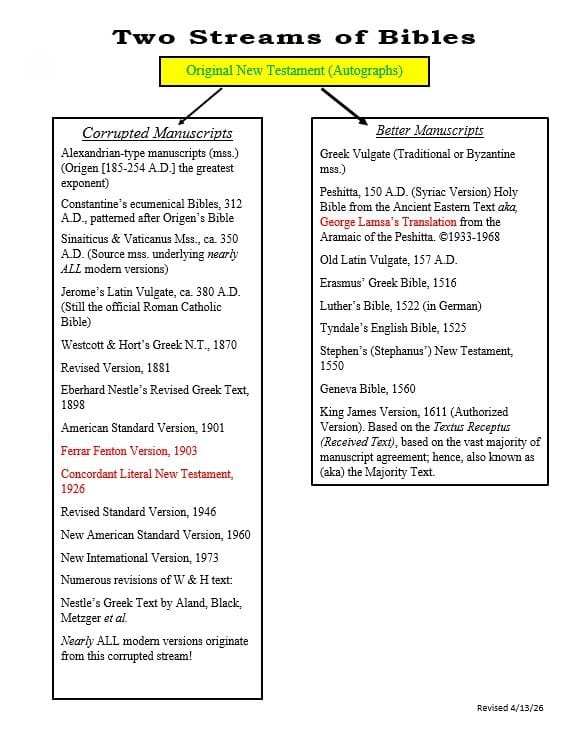
Other closely related names for it include the Common Text, the Byzantine Text and the Traditional Text.
Westcott and Hort (W & H) despised the KJV and the Textus Receptus. They had their own agenda and decided to make a new version of the Greek New Testament.
They derived it primarily from two manuscripts: the Vaticanus (designated as Codex B) and the Sinaiticus (designated as Codex Aleph); and of these two, they leaned much more heavily on Codex B.
The Vaticanus had been squirreled away in the Vatican, evidently for centuries. Not surprisingly, its “readings” convey a Roman Catholic perspective and bias.
This Greek NT of W & H became the basis of the Revised Version of 1881. Westcott & Hort were the dominant forces on the Revision Committee. The very title itself—Revised Version—is a lie, since it was not a revision of the KJV at all, but an entirely new Bible, intended to supplant the KJV.
Now, over 140 years later, the KJV and its Textus Receptus stand nearly alone against the onslaught of other English language Bible versions. With roughly only a handful of exceptions, nearly every other Bible version available today has its New Testament derived (either directly or indirectly) from W & H’s Vatican-based Greek text.
New readers can go back to our earlier blogs on W & H (beginning here) which elucidate all the many reasons why we believe the Textus Receptus is to be preferred over W & H’s text or their modern offspring texts.
But it was thought that even without that background new readers will find this particular aspect of the activities of W & H to be most fascinating. Because our account reaches from the halls of Cambridge University, where W & H were students and teachers, to the campuses of today where numerous young people are being taught to “contact their spirit guides.”
This and the next chapter extends from the study of ancient biblical Greek manuscripts to the creation of the United Nations charter. It connects W & H’s extracurricular activities with individuals who were prime movers and shakers later associated with the secret “Round Table Group,” and their creations, the Royal Institute of International Affairs (RIIA, also known as Chatham House), and its American subsidiary, the Council on Foreign Relations (CFR).
When I began these chapters on W & H, I stated that it was important that we not only look at the relative merits or lack of merits of their work in Bible translating and theorizing, but I emphasized that it was also important that we look at where they stood on the theological spectrum.
What doctrines did they believe? Did they hold to the foundational doctrines of Christianity, such as the inspiration of Scripture and the blood atonement of Christ? We can now easily see how important it is to know where these men stood on these doctrines. They stood against them.
Westcott & Hort gave all the appearances of being pious and devout and devoted to finding the true and original words of the New Testament. But it is hard to spot a wolf when he looks like a sheep.
Not only do we need to examine W & H’s theological positions, but it is also important that we examine who the individuals were in their social circles. Who were their close friends and associates? What kind of activities were W & H involved in when they were not doing “God’s work”?
After all, just because a man is a superlative scholar when it comes to Greek, that should not mean that we automatically give them carte blanche to edit our scriptures, should it?
Believers in the Word of God would want to have men who are not only learned in the original languages, but also men whose faith in the Scriptures is unquestioned, and whose personal live attest to their good character.
For example, you wouldn’t want a great Greek scholar editing a new Bible if you knew he was a homosexual, would you? The simple fact is, when it comes to God’s Word, and when it comes to who is going to tell us what those words are in English, we want to have godly people doing it.
By the way, whether King James I was a homosexual or not and his influence on the KJV is something we will discuss in a later chapter in this series. We are quite familiar with the rumor mill in that regard.
So that is why we need to look further into the lives of Westcott & Hort. Yes, these men knew their Greek; but what did they do when they were not translating Greek to English?
We will now demonstrate that W & H were involved in some very curious activities for the better portion of their adult lives ...activities which should make any Christian have serious questions about them—we are talking here about what is generally labeled “the occult.”
(To be continued.)
~END~