

Which Bible, Which Version?
In the past six chapters in the series, we have essentially been laying the foundation for the meat, the main course, of this series examining the plethora of Bible versions which flood the marketplace in America.
That foundation commenced with our discussion of the doctrine of the inspiration of the Bible. Secondly, we have spent considerable time introducing readers to various concepts associated with the study of Bible manuscripts.
Then, we only scratched the surface to become familiar with what is meant by “textual criticism.” We learned the difference between textual criticism per se—which is called lower criticism—as opposed to what is commonly referred to in Bible scholarly circles as higher criticism.
We also learned that despite the more than 100 different versions of the Bible in English today—actually, in this year of 2026, there are far more than 100 different versions counting all the versions on the internet. But despite the glut and wide variety of Bible versions in English, there are, in fact, only two branches or streams of underlying texts and manuscripts upon which these hundreds of Bible versions are based.
What that means, of course, is that there are really only two kinds of Bibles (in English). Here again we reprise the simple chart we have used to illustrate the two streams of manuscripts leading to our various English language versions.
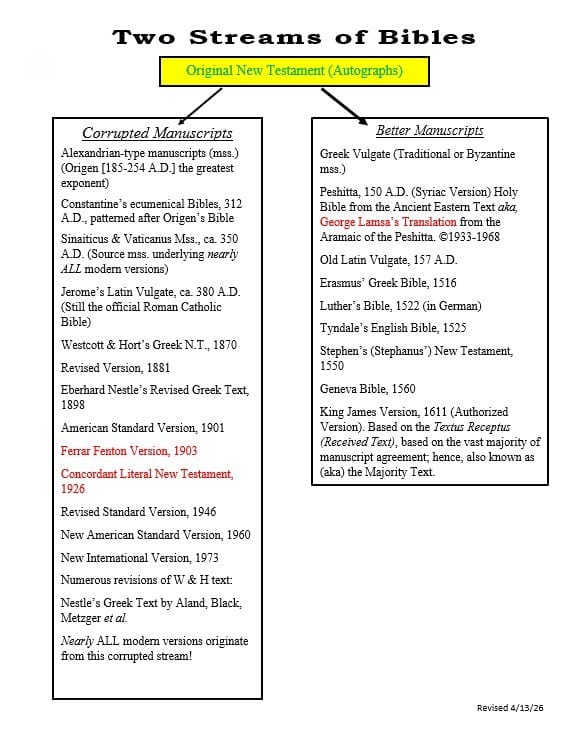
This chart visually shows the difference between those very few versions, which are based on the Textus Receptus, as opposed to virtually all the other versions, which are based upon the work of Westcott and Hort in one way or another.
This means that those versions which are based upon the Textus Receptus—and that is primarily the King James Version, the old Geneva Bible, and to an extent the New King James Version, and a handful of others, most of which, while they have come out in recent years but are somewhat obscure in popularity at this point in time—that these few are markedly different from virtually all other English language versions.
Now, I just emphasized that I was speaking of the old Geneva Bible, because there is now a relatively new Bible out on the market whose publisher has called it the Geneva Bible.
But it is not the same. This new one is actually a New King James Version. However, they call it the Geneva Bible because there are a group of Bible scholars, including the late Dr. R.C. Sproul—he was the general editor—and they have, or at least the publisher claims, that these men have written extensive notes for this Bible.
QUOTE: Dr. R.C. Sproul (1939–2017) was founder of Ligonier Ministries, first minister of preaching and teaching at Saint Andrew’s Chapel in Sanford, Fla., first president of Reformation Bible College, and executive editor of Tabletalk magazine.
His radio program, Renewing Your Mind, is still broadcast daily on hundreds of radio stations around the world and can also be heard online. He is author of more than one hundred books,… He is recognized throughout the world for his articulate defense of the inerrancy of Scripture and the need for God’s people to stand with conviction upon His Word. END QUOTE Source.
Dr. Sproul and his team have allegedly done for the modern Geneva Bible what Calvin, Knox, and other Reformers did for the old (original) Geneva Bible. I have not reviewed the new version yet other than to notice those differences, and so I cannot make a judgment of it. But I thought it appropriate to advise you that it is not the original Geneva Bible.
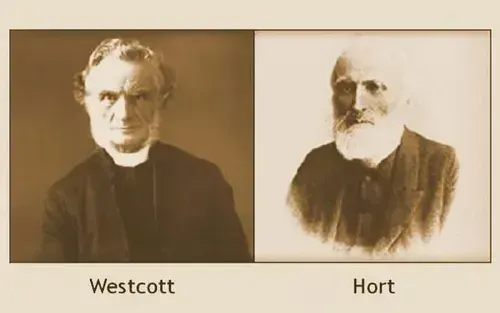
For the next few chapters in this series on Bible versions, I will be presenting much information about the lives and impact of two Englishmen: Bishop Brooke Foss Westcott and Dr. Fenton John Anthony Hort.
As I have mentioned in the previous chapters—and we can state without fear of contradiction—that these two men are among the very most important figures in the history of the (English) Bible. Their influence has been and continues to be that great.
You already know some things about them from our study of Bible manuscripts. But because of their enormous impact, it behooves us to examine them closely. We must not only peruse and scrutinize their theory of Bible textual criticism, but it is also vitally important to look beyond their scholarly methods to see just what types of persons these men were.
Who were their associates? What kind of organizations were they involved in? What religious doctrines did they espouse?
Before we actually begin studying the lives and work of Westcott and Hort, I want to head off one potential criticism at the pass.
Someone, a Westcott and Hort devotee, for example, might suggest that, “Well, one always has to resort to ad hominem arguments or ad hominem attacks when you cannot refute your opponent’s arguments.
Now, for those readers in Carthagena, Ohio, let me explain that term. Ad hominem is a Latin phrase which literally means “to” or “toward the man.” An ad hominem attack refers to when someone attacks a person’s character. You demean him. You put him in a bad light, often falsely.
For example, if an evolutionary scientist cannot refute the facts or logic of a creationist scientist, then the evolutionist might start calling the other man names, as in, “Well, he’s just a fanatical Bible thumper.”
Or he might characterize him by saying his brain power is such that he’s about three sandwiches short of a picnic. Or as we used to say in the construction business, that so-and-so is dumber than a sack of hammers.
Or someone making an ad hominem attack might claim that his opponent is a wife beater or some other such made up lies. We see ad hominem attacks happening throughout any and all political campaigns. The dishonesty of ad hominem attacks is the tactic that if you cannot refute the facts and the logic, you attack his personality or his character.
Now therefore, let me set the record straight here before we begin. First of all, we do not have to resort to ad hominem attacks. The merits, or shall we say the lack of merits, of Westcott and Hort’s theory and their subsequent Greek text falls of its own weight.
It crumbles to dust because the foundation for it is non-existent. It was a figment of their imagination, and we will demonstrate that in due time.
What we are going to tell you concerning their lives will only add further weight to our case against the work of Westcott and Hort.
We will further demonstrate that the aspects of their personal lives that we do relate to you are very relevant to the subject matter in this series.
If you recall political history from back in the presidential race of 1992, remember Bill Clinton’s supporters were very angry because details about Bill Clinton’s personal life were being somewhat exposed in the media. Remember the Monica Lewinsky scandal?
There was a “60 Minutes” or one of those TV news magazine-type shows where Bill and Hillary were there on set pretending to be all lovey-dovey. Borrowing a line from the old country song, Hillary was pretending to “stand by her man,” as she said something to the effect that…
“Oh, yes, we had some marital problems, but it’s all in the past, and, you know, all this stuff about Bill’s adultery and…” blah, blah, blah.
Well, the Clinton campaign advisors knew they had a huge challenge from the public relations perspective, the optics, as we say now. They had to face the facts that people were attacking Bill’s character.
But his campaign advisors were saying, “Oh, those are just ad hominem attacks. And that’s just not fair.”
The advisors tried to deflect the charges by saying that the character issue was not important. Remember that?
And of course, this is playing out once again on the political stage in various campaigns now in 2026. Need I mention the campaign of the manufactured candidate for U. S. Senate from Maine, Mr. Nazi tattoo, Graham Platner? Who just won the Democrat nomination this past week.
Or the equally weird candidate for Senate from Texas, the Democrat vegan and “pastor-in-training,” Mr. James Talarico, who also won his primary race.
Of course, anyone with an ounce of common sense knows very well that a man’s character is or should be a very significant criterion when he is being considered for political office.
One of the main reasons we are in the national mess that we are in today is precisely because so many politicians lack good character. And therefore, they are prey to any and all lobbyists or whoever that will buy them or blackmail them.
If I remember correctly from my classes at the School of Journalism at the Ohio State University, it was way back in the early 1700s in the celebrated case of John Peter Zenger that American jurisprudence gave recognition to the legal principle that truth is a defense against libel.
QUOTE: It is important to note that the Zenger case did not establish legal precedent in seditious libel or freedom of the press. Rather, it influenced how people thought about these subjects and led, many decades later, to the protections embodied in the Unites States Constitution, the Bill of Rights and the Sedition Act of 1798.
The Zenger case demonstrated the growing independence of the professional Bar and reinforced the role of the jury as a curb on executive power. As Gouverneur Morris said, the Zenger case was, “the germ of American freedom, the morning star of that liberty which subsequently revolutionized America!” END QUOTE Source.
In other words, you are not libeling someone if you are telling the truth about them.
The point is, we are going to be discussing some matters concerning Westcott and Hort, which their defenders, like Bill Clinton’s, may try to characterize as ad hominem attacks by myself. Such is not the case.
We are simply going to point out the truth about them, and then you can decide whether or not what we have revealed is pertinent to the subject of Which Bible, Which Version.
I expect that most readers will conclude that these facts are indeed exceedingly relevant and pertinent. As we reveal these facts about Westcott and Hort, we are going to use some of the most impeccable and unimpeachable sources possible.
Namely, their very own lips and pens. By their own mouths and pens, they will condemn themselves.
I have noted it before, that I have done an enormous amount of reading and research into this topic. Many of the books that I have read and studied discuss Westcott and Hort, and most of them are documented with footnotes.
I have not accepted the footnotes of secondary authors at face value, but I have been able to obtain, for my own library, original source materials.
These are called The Life and Letters of Fenton John Anthony Hort, published by his son Arthur in 1896. The two volumes comprise 978 pages of very often dry and boring, but occasionally very astounding information.
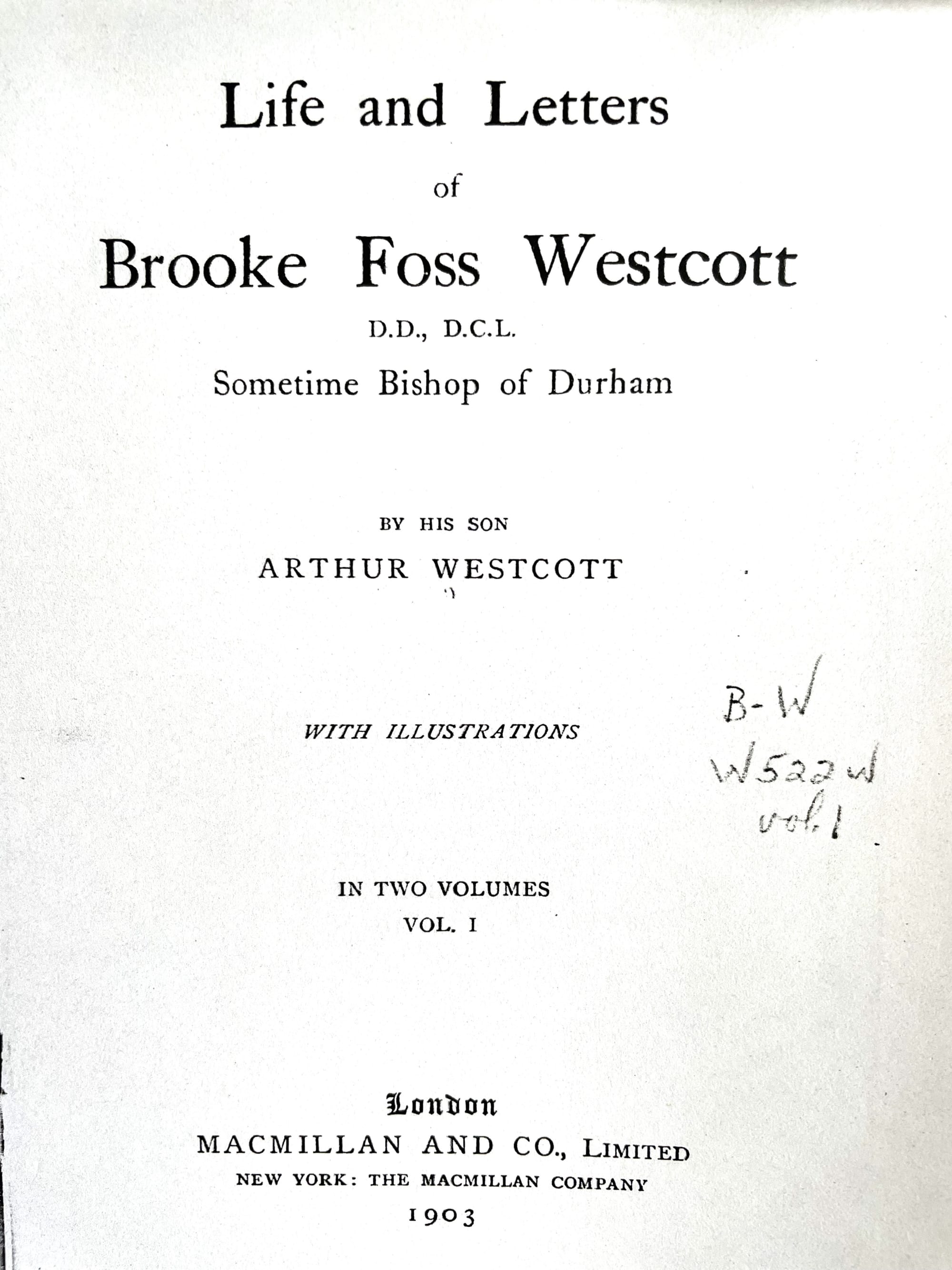
The second book is The Life and Letters of Brooke Foss Westcott, published in 1903 by his son Arthur (Yes, both sons were named Arthur). Similarly, its two volumes comprise 900 pages. So I will be quoting from those original sources.
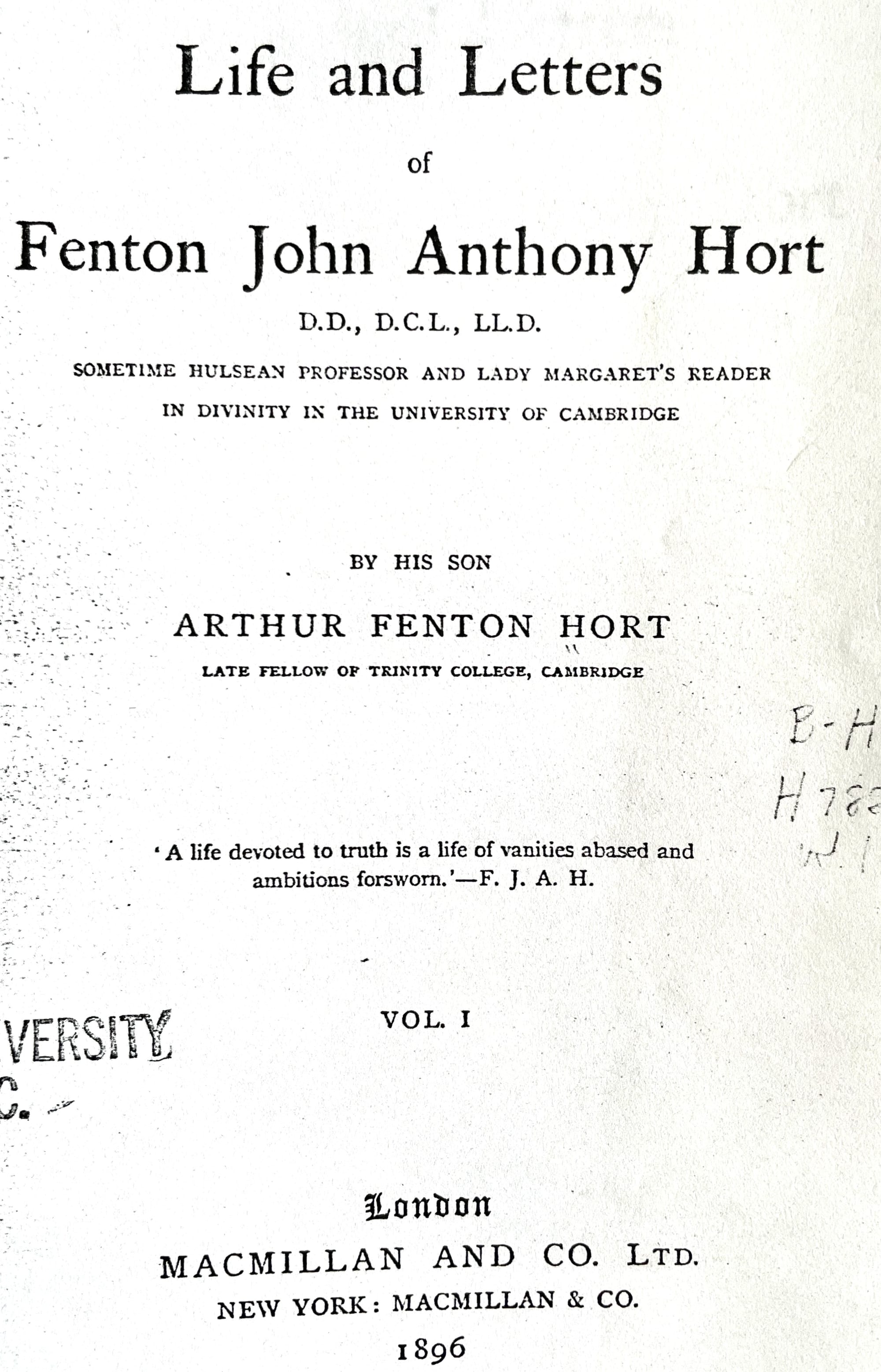
It has become evident to me that upon occasion that some of the books I have read have quoted them out of context, and so that is what I was checking on in the original sources, to make sure that what I am quoting is in context.
Moreover, in those couple of cases where I believe that they were not dealt with fairly, I have just ignored those points. I am not even going to bring them up.
But the ones that I do quote to you from these original sources, biographies, so to speak, with their life and letters written and compiled by their sons, I am using their own words.
And by the way, for convenience sake, when I refer to either of these books during the remainder of this series, I may simply abbreviate the title by referring to them simply as The Life of Westcott or The Life of Hort.
Let me begin with this significant revelation by Hort’s son, Arthur Fenton Hort, in his preface to The Life and Letters of Fenton John Anthony Hort. This is from pages Roman numeral 7 and 8, volume 1. As usual, in all my quotations from other sources, unless otherwise noted, all emphases and comments within [brackets] are mine. QUOTE:
The subject of this memoir was little known outside the world of scholars. In all that he wrote, his real self is shown, and nowhere more than in his letters. I should add, perhaps, that in his letters he was wont to express his opinions with considerable freedom.
He would unburden himself to a friend with a remarkable absence of the reserve which otherwise characterized his utterances. For this very reason it would not be right to give to the world without a caution, views which he never meant for publication. END QUOTE
In other words, what we find in his letters is the real Fenton John Anthony Hort.
In reading many books about the Bible texts and manuscripts, I find those who are of the Westcott and Hort camp are sometimes gleeful in their proclamations that Westcott and Hort “slew the Textus Receptus,” or that they “dealt the death blow to the Textus Receptus,” or some other such gloating.
Incidentally, Dr. Hort is usually given the greater prominence over Westcott. Somewhere early on in their combined work, Westcott got his name first, but it was primarily Hort’s theory and Hort’s work. Thus, if we seem to have more occasion to refer to Hort, that is the reason.
Well, frankly, I believe that the arrogant and phony scholars of the Westcott and Hort camp were a bit premature in declaring the death of the Textus Receptus.
Rather, what has happened is that the new versions of the Bibles that are coming out, which are based on the Westcott and Hort text, are appearing with greater and greater frequency.
It seems as though someone, or some-ones, would like to see the Textus Receptus, as represented by the King James Version, buried in an avalanche of other competing Bible versions. Unfortunately, they are beginning now to see some success with that strategy. Hence, the increasing importance of this work we have undertaken.
I also must stress that readers understand that what I am bringing forth here is not to defend the King James Version, per se, but rather the Textus Receptus upon which it is based.
Before this series is over, I will deal at length with what I believe are the shortcomings of various versions, including the King James Version, the Ferrar Fenton Version, the New American Standard, the New International Version, and a host of other versions.
So, please, do not put me in the category of, or label me as some kind of fanatic King James-only person. I am not. After all, some joke that the KJV is the version that Jesus and the Apostles used, so I guess it’s good enough for me.
No, I use the King James Version because I am convinced it is the best English translation available, not because I believe it is perfect and inspired in the English language.
And while I’m speaking in the realm of by-the-ways, let me also give you this one. I realize that many of our readers use versions other than the King James as your primary Bible.
Years ago, perhaps you or I had been told by a friend, or by a Sunday school teacher, or perhaps in Bible college, that such and such version is the best one.
And consequently, we find ourselves having used that version for perhaps many years without ever giving another thought to the subject.
I remember very well how when I first gave my life to Christ, and Roxanne and I began going to a fundamentalist, Bible-believing church back in Ohio, I recall asking around, and being advised that the best Bible to get is the New Scofield Reference Bible. And so guess what Bible I bought and used for many years?
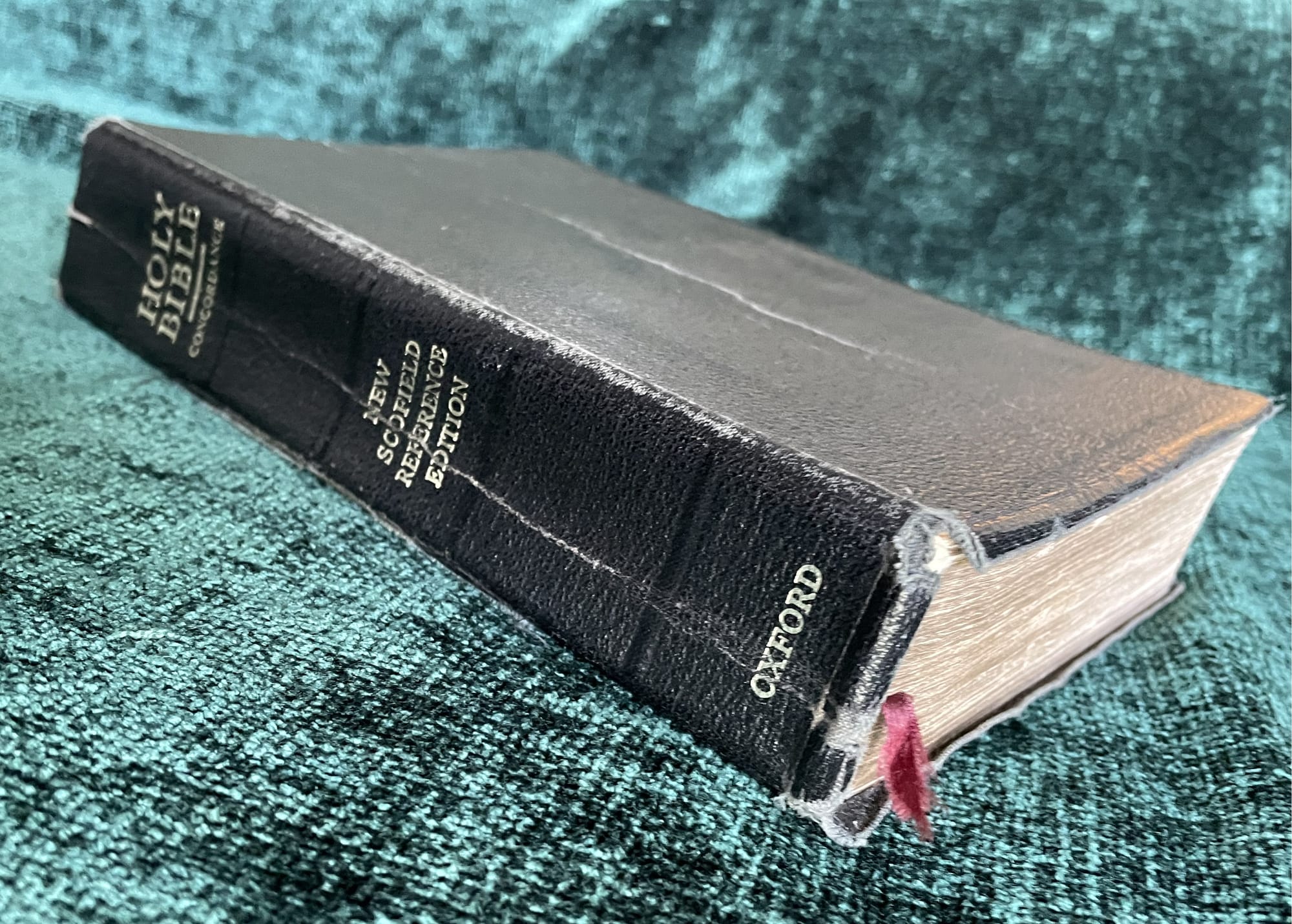
Although it is now in sad shape and the covers are kind of ragged, I still pull it out once in a while because I made thousands of marginal notes in my own handwriting there, mostly from learning from other ministers after we had left that fundamentalist church (which had lots of nice people) in Columbus, Ohio.
So the point is that if you currently are using any other Bible than the King James version, I’m not trying to offend you, I’m not trying to condemn you, I’m not trying to shame you or anything else. We have all been deceived in many ways, especially in religion and politics, don’t we know?
We all know that we have been deceived in various ways, but it is always difficult—because of that old devilish pride—to admit it, and then to make the necessary changes and adjustments to what we can now see as the truth.
So I am simply trying to present to you the results of my years of intense study into this matter. Then you can either be persuaded and make the changes necessary, or perhaps the super-Bereans among you will want to check out my sources and do your own study to satisfy yourself that my conclusions are correct.
I welcome that because I want you to let me know if I am in error. In the 30-plus years since this series has been available in audio format, I have not found any reasons to change my essential teaching on this matter.
I was, however, virulently attacked by a fellow minister (who has now passed away) shortly after the audio versions of this 20-lecture series came out. His rants were full of actual ad hominem attacks (e.g., that I was a “Jewish infiltrator,” a sheep stealer, a homosexual, and other lies).
I certainly have made errors in the past, and I am sure I will continue to fall short from time to time. But as I present all that work from my lectures decades ago, I have found nothing of major importance doctrinally, that I would change.
Anyone can still obtain and listen to the original lectures on audio to verify that. (Find Description and Order Form here.) But I am adding considerably more information as these lectures are being converted into print here on the internet.
Oh, one other thing, and I should have given this caveat back in the early parts of this series: Please do not use this material to blast another minister for his use of a Westcott and Hort-derived Bible.
I can assure you, that is not the way to get him to change. I mentioned to you at the outset of this series how I myself did not appreciate being blasted by someone years ago about my using a non-King James Bible.
That is not the way to get a minister or a fellow believer to change to what you perceive to be the truth. Every Bible preacher, evangelist, teacher has to be led of the Spirit to do things in his own time.
As a matter of fact, I am getting blasted right now about someone else’s pet view on certain matters, and why don’t I get with it and change my view?
Well, I will not change my view until I have studied out the matter with the Scriptures to my own satisfaction.
And that might take some time. I don’t know. But if it is not a topic that I deem of highest importance, like someone else does, well, how about a little Christian patience with me?
And maybe you might want to couple that with some prayer for this poor, ignorant, misguided teacher who just doesn’t get it yet.
When we continue, we shall briefly review the history and background of the Christian world, particularly in England in the 19th century.
(To be continued.)
~END~