


Which Bible, Which Version? Series
We are now in the middle of our series entitled Which Bible, Which Version? Yes, that means we have a long way to go in making our case. These essays are based upon a 20-lecture series originally presented to our Stone Kingdom Fellowship audiences in Tennessee and Georgia ca. 2004 ff.
Central to this entire subject are the lives and legacies of two Englishmen in the late 1800s named Bishop Brooke Foss Westcott and Dr. Fenton John Anthony Hort. I am demonstrating how they are among those about whom our Savior warned us would invade His church as wolves in sheep’s clothing.
In case there are some who have not had the benefit of the previous lectures in this series, I will state once again that in this series there are a number of terms which refer to the Greek text which underlies the King James Version, the Old Geneva Bible, the New King James, and quite a number of more recent ones. See the addendum below.
Although there are some slight technical differences in these names, we are trying to avoid unnecessary technicalities in these messages, and so we are simply going to treat all of these terms synonymously.
These terms include the Textus Receptus, which is simply Latin for Received Text. Therefore, when you hear me saying or writing Textus Receptus, or Received Text, or you will know that if I call it by that or any other of these names I am going to give you, that I am referring to that Greek text which underlies the King James New Testament and the rest listed in the addendum
Some of those other names which are synonymous for purposes of our lectures are the Majority Text, the Byzantine Text, the Common Text, and it is occasionally been referred to, at least by Westcott and Hort, as the Antiochian Text, or the Syrian text. Hort liked to call it the Syrian text.
Hort understood the value of names and labels. For example, he called the Roman Catholics’ Vaticanus manuscript the Neutral Text. But it was anything but neutral.
Likewise, nowadays, when we in the West hear the term Syrian, or even Byzantine, perhaps we feel a little bit uncomfortable with that, because when we think of Byzantine, we think of the Byzantine Empire, and most of our roots are primarily from Northern and Western Europe.
But if we feel a little bit alien to the Byzantine Empire, I ask you not to let that confuse or dissuade you, because we need to look beyond that.
In scholarly circles, what is meant by those terms—the Byzantine or the Syrian, the Received Text—is the Greek text which was preserved. I believe it was preserved by divine providence in the Greek-speaking East, in the Byzantine Empire, while our ancestors were suffering in Western Europe under the Dark Ages of the Roman Catholic Church’s domination.
But when the light of the Renaissance and the Reformation dawned, those Greek texts came westward into the hands of the reformers, into the hands of Erasmus and Luther among many other scholars.
By the way, did you know that Desiderius Erasmus and Martin Luther were practically next-door neighbors. Now, of course, we all know Luther was a German. But Erasmus was from Rotterdam in the Netherlands, but he did live for a while in Wittenberg, Germany. Wittenberg is about 56 miles southwest of Berlin.
And there, the homes of Erasmus and Luther were only about 200 yards from each other. A friend of mine came back from a trip to Germany where he visited Erasmus’ and Luther’s houses, and he said, “It’s just a short walk.”
In any case, these two men worked very closely together, debating and hammering out the biblical truths that God was revealing at that time.
Evidently, Erasmus’ personality was more suited to be a behind-the-scenes type of scholar, while Martin Luther was gifted with being the bold and outspoken proclaimer and point-man of these truths.
In the previous several installments, we quoted to you from the pens, from the very mouths, as it were, of Westcott and Hort. We showed you what their views were on various foundational Christian doctrines.
Allow me to refresh our memory concerning Hort’s attitude towards the Received Text, the Byzantine text.
Hort was 23 years old and a graduate student at Cambridge when he wrote, QUOTE:
I had no idea till the last few weeks of the importance of texts, having read so little Greek Testament, and dragged on with the villainous Textus Receptus. Think of that vile Textus Receptus, leaning entirely on late manuscripts. It is a blessing there are such early ones. END QUOTE
Furthermore, recall that Hort and Westcott did not change their views on the major issues throughout their entire lives.
In fact, Hort’s misconception concerning the relative lateness of manuscripts, led to his lifelong obsession to do away with the Textus Receptus as the text which would underlie most English Bibles.
Well, what text would he substitute for the Majority Text then? It was only one year later when he and Westcott agreed that they themselves would collate a new Greek text.
Hort wrote that he estimated that they could have that project done in about a year. The fact that it took him 18 years or more to put together their Greek New Testament text does not detract from the fact that Hort had a preconceived antagonism towards the Textus Receptus, the Received Text, apparently caused by his misunderstanding that the Textus Receptus was based on late manuscripts.
Let me add this: if you should ever decide to do some extensive research into this whole area of Biblical texts, you will find even today that many writers and alleged scholars in the Westcott and Hort camp will flatly state, without any proof, they just flatly state this same false notion that the Majority Text is based entirely upon late manuscripts.
I have come across this in any number of books while I have been researching this. But yet, there are equally educated men who demonstrate—they do not flatly state—they demonstrate, they prove in their works that the readings in the Greek Textus Receptus have the very earliest documentation and attestation.
We will get to that later. But anyhow, Hort set out to replace the Textus Receptus. I gave my own personal conjecture as to his motives in the past few installments. Based on the known facts, I concluded that his primary objective was to see the end of Protestantism by reunion with Rome.
Thus, Hort and Westcott’s text (and all writers agree that it was primarily Hort that did the work on it), Hort’s text was constructed primarily from the Vaticanus manuscript, with secondary help from Tischendorf’s Sinaiticus manuscript.
We have noted previously that there were a vast number of differences, significant differences, between the Textus Receptus on the one hand, and the Vaticanus-Sinaiticus combination of texts on the other hand.
I shall give you some examples of those differences before we are through with this series.
Now, since Westcott and Hort could not simply just pop up with a new Greek text which was so radically different from the Byzantine text, without some valid reasons behind it, they realized that they had to do several things.
Number one, they had to come up with reasons why the Common Text, the Received Text, underlying the King James Version, why that text was defective.
And then, number two, they would have to provide sound reasons why their new Greek text was superior.
I surmise that is the reason that it took 18 or more years to come up with their new Greek text. You see, the job of interspersing some verses from the Sinaiticus with the Vaticanus was not an 18-year job.
Rather, it was having some “scholarly” theory to give it support that took so long. So let us now commence to examine this theory of Westcott and Hort.
It should go without saying that if the Westcott and Hort theory can be shown to be defective in critical areas, then it follows that the Greek text, which rests upon that theory, has no validity either.
And if the Greek text of Westcott and Hort has no validity, then it follows that all those Bible versions which have the Westcott and Hort text as their basis— and remember that includes almost all English language versions except the Old Geneva, the King James, and to an extent the New King James, and a handful of more recent ones (listed in the addendum)—that all these other Bibles would also be fraught with serious errors.
And that, we intend to demonstrate. So the first step is to spell out for you just what the Westcott-Hort textual theory is. I begin by giving you just a brief summary of the major points of the Westcott-Hort theory.
Then we will go back and discuss each of them in some detail, including some discussion of the fallacies of each and every major point, which thoroughly debunks and destroys the entire Westcott-Hort theory.
Now let me make clear that I myself in this series will not be walking you through step-by-step proofs of the fallacy. That is beyond the purpose and scope of this series, and frankly it is far too technical for a general audience.
I am not saying it cannot be done, but one must have done considerable study in this area and follow the technical details involved in the proof. I do not claim to be a great scholar, but I have done much research in this area (hundreds, if not thousands of hours over several years), and I feel fairly comfortable with understanding the technical details of it now.
For anyone who might wish to pursue the actual technical proofs, I can point you to the right books. But for these lectures, we will only be going just a few layers below the surface, as it were, not going into the total depths of these matters.
So let me now point you to a couple of those works in which you can pursue the technical details. One is called The Identity of the New Testament Text by Wilbur Pickering.
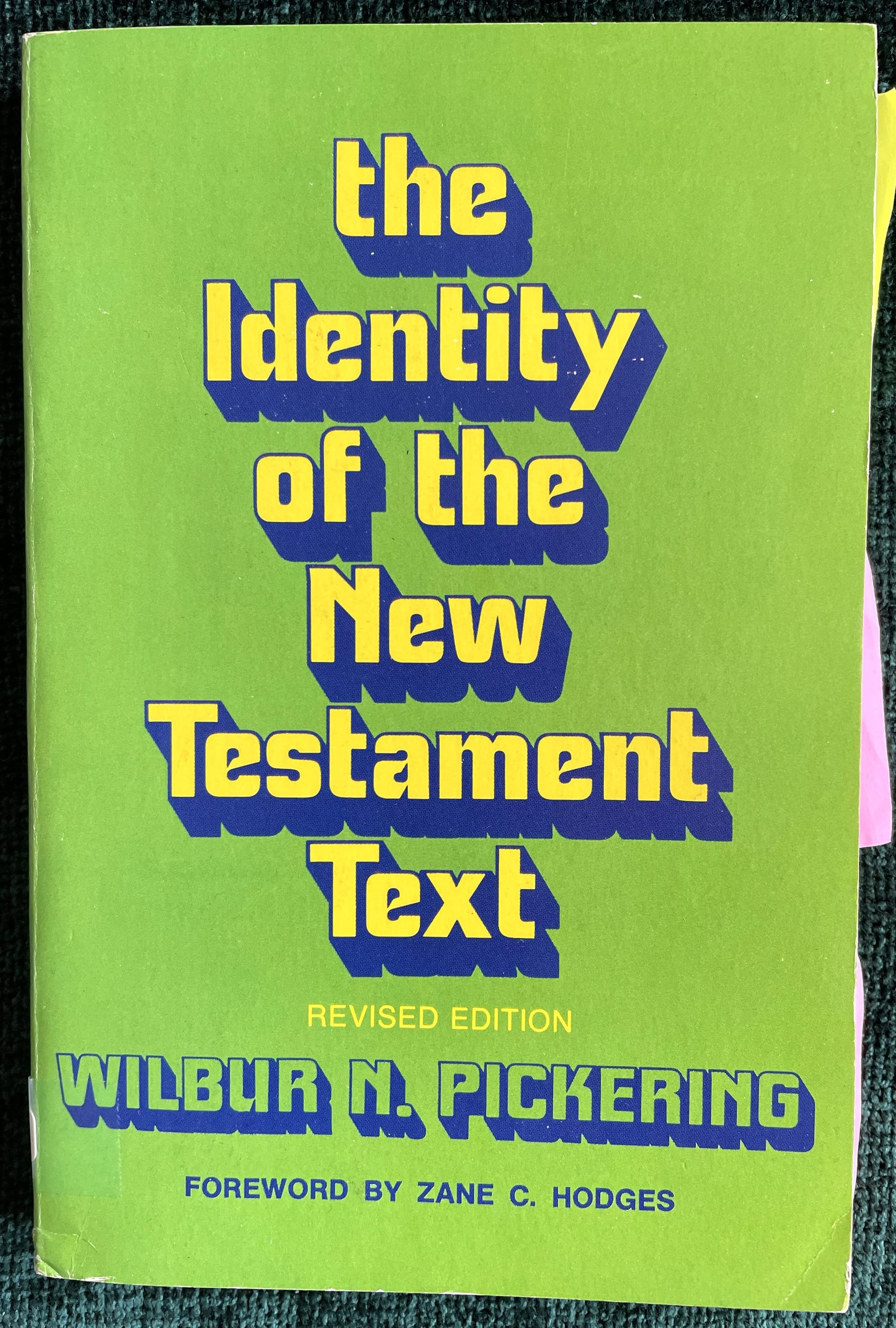
We will be using some material from this book in our discussion shortly, but he has several appendices where he goes into deep technical detail.
Also, two other books are very worthy of note here. They are both by Dean John William Burgon. Dean Burgon was a contemporary of Westcott and Hort and a vigorous opponent of their attempts to destroy the validity of the Textus Receptus.
These two books are entitled: The Traditional Text of the Holy Gospels Vindicated and Established and The Revision Revised.
During my research for this series I went down to Atlanta and spent a day at the Emory University’s Theological Library. There I found Herman Hoskier’s two-volume work called Codex B (remember, that is the technical name for the Vaticanus, the Catholic’s manuscript) Codex B and its Allies.
It is a very famous work in the field of textual criticism. But be aware that it contains a great deal of Greek in it.
Hoskier compares the Vaticanus and Sinaiticus and their allies with each other, and against the Textus Receptus to show readers the great number of errors and divergencies. That is an extremely technical book.
Now, let us proceed with our examination of the vaunted theory of Westcott and Hort.
(To be continued.)
ADDENDUM
The following versions generally aim to provide updated language or formatting while maintaining the Greek New Testament source text used for the original King James Version. Recent English Bible translations based on the Textus Receptus include in no particular order:
- Modern English Version (2014)
- Literal Standard Version (2020)
- King James Version 2023 Edition
- Third Millennium Bible (1998)
- American King James Version (1999)
- Updated King James Version (2004)
- New Cambridge Paragraph Bible (2005)
- Green’s Literal Translation (1985)
- New King James Version (1982)
- Modern King James Version (1990)
- Simplified KJV (2022)
- A Voice In The Wilderness Holy Scriptures (2003)
NOTE: While I have some of these in my library, I have not personally examined all of these versions. This addendum is based on my web search conducted today.
~END~