
Which Bible, Which Version? series
Note to readers: All emphases in my quotations of others and comments within [brackets] are mine unless otherwise noted.
The first major premise of the Westcott-Hort theory is that the New Testament is to be treated like any other book.
This would allow Hort to go on to the second basic tenet of his theory, which was to supposedly prove that the Majority text, the Byzantine text, was inferior because it was based on late manuscripts, he thought.
This then having been done, Hort would then posit the third basic tenet of his theory, which was that because of their great age, the Vaticanus and Sinaiticus manuscripts are to be the primary basis for the New Testament Greek text.
There are a lot of sub-premises in each of those major premises or tenets of the theory.
Some scholars will say there are two basic premises, and some will say there are three basic premises, and some will give four, some will give six. This is the way I summarize it today.
As far as I know, Hort himself did not ever spell them out, as though he said, “Here’s one, two, three, four.”
He simply presented his work to the Bible Revision Committee which stood from 1871 to 1881, as a fait accompli. He pulled a fast one and then laid down conditions to the Committee.
He presented his work to them secretly. He told them they could not tell anybody. They had to keep silent about it, and then later on, Hort presented his theory to the world.
Basically what he was saying was, “Well, here it is. This proves it. The Traditional Text is no good. Our text is superior.”
“Now it may not”— he’s trying to be humble now— “It may not be perfect, but it’s the best that scholars can do today, so take it and run with it.”
And so, many scholars did accept it, being intimidated by the supposed brilliance of the great Dr. Fenton John Anthony Hort. Hort was no dummy, no doubt about that, he was a brilliant man. Brilliantly evil, in my studied opinion.
And thus, the Hort tag-along scholars and Bible publishers have been running with Westcott and Hort’s theory and text ever since. They have been running right into the pit of apostasy.
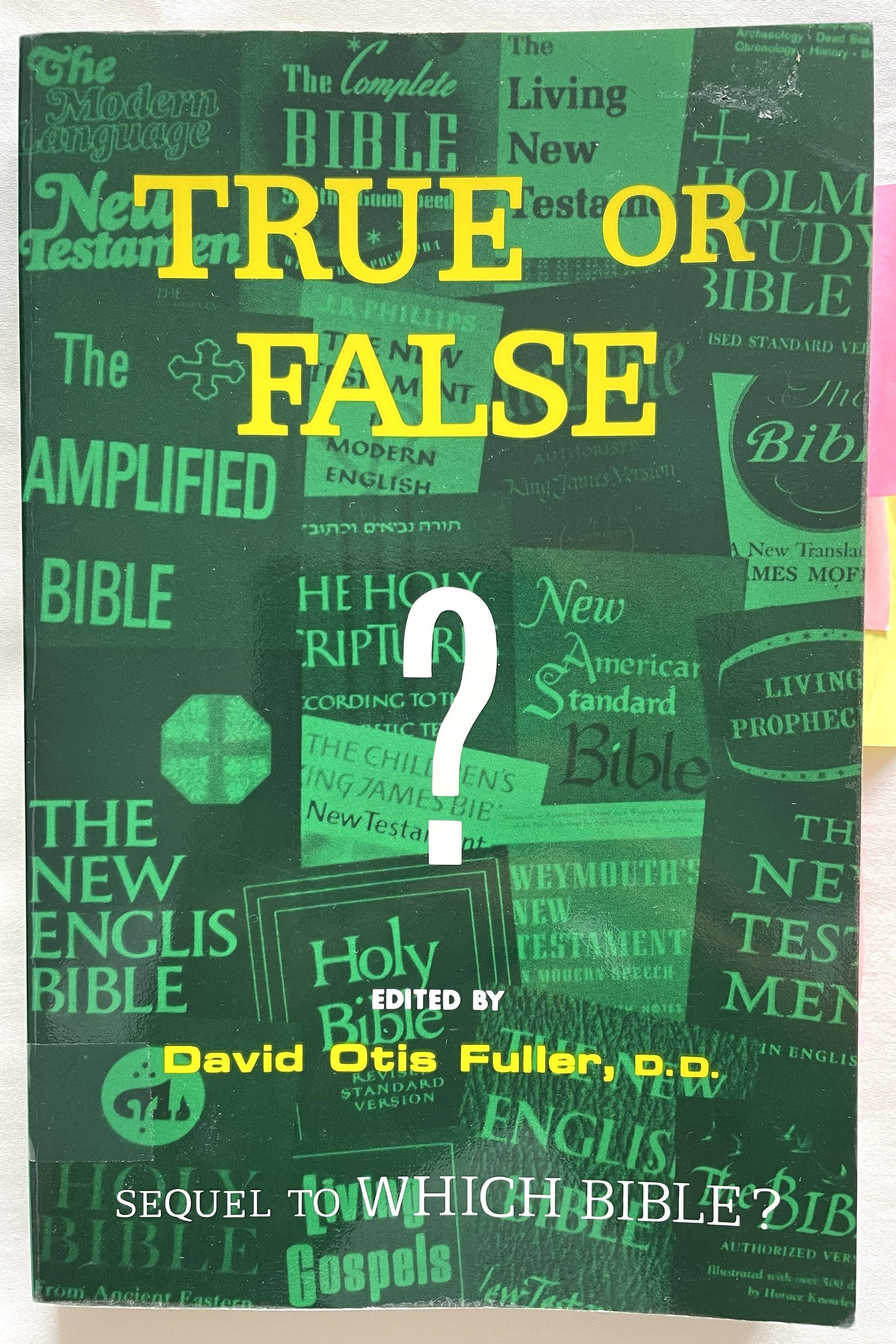
Along these lines, here is the way Dr. Alfred Martin put it in 1951 in his doctoral thesis called “A Critical Examination of the Westcott-Hort Textual Theory.”
I am quoting this from Dr. David Otis Fuller’s book, which he edited and called it: True or False, pages 145 and 151.
QUOTE: Most work in textual criticism today has at least a Hortian foundation. An amusing and amazing spectacle presents itself.
Many of the textbooks, books of Bible interpretation, and innumerable secondary works go on repeating the Westcott-Hort dicta, although the foundations have been seriously shaken, even in the opinion of former Hortians and those who would logically be expected to be Hortians…
The present generation of Bible students, having been reared on Westcott and Hort, have for the most part accepted the theory without independent or critical examination.
To the average student of the Greek New Testament today, it is unthinkable to question the theory, at least in its basic premises.
Even to imply that one believes the Textus Receptus to be nearer the original text than the Westcott-Hort text is, lays one open to the suspicion of gross ignorance or unmitigated bigotry.
That is why this controversy needs to be aired again among Bible-believing Christians. There is little hope of convincing those who are unbelieving textual critics.
But if believing Bible students had the evidence of both sides put before them, instead of one side only, there would not be so much blind following of Westcott and Hort. END QUOTE
So, the first premise of the Westcott-Hort theory is that the New Testament is to be treated like any other book. In other words, they would allow no special considerations to be made concerning its claims of inspiration or divine preservation.
Why then did Hort need to lay down this premise? The answer is, so that he could bring over to Bible textual criticism the “family tree method,” the genealogy method that students of the ancient classics had developed.
In other words, as the people studying Aristotle and the texts of Plato, etc., did, so Hort wanted to bring those same family tree methods over into the study of the New Testament. The question then arises, why did he need to do that?
Why did he need to employ the genealogy methods on the New Testament manuscripts? Very simple. In order to be able to destroy the credibility of the Traditional Text, that is, the Textus Receptus.
You remember from our previous lectures that there are extant, there are available in the world today, about 5,000 or more New Testament manuscripts. About 90 to 95 percent of them are in substantial agreement with one another.
That is what the Majority Text is. And these back up the Textus Receptus.
And so now, if Hort could show that almost all of them, the 90 to 95 percent that are in substantial agreement, if he could show that almost all of them could be traced back to one common ancestor, then the Majority Text would no longer be the majority. Do you follow that? Let me state it another way.
Hort needed to use the family tree method in dealing with New Testament manuscripts so that he could trace the majority of the 5,000 or so manuscripts, and I am including the cursives, the uncials, the papyri, etc., all of that, so that he could trace those which support the Textus Receptus back to one, you might say, master text, or one official version of the Greek text.
He theorized that most of the Majority manuscripts were traceable to this one official version, which he theorized was made around 350 A.D. Therefore, all of the 90 to 95 percent of extant manuscripts that agree with and support the Textus Receptus would then only count as one manuscript.
So, you see, then Hort would have evened up the sides, so to speak.
There would be one ancient manuscript to support the Textus Receptus versus the one Vaticanus along with the Sinaiticus. Then, since he said that the Vaticanus and the Sinaiticus were older, they were therefore the more reliable, he said.
But we are getting ahead of ourselves for the moment, so let us see if this first premise of Hort is defensible and true. It is now clear that the genealogy process is crucial to Hort’s theory.
It enabled him to reduce the great mass of manuscripts to what he said were four basic textual families, which he called the Neutral, the Alexandrian, the Western, and the Syrian. There’s that word again, Syrian, as though it is derogatory. It means the Textus Receptus.
If you remember back a few chapters ago, I referred to the textual families for convenience sake in trying to introduce you to the subject of manuscripts. But do you remember how I cautioned you not to get hung up on the idea of textual families?
The reason is simple. It’s a false method; it doesn’t work. We can use it for convenience sake, but it simply doesn’t work. Hort never proved it! We will get to that.
Now, in order to employ the family tree method, Hort presupposed that there was no malicious tampering with the text in the early centuries of the church. He had to presuppose that because if there were malicious tampering, it would make the genealogy method totally useless.
In other words, there would be no way to devise reliable rules of examining internal evidence of manuscripts if there were some unpredictable variable, some wild card, so to speak, introduced into the New Testament texts.
It would put the recovery of the original official text, if there were one, of 350 A.D., beyond the reach of this process of the genealogy or the family tree method.
So he had to assume, presuppose, that there was no malicious tampering with the early church or in the early church in the Bible manuscripts back then.
But we have already noted in a previous chapter that there was, in fact, malicious tampering with the New Testament texts.
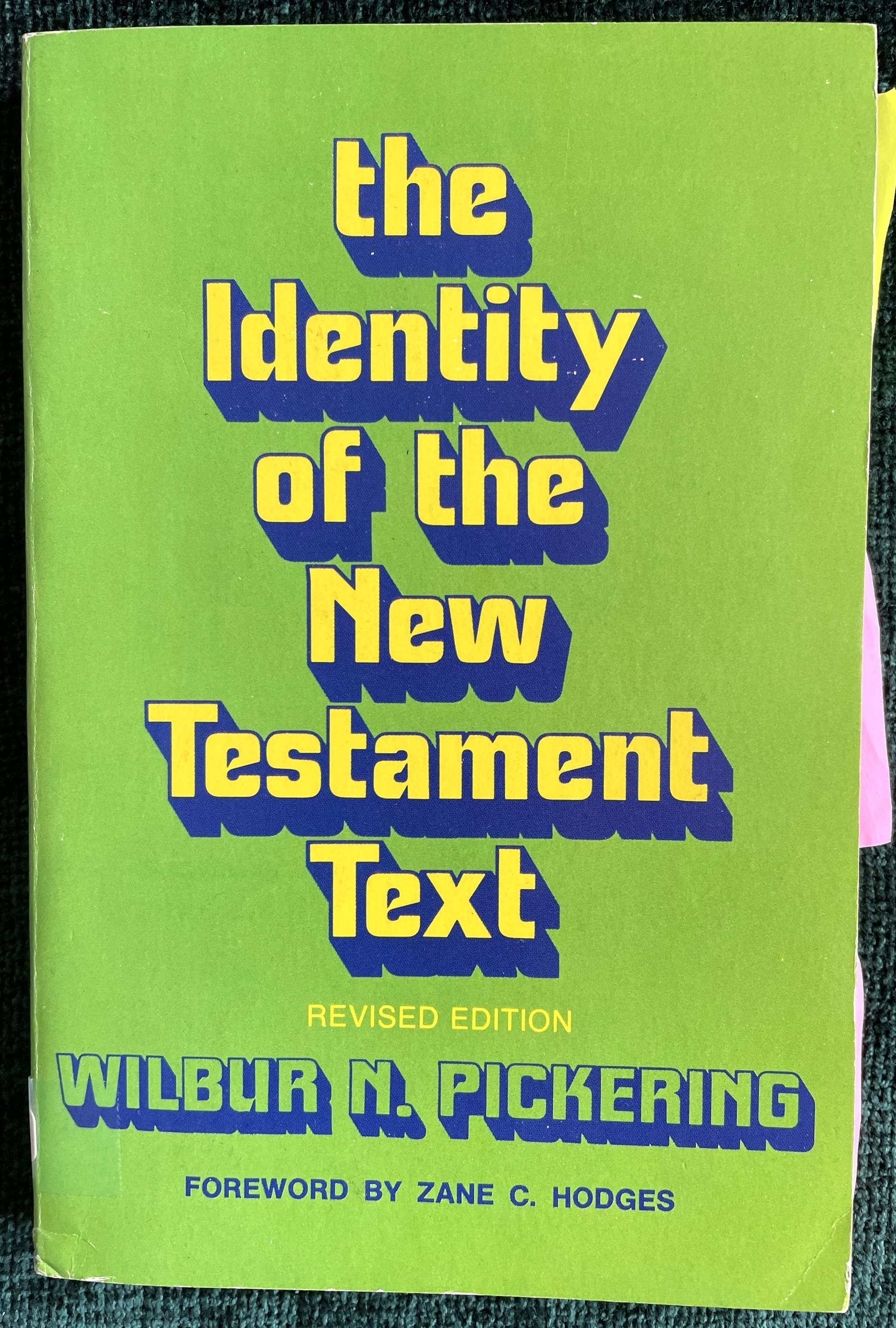
Let me read several more quotes, this time from Wilbur Pickering’s book, The Identity of the New Testament Text. Page 41. QUOTE:
Hort said that, “there are no signs of deliberate falsification of the text for dogmatic purposes.” But the early church fathers disagreed.
[Bruce] Metzger states, “Ireneus, Clement of Alexandria, Tertullian, Eusebius, and many other church fathers accused the heretics of corrupting the scriptures in order to have support for their special views.
“In the mid-second century, Marcion expunged his copies of the gospel according to Luke of all references to the Jewish background of Jesus.
“Tatian’s Harmony of the Gospels contains several textual alterations which lent support to ascetic or Encratite views.
“Gaius, an Orthodox father who wrote between AD 175 and 200, names Asclepiades, Theodotus, Hermophilus, and Apollonides as heretics who prepared corrupted copies of scriptures, and who had disciples who multiplied copies of their fabrications.” [End quote from Bruce Metzger.]
Surely Hort knew the words of Origen.
[Pickering quoting Origen:] “Nowadays,” [which was about 150-200 AD, the time of Origen,] “Nowadays, as is evident, there is a great diversity between the various manuscripts, either through the negligence of certain copyists, or the perverse audacity shown by some in correcting the texts, or through the fault of those who, playing the part of correctors, lengthen or shorten it as they please.” [End of quote of Origen. Pickering continues] Even the Orthodox were capable of changing a reading for dogmatic reasons.
Epiphanius states that the Orthodox deleted the words, “He wept,” from Luke 19:41. They deleted that out of jealousy for the Lord’s divinity.
Subsequent scholarship has tended to recognize Hort’s mistake. Colwell has done an instructive about-face. [Now Pickering quotes Colwell.]
“The majority of the variant readings in the New Testament were created for theological or dogmatic reasons.
“Most of the manuals and handbooks now in print (including mine!) [says Colwell] will tell you that these variations were the fruit of careless treatment, which was possible because the books of the New Testament had not yet attained a strong position as the “Bible.”
“The reverse is the case. It was because they were the religious treasure of the Church that they were changed. The New Testament copies differ widely in nature of errors from copies of the classics.
The percentage of variations due to error in copies of the classics is large.
In the manuscripts of the New Testament, most variations, I believe, were made deliberately.” Ending of Pickering quoting Colwell.]
Matthew Black states flatly, “The difference between sacred writings in constant popular and ecclesiastical use and the work of a classical author has never been sufficiently emphasized in the textual criticism of the New Testament.
“Principles valid for the textual restoration of Plato or Aristotle cannot be applied to sacred texts such as the Gospels or the Pauline Epistles.
“We cannot assume that it is possible by a sifting of scribal errors to arrive at the prototype or autographed text of the biblical writer.” End of quoting Matthew Black.
It is important to note that two of the men quoted, Metzger and Colwell, are Hort followers.
The late Ernest Cadman Colwell was one of the recognized leading textual critics during the 1950s and 60s. Notice I say “recognized.”
You see, in the field of textual criticism, you are not a recognized scholar unless you automatically bow to the idol of Westcott and Hort. Well, Colwell did bow, he was a Hort follower.
But he also flatly contradicted Westcott and Hort in a number of key points. One was that he emphatically stated that the family tree method could not be applied to the New Testament.
Metzger is Dr. Bruce Metzger of Princeton University, and he was the senior recognized scholar in North America. He is one of those men who have taken the Westcott-Hort Greek text and revised it again and again and again. More on this next time.
(To be continued.)
~END~