


Which Bible, Which Version? series
Note to readers: We are necessarily picking up the thread in the middle of a study and so we recommend readers to read the previous section(s) for context. As always, all emphases and comments within [brackets] is mine unless otherwise noted.
Continuing from Section 2: It is this Greek text, Metzger’s warmed-over Westcott and Hort text, which is the basis for many modern Bibles. In reference to these latter incarnations of the Westcott-Hort text, I like to refer to it as the Westcott-Hort, Eberhard Nestle, Bruce Metzger, Kurt Aland, mongrel Greek text.
That is the same Bruce Metzger who admits that there was much malicious tampering with the text by early heretics. Since that is a fact, then the family tree method as applied to New Testament textual criticism holds no weight whatsoever!
Not only that, but here is a little more about Bruce Metzger. This Bruce Metzger is the one who gave us the Reader’s Digest Condensed Bible.
It used to be a joke. People would say, that one of these days they’ll come out with a Reader’s Digest Condensed Bible.
We all laughed about it decades ago. But they did it, didn’t they? And Bruce Metzger is the Editor. Here is the link.
Does that tell you anything about Bruce Metzger?
And I have also mentioned the German “scholar,” Kurt Aland. (See Extra Credit below.)
He is a man who was among the most highly-recognized scholars in Hortian circles in the 20th century. He collaborated with Metzger and others on the modern version of the Westcott-Hort text.
Significantly, he also flatly stated that this genealogical method “cannot be applied to the New Testament.”
So isn’t it telling that all of these so-called scholars are Hort followers, but they recognize that the family tree method Hort leaned on is bogus, yet they still follow him! What happened to intellectual honesty?!
Now going back to Ernest Colwell… Almost incredibly, Colwell, after knowing the bankruptcy of the Westcott-Hort theory, still went on to write “Westcott and Hort’s genealogical method slew the Textus Receptus.”
Now, why would a man say such a thing as that, and then go on to follow the Westcott-Hort path the rest of his life? He knew it was wrong.
We can only speculate about that, but I suspect it had something to do with pride and covetousness. You see, Colwell was first a professor at, and then he became president of, the University of Chicago.
For those readers who know something about the Rockefellers, you will know that the University of Chicago is essentially a Rockefeller asset.
Not only in terms of money, but more importantly, in terms of what money can buy. Namely, in the case of universities, to control the agenda of public discourse.
And more than that, to determine what is “acceptable” scholarship and what is not acceptable scholarship. This, of course, goes on to influence public policy.
And critically important, when we are talking about New Testament textual criticism, it goes on to influence Bibles, doesn’t it?
Thus it has a great influence on the course of our nation. Because the type of government we have is determined by our culture and our culture is shaped by the religious principles practiced by the nation’s citizens. To put it another way, politics (government) is downstream from culture and culture is downstream from religion.
Will we be a Bible-believing nation which has liberty in Jesus Christ? Or will we be led by, “recognized scholars” who take us down the primrose path to slavery because we have rejected Christ by rejecting His Word?
So in the case of Ernest Colwell, I am sure he recognized that if he were to totally repudiate the bogus theory of Westcott and Hort, he might find himself unemployed. Not to mention losing his status in the eyes of men as one of the great, recognized scholars of our day.
Do you think that is a reasonable hypothesis of why he would do that? Colwell comes out and says, on the one hand that you cannot use this genealogical process, as Hort was attempting to do, and yet Colwell remained a Hort follower all his days. Amazing!
But that is not all. There is one more “little detail” about this genealogy method which I have yet to introduce as evidence against Westcott and Hort. That little piece of evidence is this:
Westcott and Hort never traced any manuscripts to prove anything. I am not jesting. All that Hort did was to write about how the process would work. But shockingly (or not), he never did it!
In fact, in all the hundred-plus years since Westcott and Hort, all of Westcott and Hort’s followers and critics alike have so far been able to isolate only one parent-child relationship in all of the 5,000-plus manuscripts. And Hort’s defenders have tried desperately to do so.
Even Rockefeller flunky Colwell said this: This is quoted from The Identity of the New Testament Text, page 44 and 45:
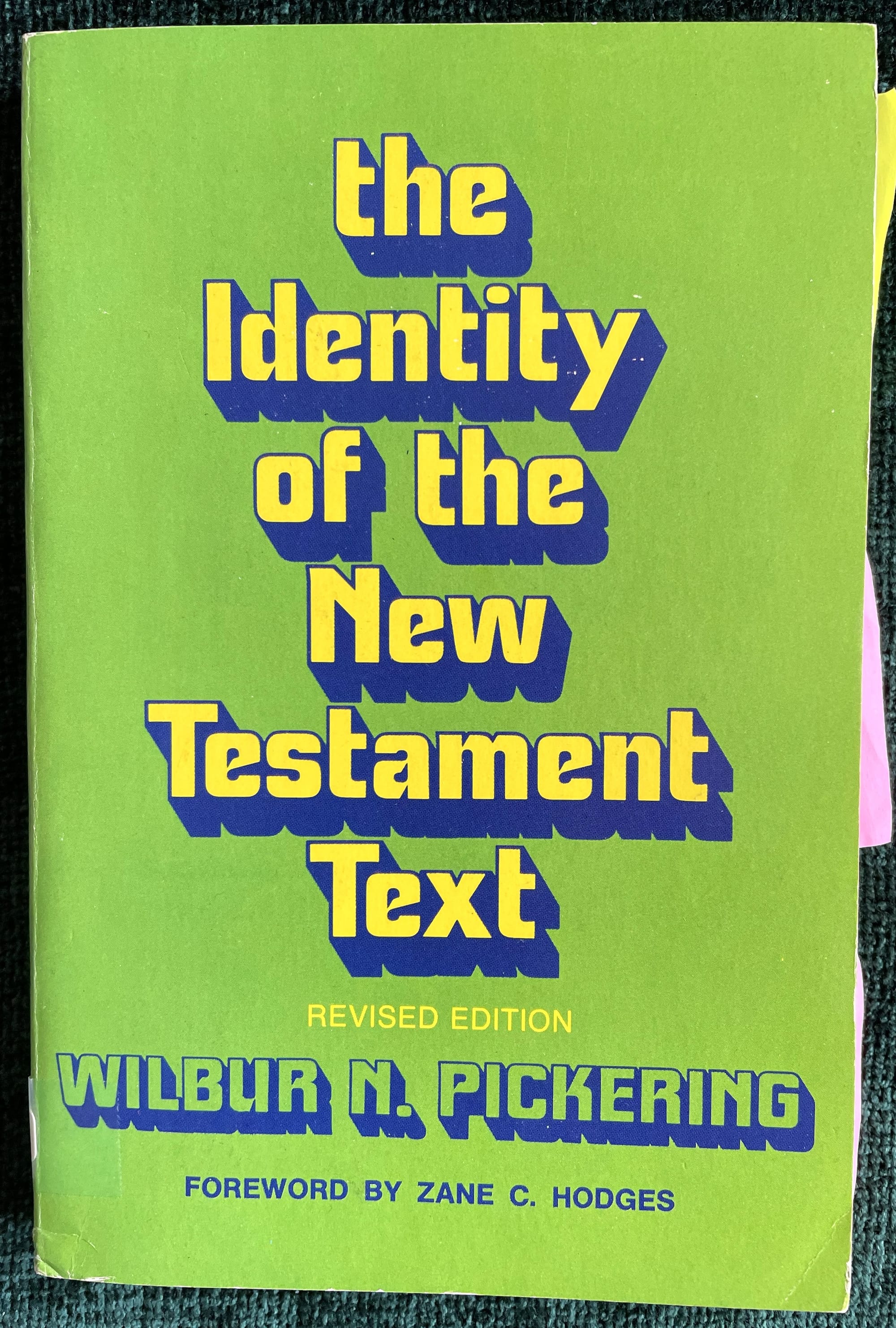
QUOTE: Thus, that Westcott and Hort did not apply this method to the manuscripts of the New Testament is obvious. Where are the charts which start with the majority of late manuscripts and climb back through diminishing generations of ancestors to the neutral and western texts?
The answer is that they are nowhere. Look again at the first diagram.
[Pickering is talking here about Hort’s own manuscript genealogy charts. Pickering has them in front of him and he says:]
Look at them. Look at that first diagram and you will see that what is labeled A, B, and C are not actual manuscripts of the New Testament, but hypothetical manuscripts.
The demonstrations or illustrations of the genealogical method as applied to New Testament manuscripts by the followers of Hort likewise use hypothetical manuscripts, not actual codices.
Note, for example, the diagrams and discussions in Sir Frederick Kenyon’s most popular work on textual criticism, including the most recent edition. All of the manuscripts referred to are imaginary manuscripts. The later of these charts was printed sixty years after Hort. END QUOTE
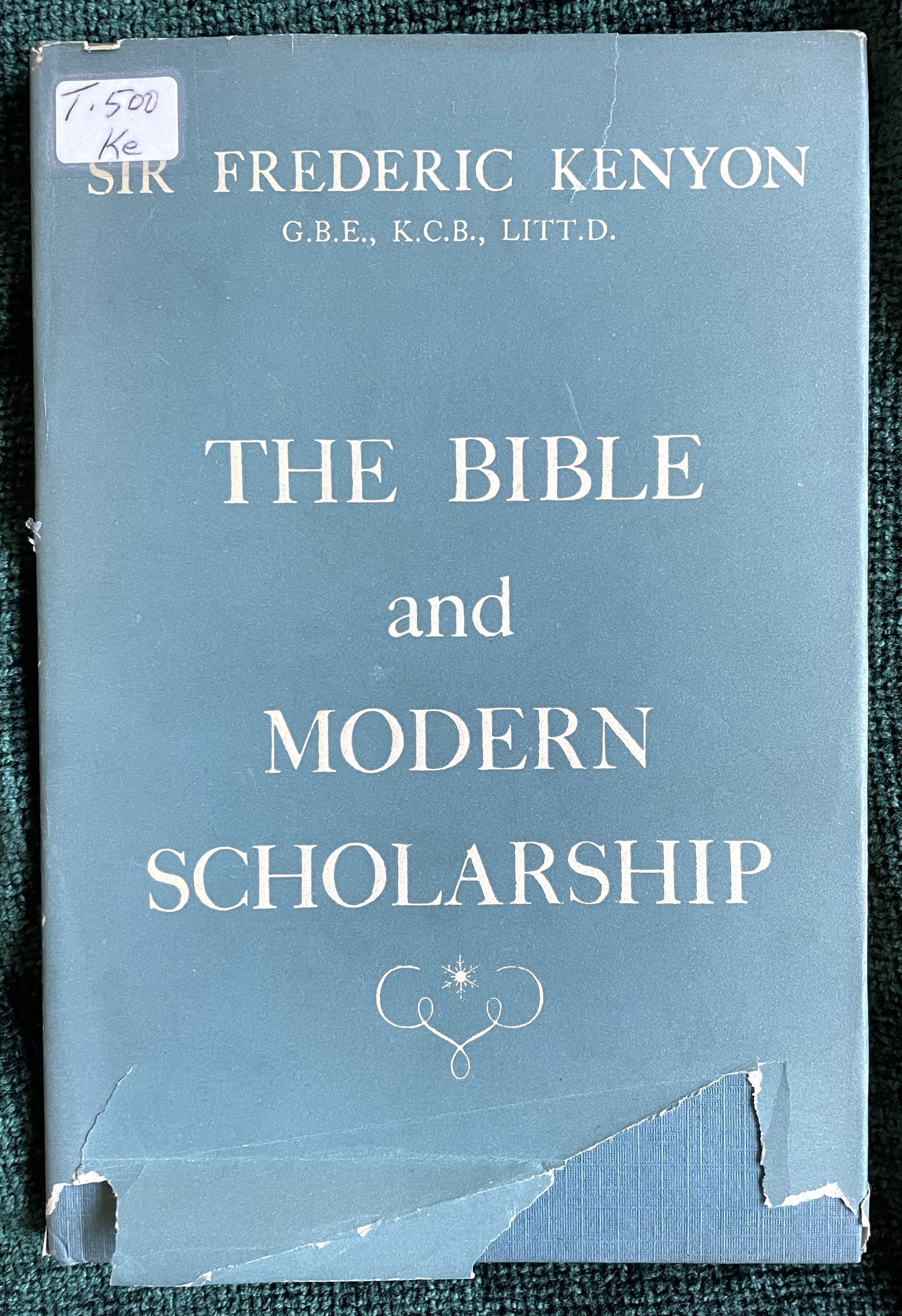
So Hort did not prove a single thing with the genealogy method. Wilbur Pickering then comments in The Identity of the New Testament Text, page 47:
QUOTE: Actually, Hort produced no demonstration at all, just assumptions. Since the genealogical method has not been applied to the manuscripts of the New Testament, it may not be used as an integral part of the theory of New Testament textual criticism.
If it was Hort’s genealogical method that slew the Textus Receptus, then the Textus Receptus must still be alive and well. The weapon was never used. But Hort claimed to have used it.
And the weapon was so fearsome, and he spoke of the ‘results’ with such confidence that he won the day. END QUOTE
You know, there’s a word for that in Yiddish. It’s called chutzpah, right?
Now, Pickering quotes Colwell. QUOTE: Since Westcott and Hort, the genealogical method has been the canonical method of restoring the original text of the books of the New Testament, it dominates the handbooks.
Sir Frederick Kenyon, C.R. Gregory, Alexander Souter, and A.T. Robertson are a few of the many who declare its excellence. [End of quote from Colwell.]
The situation is essentially the same today, and the warning Colwell gave ten years ago is still valid. [Pickering quoting Colwell again:]
“Many years ago, I” [that’s Colwell] “joined others in pointing out the limitations in Hort’s use of genealogy, and the inapplicability of the genealogical method to the textual criticism of the New Testament.
Since then many others have assented to this criticism, and the building of family trees is only rarely attempted. Therefore, we might assume that the influence of Hort’s emphasis upon genealogical method is no longer a threat.
But this assumption is false. Hort’s brilliant work still captivates our minds. So when confronted by a reading whose support is minimal and widely divorced in time and place, we think first and only of genealogical relationships.
Hort has put genealogical blinders on our eyes.” END QUOTE of Pickering quoting Colwell, and END QUOTE from Pickering.
Brothers and sisters, as I read that quote of Colwell, one passage from God’s Word leapt immediately to the forefront of my mind.
Matthew 15:13 But he answered and said, Every plant, which my heavenly Father hath not planted, shall be rooted up.
In Matthew 15, verse 13 and 14: “But Jesus answered and said, “Every plant which my heavenly Father hath not planted shall be rooted up.
14 Let them alone: they be blind leaders of the blind. And if the blind lead the blind, both shall fall into the ditch.
So here we have an outstanding example of the blind, Westcott and Hort leading the blind: Sir Frederick Kenyon, C.R. Gregory, Alexander Suter, A.T. Robertson, and Colwell, and Metzger, and Aland, etc., and many other “recognized” scholars.
Debunking just this one premise of Westcott and Hort is alone sufficient to toss their theory into the trashcan, and their Greek text along with it.
But let us go on now to Hort’s second premise which we stated in Section 1.
(To be continued.)
ADDENDUM:
Ernest Cadman Colwell (1901–1974) was a prominent American biblical scholar, textual critic, and paleographer known for his work on the New Testament. He served as the President of the University of Chicago from 1945 to 1951 and later as the President of the Claremont School of Theology from 1957 to 1968.
Claremont School of Theology (CST) is a private graduate school focused on religion and theology and is one of the thirteen official theological schools of the very liberal United Methodist Church. Colwell also co-authored the Goodspeed translation of the Bible.
EXTRA CREDIT: The Doctrinal Views of Dr. Kurt Aland, Textual Critic
What today’s Christian needs to know about Dr. Kurt Aland, German theologian and biblical scholar (1915–1994). 30 pages from the Trinitarian Bible Society of the UK. Can be read here.
~END~