

Which Bible? Which Version? Part 17
Ephesians 6:11 Put on the whole armour of God, that ye may be able to stand against the wiles of the devil.
With no lack of space in the internet realm, I feel free to expand a bit more on certain, vital aspects of our long term study of Bible versions. All Christians who wish to be armed against the schemes of the devil(s) should have a working understanding of the phony and pious posturing of the host of Bible “scholars” who call their intellectual practices “higher criticism.”
These are those who in recent centuries have hidden behind the façade of being experts on the Bible by determining on their own authority what belongs in the Word of God and what does not.
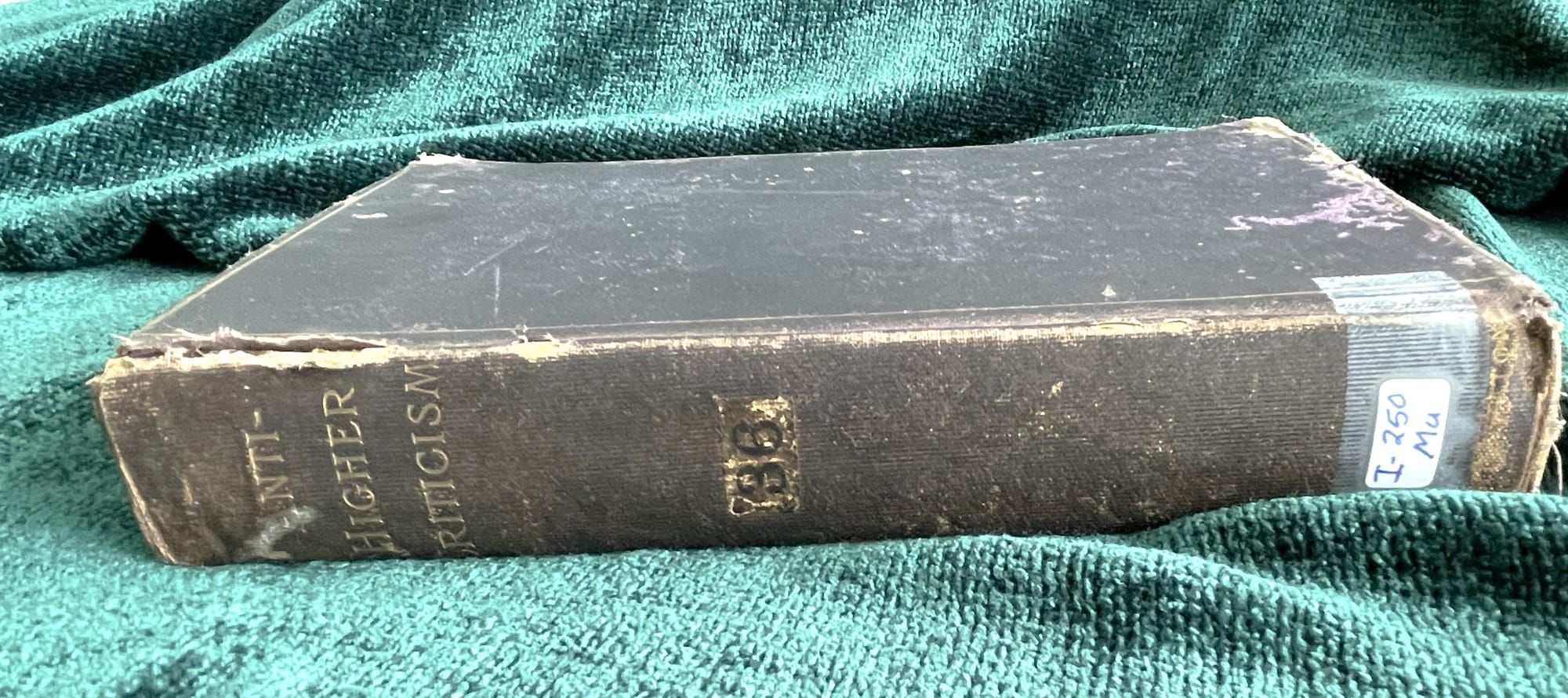
I have in my library a book I acquired many years ago entitled Anti-Higher Criticism. The editor and the contributors to this volume were all keenly cognizant of the dangers posed by the wolves in sheep’s clothing. The book was copyrighted in 1893.
From the Preface by the editor, Rev. L. W. Munhall, M.A., here are a few paragraphs providing some background of this 354-page volume. QUOTE:
For the past six years I have conducted a Bible Conference each summer by the seaside. It has been interdenominational in its character. The object has been “the promotion of prayerful, critical, exegetical study of the Holy Scriptures.”
…Because of the audacious and persistent assaults made upon the integrity of the Bible by many pastors, editors, theological professors, and other educators belonging to orthodox Churches, and because of the impudent assumption of these gentlemen that scholarship is almost wholly with them in their methods, work, and conclusions, I decide that the testimony of the last Conference should be directed against these assaults and assumptions. ….
The call was issued over the signatures of the following gentlemen: END QUOTE. Rev. Munhall then lists dozens of men from all realms of the Christian world in America from the following denominations or other groups: Presbyterian, Baptist, Methodist Episcopal, Congregational, Protestant Episcopal, Lutheran, United Brethren, Southern Presbyterian, Methodist Episcopal, South; Disciples, Cumberland Presbyterian, Reformed Episcopal, United Presbyterian, Friends, German Reformed, Reformed Dutch, Moravian, and Collegiate Reformed…
The Conference met in Asbury Park, N. J., August 11, 1893 and continued its sessions ten days. The sessions were attended by from two hundred to two thousand persons…
Many of the addresses were so scholarly, comprehensive, convincing, and satisfactory to honest and reverent minds that numerous requests were made by those who heard them that they should be published in book form.
The volume is sent on its way with the sincere desire and earnest prayer that it may be owned of God in confirming many in their belief that the Bible is the infallible, life-imparting, hope-inspiring, unfailing word of the living God, and that many wavering and doubting ones may be helped to hereafter speak and teach “as one that had authority, and not as the scribes.” END QUOTE and subscribed by L. W. Munhall, Germantown, PA, Nov. 14, 1893.
We think that Rev. Munhall would be pleased to know that the good work by him and his fellow contributors to this volume is still bearing fruit 133 years after it was published.
Now, from the “Introductory” by Rev. Munhall, we extract the following, QUOTE:
Dear Brethren: Our object is not only to vindicate God’s insulted and dishonored word, but also to exalt it to the extent of our ability.
We know how in times past the enemies of God have done their utmost to bring the Bible into contempt and to destroy it. We know how they utterly failed and were themselves brought into confusion and contempt.
In these days we are called upon to contemplate the most extraordinary and astounding spectacle of many pastors, teachers, and editors…making the very same fight against the word of God, and using the same weapons as were made and used by Astruc, Voltaire, and Paine. …
[Note from AI overview: Jean Astruc (1684–1766) was an 18th-century French physician and biblical scholar who served as a professor of medicine in Montpellier and Paris. He is historically significant for publishing the first major treatise on syphilis and for pioneering the documentary hypothesis in his 1753 work, Conjectures sur les mémoires originaux, which proposed that the Book of Genesis was compiled from multiple source documents. That is, the J, E, D, P theory.]
The work of these critics in American and great Britain is largely that of “threshing old straw,” and thereby throwing dust into the yes of the spiritually near-sighted, and thus “darkening sound doctrine.” They seem to be ready to accept, without hesitation, any criticism of the Bible that bears the imprint of rationalistic Germany.
The late Professor Christlieb once asked a friend of mine, “Why do Americans and Englishmen gather from the gutter so much of the theological rubbish we Germans throw away?”
And there is no doubt in my own mind but that, as suggested by the great theological professor of Bonn, many of the critics in this country are but theological scavengers.
I am quite sure I voice the feelings of all the speakers who will occupy this platform when I say we are in favor of all honest and reverent criticism, higher and lower.
We surely desire to possess ourselves of all trustworthy information concerning the authors and dates of the various books of the Bible—their grammatical construction and scientific and historic reliability.
Furthermore, I am very certain that these speakers are ready, any moment, to abandon any traditional views of the sacred volume that may be proved, demonstrably, to be erroneous. We will not continue to believe that which is not true because the fathers believed and taught it, if we know they were in error.
And I am equally certain that they are unwilling to abandon traditional views for which the scholarly fathers successfully contended, which God has honored by his favor and blessing, and which have been baptized by the prayers and tears and blood of those “of whom the world was not worthy,” at the dictation of rationalists, who in a most irrational manner argue from postulates that are subversive of the most holy and venerated things.
There are certain things we most respectfully insist upon, namely:
1. That inability to reconcile apparent discrepancies in God’s word, or to understand certain philological, scientific, and historic statements does not prove the presence of inaccuracies and errors.
The Assyriologist, Egyptologist, historian, philologist, and scientist are at work. Within the past twenty years many apparent discrepancies and errors have been reconciled and made clear as the result of their labors.
The natural and reasonable presumption therefore is that other difficulties will disappear as they prosecute their work.
We, at least, will possess our souls in peace, knowing that it is true. “Forever, O Lord, thy word is settled in heaven.”
2. That any criticism of the word of God based upon mere assumptions or presuppositions is discreditable to honest, comprehensive scholarship. This, I believe, is largely the common method of the rationalistic school.
3. That the professional critic is more likely to be wrong than right, and is, therefore, an unsafe guide.
I mean by professional critic one who spends his time and strength in trying to find some error or discrepancy in the Bible, and, if he thinks he does, rejoiceth as ‘one that findeth great spoil;’ who hopes, while he works, that he may succeed, thinking thereby to obtain a name and notoriety for himself.
4. That any method of biblical criticism that ignores the supernatural and lowers the Bible to the level of other books is deserving of unqualified condemnation, since God’s thoughts are as much higher than man’s as the heaven is above the earth.
5. That the criticism which minimizes, ignores, or antagonizes the testimony of the Bible to its own authorship, character, and integrity; that denies to Jesus Christ and the Holy Spirit the right and ability to testify in such matters, is subversive of the very foundation principles of our holy religion and destructive, to the last degree, of the Christian faith,
6. That any criticism of the Bible that fails to make proper account of its miraculous formation and preservation, of its transforming influence upon the hearts and lives of men, and of the silent and irresistible power it has exerted over the nations, is certainly and necessarily faulty.
7. That any criticism wholly lacking in the elements of common sense should be viewed with suspicion. The E, J, JE, D, P, PE, and R method of composition which the higher critics [Astruc et al.] have invented for the Pentateuchal books, and which may be properly called the “crazy quilt” method, is devoid of every principle of common sense.
No other book was so constructed, no book could be so constructed; and yet, as they argue the case, it must be that every other book, not even excepting the Dictionary, was made just in this same fashion.
The argument that, because there appears to be a difference in the literary style of the first thirty-nine and last twenty-seven chapters of Isaiah, therefore one man could not have written the entire book, is also lacking in this essential element; for does not common sense tell us that a man may have more than one style of writing, and that one’s style of writing may change with the passing years?
8. That the claim that all scholars are at one with the rationalistic methods, work, and results of the higher criticism, excepting in the cases of a very few who are so wedded to traditionalism as to be incompetent to arrive at an unbiased and honest conclusion, is audacious in assumption, untruthful in assertion, uncharitable in spirit, and can deceive none but the conceited, weak-minded, and ignorant.
9. That scholarship alone is a very dangerous thing to the cause of truth. “The mind of the flesh is enmity against God; for it is not subject to the law of God, neither indeed can it be.”
In these days there is an increasingly great disposition to exalt and magnify human learning, and to forget that the “foolishness of God is wiser than men,” and that “the world by wisdom knew not God.” We need constantly to be upon our guard against this peril.
10. That we recognize our entire dependence upon God for light in order to properly read his holy word. Without his help we shall be unable to make right uses of the great stores of information the scholars have gathered from many sources.
We rejoice that the dear Lord has not left us in darkness and ignorance to grope our way. The promises of his word assure us of all needed light and instruction. All he would have us know we may and sometime will know.
Jesus said to his sorrowing disciples, “But the Comforter, even the Holy Spirit, whom the Father will send in my name, he shall teach you all things.”
And, “Howbeit when he, the Spirit of truth, is come, he will guide you into all truth.” We are also told, “But the natural man receiveth not the things of the Spirit of God: for “they are foolishness unto him: neither can he know them, because they are spiritually discerned.”
And again: “But the anointing which ye have received of him abideth in you, and ye need not that any man teach you: but as the same anointing teacheth you of all things, and is truth, and is no lie, and even as it hath taught you, ye shall abide in him.”
Therefore, brethren, let us look heavenward for help, and in humble dependence upon the Holy Spirit give ourselves to much prayer, that the influence of this Conference may be salutary and very far-reaching, to the glory of God’s grace in Jesus Christ. END QUOTE
I trust that this sidebar excursion will prove to be beneficial to all readers as we move forward in our study of which Bible, which version.
~END~