Which Bible? Which Version?
There are numerous other examples I could cite and continue on about how the higher critics try to discredit Yahweh’s Word, but I will let one more suffice, and then I will get back to Constantine Tischendorf.
This one is important because of the news coverage it has received—both in the religious press and the “fake news” media—over the decades since it was founded in 1985. It’s called the Jesus Seminar.
This is a group of “Bible scholars” from all over the country who meet periodically to review and publish their latest theories and findings about Christ and the Bible.
Most recently, they have come up with their own version of the five Gospels. Yes, I said the five Gospels. Here is what they have done. They have cut out, removed all kinds of words and verses from the four Gospels which these alleged scholars have determined that Jesus never said. Then they have added the Gospel of Thomas, which is clearly their favorite.
Have you heard of the Gospel of Thomas? My own conclusion is that the Gospel of Thomas was not written by Thomas the Apostle. Obviously, it was rejected from the canon of Scripture by the early believers under the guidance of the Holy Spirit. (Much later in this series, we will discuss how, when, and by whom the canon of the Bible came to be closed and accepted.)
Here is an example of one of alleged sayings of Jesus from the Gospel of Thomas. Listen carefully: “every woman who makes herself male will enter the kingdom of heaven.”
I’m reading shock on your faces. Yes, that’s the Gospel of Thomas. Now, where did this pseudo-Gospel originate? It comes out of Egypt. In Bible symbology, Egypt is a type of a number of related concepts. It symbolizes the world, sin, bondage, death, and corruption.
With what philosophy is the Gospel of Thomas associated? Gnosticism. For those of you who may have heard that word but really don’t know what Gnosticism was all about, be patient, we will get to it in due course in this series.
But for now, just be satisfied to know that it was a heresy in the early centuries of Christianity, and it has been in the pit, so to speak, for many centuries.
But now, in our times, it has once again risen up to the surface. I think you’re going to be surprised and astonished at the extent to which it is now all around us in America. And yet, the vast majority of Christians do not recognize this anti-Christian heresy for what it is.
I know I am teasing you with such a statement like that, but I want you to stay tuned because there’s so much more and very exciting material that we have yet to cover.
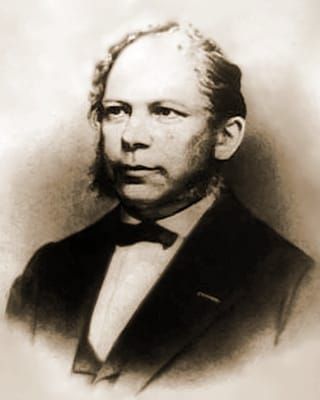
Now, back to Constantine (or Konstantin von) Tischendorf (1815–1874).
The spreading virus of higher criticism in Europe in the early to mid-1800s, especially in Germany, led the higher critics to come to doubt the entire New Testament. As a result, Tischendorf, as a young man growing up in that environment became very concerned about the accuracy and reliability of the Scriptures.
And then he spent the rest of his entire life trying to prove the reliability of the Bible. He was “ever learning but never coming to the knowledge of the truth.” He took the wrong approach. He was always looking for proof first instead of believing first.
In the end, having discovered what he thought was a manuscript which would uphold the integrity of the Bible, the Codex Sinaiticus has instead lent itself very well to the purposes of Westcott and Hort and other critics who try to destroy true Bible Christianity. A bit further on in this series, I will show you specifically how they do that.
In his search for ancient manuscripts, Dr. Tischendorf realized that perhaps some of the many religious monasteries in the Middle East would be likely locations to find them.
Men in the previous century had already been to St. Catherine’s Monastery which is located at the foot of what is called “Mount Sinai” in the southern tip of the Sinai Peninsula.
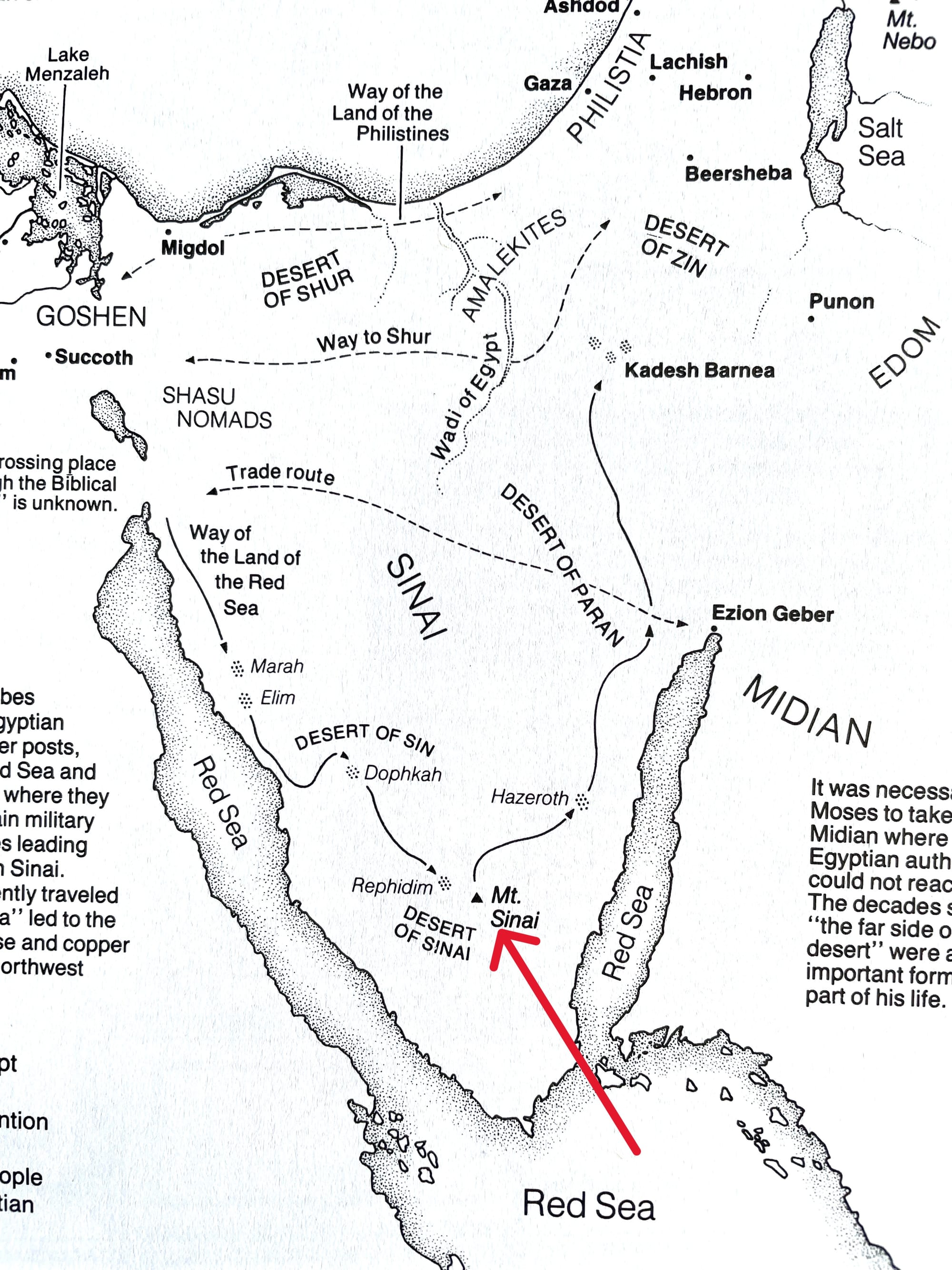
If you have maps in the back of your Bible, you can probably find one there which purports to show the route of the Israelites’ exodus from Egypt. You will probably see a little X in the southern tip of the Sinai Peninsula which they say is the Mount Sinai where Moses received the Ten Commandments, etc.
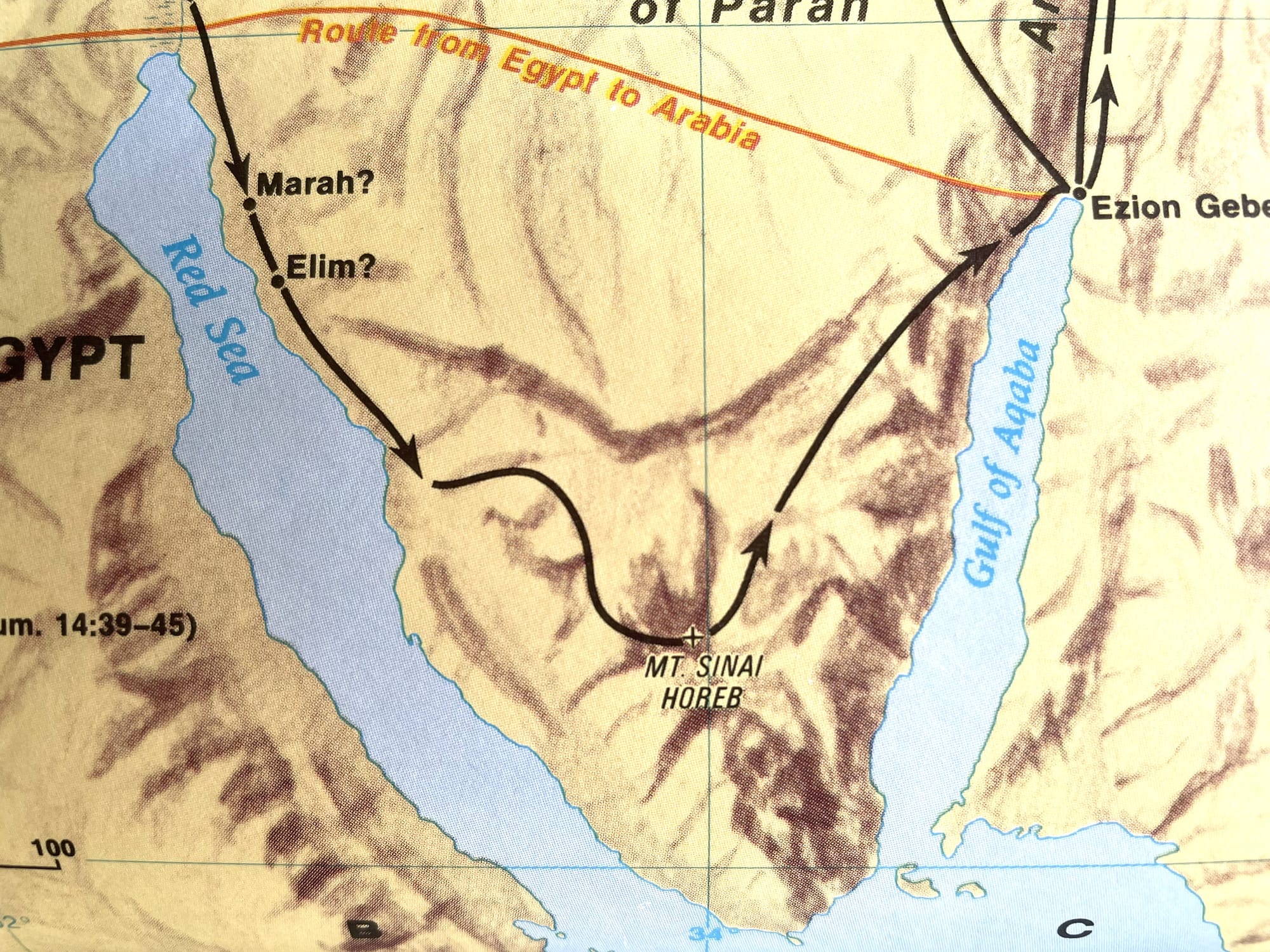
There at the foot of that mountain is where this monastery called St. Catherine’s is located and Tischendorf journeyed there.
The monastery which had been built in approximately the 500’s or 600’s A.D. and it was literally a high and dry place. Therefore, if any ancient manuscripts were there, they would undoubtedly stand a good chance of surviving and be preserved. There would be much better chances of ancient manuscripts surviving there than any that might be found in the moist Mediterranean climate.
So, on his first trip to the monastery in 1844, Tischendorf came upon a waste basket in a hallway with a stack of old parchments in it, ready to be thrown into the fire by the monks. But “Connie the Tisch” persuaded the abbot to let him have 43 sheets out of what he said were about 130 in the stack.
Tischendorf later wrote that he thought that his own display of enthusiasm for this stuff in the waste basket probably tipped off the abbot and so the abbot refused to give him permission to take any more than 43 sheets with him.
When Tischendorf got back to Germany, he wrote about his find and the way he characterized these monks in this monastery was that he made them appear to be a bunch of nincompoops and total idiots because according to Connie, they did not recognize the value of the parchments they had intended to burn as trash.
Tischendorf’s findings in his articles were published far and wide all over Christendom, especially Western Europe and America at that time. Tischendorf went on to make other discoveries elsewhere in the Middle East in the meantime, but he did not get back to St. Catherine’s Monastery until 1859—15 years later.
In the meantime, he also managed to publish about 20 different versions of the Greek New Testament, which many so-called scholars of the Westcott-Hort lineage still consult to this day.
Tischendorf’s first trip had been financed by the German government. This trip in 1859 was financed by the Tsar of Russia with the agreement by Tischendorf that any discoveries would be brought back to Russia and given to the Tsar.
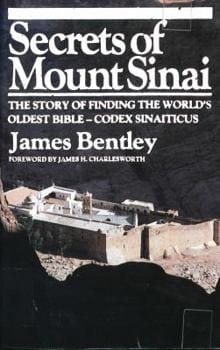
Let me quote this part of the story now directly from James Bentley in his book, The Secrets of Mount Sinai.
QUOTE: In January 1859, Tischendorf once again set sail for Egypt. He devoted a few days in turning over the manuscripts of the monastery, not without alighting here and there on some previous parchment or other, but of his old discovery, he saw nothing.
On the 4th of February, he told his Bedouin to prepare to leave for Cairo three days later. That evening, he took a walk with the young Athenian steward of the monastery and then went for some refreshment in the steward’s cell.
Then the steward said that he too had read the Greek version of the Old Testament, and he took down from the corner of his cell a bulky parcel wrapped up in a red cloth and laid it before Tischendorf. Tischendorf took it to his own rooms.
Altogether, he held in his hands 346 parchments, all in the same handwriting and from the same volume. [Tischendorf is writing a letter now to his wife.] “I was beside myself with joy,” he wrote to Angelica.
He was amazed to see not just the Old Testament, but also the whole of the New. “It is the only such manuscript in the world,” he told his wife.
Neither the Codex Vaticanus nor the London Alexandrinus contains the whole New Testament, and the Sinai Codex is undoubtedly older than both. This discovery is a remarkable occurrence and a great one for Christian knowledge, he continued.
He added, “naturally, no one in the monastery really knows what is contained in this manuscript. END QUOTE
In other words, they’re a bunch of dummies. Continuing to QUOTE:
As he read on, Tischendorf was astounded to discover that the Sinai Codex contained the whole of a very early Christian letter, the Epistle of Barnabas, of which a considerable part till this moment was considered lost in the Greek original.
“I had tears in my eyes,” he told Angelica, and my heart was beating as never before. Then he picked up another page and saw the title, The Shepherd. He immediately recognized this as the visionary book written in the second century A.D. by a Christian called Hermas. Tischendorf felt deeply moved.
“Had I not always said that I go in the name of the Lord in search of treasures which will bear fruit in his church?”
Tischendorf was now faced with a problem. Entirely by his own efforts, the world would be given an extraordinary enrichment of Christian knowledge, but only if he could get the manuscript and take it away with him.
Moreover, he had also promised to bring back everything he could find and give it to the Tsar. Tischendorf, therefore, tried to bribe the young steward to let him keep the Codex. The steward refused.
Even if he had wished to deceive his fellow monks, he had no choice, since he had borrowed the Codex from the sacristan of the monastery, Skevophilax Vitalios, in order to show it to Tischendorf.
Tischendorf, therefore, now embarked on the remarkable piece of duplicity, which was to occupy him for the next decade, which involved the careful suppression of facts and the systematic denigration of the monks of Mount Sinai. END QUOTE Emphasis mine.
Yes, that is the story of how this supposedly great and priceless manuscript, which he found in a wastebasket, was brought into the battle for the Bible in the Christian West.
Over the next ten years, Constantine Tischendorf lied and deceived and made promises and broke promises and finally outright stole the Codex from the monks at St. Catherine’s Monastery.
After being unable to get the whole thing out in 1859, he did manage to copy the whole manuscript, which consisted of 110,000 lines. To these, Tischendorf added the alterations of later correctors, 12,000 altogether at that point.
Finally, in 1869, Tischendorf was allowed to borrow the Codex for a month and a half. He wrote the monks a promissory note telling them he would have it back in their hands in a month and a half or less.
What he intended to do in that month and a half, he told the monks, was take it to Russia, show it to the Tsar, get a facsimile printed up, and bring it all back. Go all the way from Egypt to Russia, and have a print job done and make the return trip to St. Catherine’s—all that in a month and a half.
Well, I suppose the monks must not have been too clever after all—or, it was simply that they did not expect this highly credentialled Bible scholar from Germany to betray their trust.
Because that was the last the monks ever saw of the Codex. Tischendorf never brought it back. He never intended to.
(To be continued.)
~END~