
Chapter 4, Section 2: Bible Critics—Higher and Lower
We are still presenting some basic information and historical details about the various streams and families of Bible manuscripts.
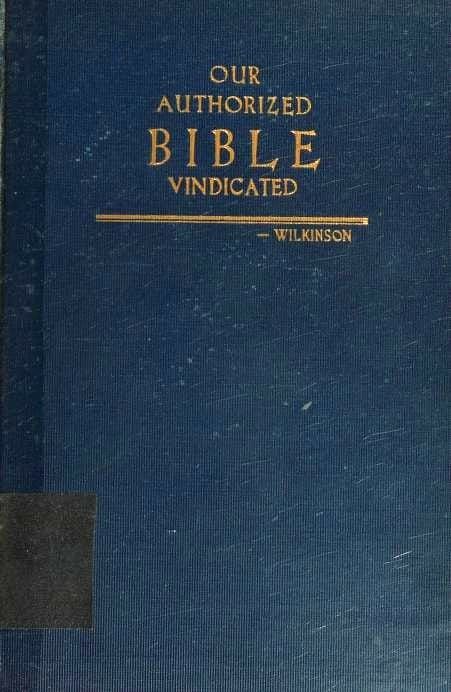
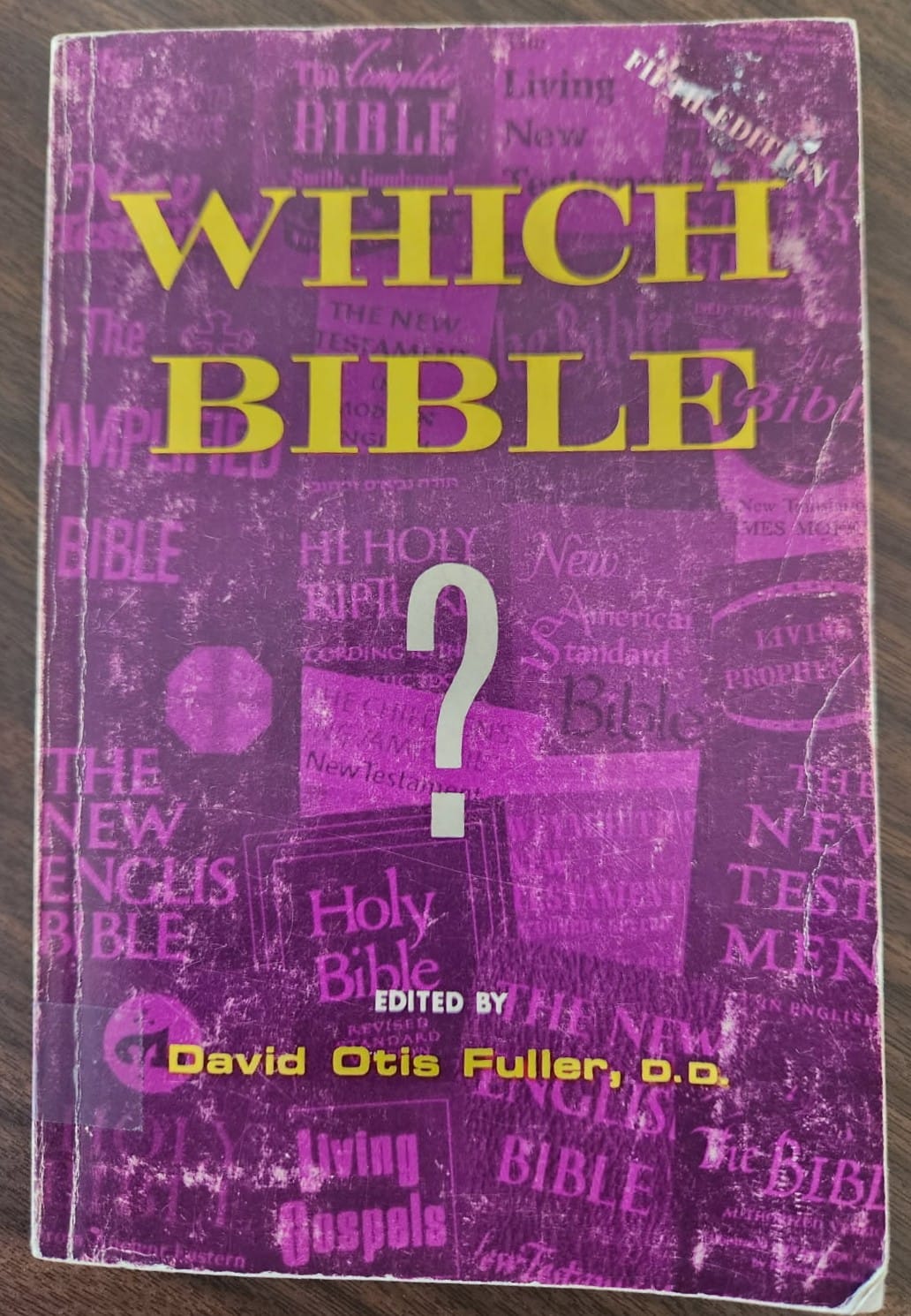
The following information comes from a classic work called Our Authorized Bible Vindicated by Benjamin Wilkinson, which was published in 1930. I am going to read a few excerpts from it, as published in the book by David Otis Fuller, which is called Which Bible?
QUOTE: The case with the Vaticanus and the Sinaiticus is no better. The problems presented by these two manuscripts were well known, not only to the translators of the King James, but also to Erasmus.
We are told that the Old Testament portion of the Vaticanus has been printed since 1587. …We’re informed by another author that if Erasmus had desired, he could have secured a transcript of this manuscript. There was no necessity, however, for Erasmus to obtain a transcript, because he was in correspondence with Professor Paulus Bombasius at Rome, who sent him such variant readings as he wished.
A correspondent of Erasmus in 1533 sent that scholar a number of selected readings from it, that is, from Codex B, the Vaticanus, as proof of its superiority to the Greek text, the Received Greek text.
Erasmus, however, rejected these variant readings of the Vatican manuscript because he considered from the massive evidence of his day that the Received Text was correct…
Let’s suppose for the sake of argument that the translators of 1611 did not have access to the problems of the Alexandrinus, the Sinaiticus, and the Vaticanus by direct contact with these uncials. It mattered little. They had other manuscripts accessible which presented all the same problems.
We are indebted for the following information to Dr. F.C. Cook, editor of The Speaker’s Commentary, and chaplain to the Queen of England. (Queen Victoria.)
Dr. F.C. Cook was invited to be part of Westcott and Hort’s Bible Revision Committee, but he declined the invitation. And he said this: “That Textus Receptus was taken in the first instance from late cursive manuscripts but its readings are maintained only so far as they agree with the best ancient versions and the earliest and best Greek and Latin fathers and with the vast majority of uncial and cursive manuscripts.”
[Continuing to quote] It is then clear that among the cursive and uncial manuscripts which the Reformers possessed, the majority agreed with the Received Text.
However, there were a few among these documents which belonged to the counterfeit family. These dissenting few presented all the problems which can be found in the Alexandrinus, the Vaticanus, and the Sinaiticus.
In other words, the translators of the King James came to a diametrically opposite conclusion from that arrived at by the revisers of 1881 [Westcott, Hort and their committee], although the men of 1611, as well as those of 1881, had before them the same problems and the same evidence. END QUOTE
To summarize this point, despite the fact that the King James Version translators did not have their hands on the physical Vaticanus, Sinaiticus, and Alexandrinus manuscripts, they nonetheless did have access to, but rejected as corrupted, those other manuscripts, which are of the same families as the Vaticanus, and thus had the same errors as the Vaticanus, Sinaiticus, and Alexandrinus.
Now let’s delve into the background of Codex Aleph, the Sinaiticus. For this portion of our study, I begin by reiterating something I mentioned in an earlier portion of this series, namely this.
Because this material is being presented orally to a live audience, I don’t wish to make it the equivalent of a spoken term paper with footnotes at the end of every paragraph and extensive documentation of everything I say. If I did that, can you imagine how tedious and boring this would become? It would become very cumbersome.
For that reason, I’m only occasionally going to cite my sources. But at the end of the series, I will offer a substantial bibliography of suggested reading material on both sides of this question so that you can study these things more deeply on your own if you so desire.
Therefore, for this part of our study, I will be relying chiefly on material found in a 275-page book by James Bentley, published in 1986, which is called The Secrets of Mount Sinai.
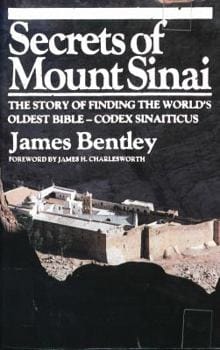
First of all, for the record, James Bentley and his book are very much in the anti-Textus Receptus, anti-King James Version, pro-Westcott and Hort camp. However, I will also be critiquing his work using material found in a number of other works. To set the stage, here are a few lines from the book jacket.
QUOTE: Recent discoveries such as the Dead Sea Scrolls and the Gnostic Gospels are challenging pivotal assumptions of modern Christianity. The author of this remarkable book suggests that further surprises are in store for us.
They are contained in the so-called Codex Sinaiticus, 347 pages of ancient manuscript, whose history alone is an intriguing story. Originally found in the mid-19th century in the monastery of St. Catherine at the foot of Mount Sinai, they were sold by Stalin in 1931 for 100,000 pounds to the British Museum, where they remain to this day. END QUOTE
The central character in the story of the discovery of this manuscript is a German Bible scholar named Constantine Tischendorf. He was the son of a Lutheran medical doctor, and he was growing up in the early 1800s.
Already by that time, the higher critics in Germany were casting grave doubts on the accuracy of the Bible. Now, we should stop at this point and explain what this higher criticism business is all about, because it is a term we are going to run into time and time again. So, it’s definition time once again.
We’ve already explained what textual criticism is. I think most of you remember this simple example I gave of textual criticism, where I gave a simple statement pretending it was a verse in the Bible.
Manuscript #l reads: The boy kicked thr red ball.
Manuscript #2 reads: The boy kicked the rod bill.
Manuscript #3 reads: The bay kicked the red bull.
Manuscript #4 reads: The boy kicked the red bell.
Manuscript #5 reads: The boy kvcked the red ball.
Now, a textual critic looks at all this and he uses his noggin (logical thinking) to conclude what the original must have been.
So, I said Bruggeman’s Greek text would have determined that the original must have read “the boy kicked the red ball.” That is just a real basic and simple example of one of the things that textual critics do. That is called lower criticism.
You see, lower criticism is concerned with correcting such textual errors which occur in virtually all extant manuscripts.
On the other hand, higher criticism, so-called, is instead concerned not so much with trying to arrive at what a given word or verse must have said in the original, it is concerned with the substance and validity of a large portion of text. What do I mean by that?
Well, it means that higher criticism is concerned with looking more at, say for example, an overall book of the Bible, or even the whole Pentateuch. The book of Isaiah, for example, or the book of Deuteronomy, or the book of Genesis, or the book of Daniel.
The higher critics examine it from an overall perspective and they judge and determine what they can allegedly correct about the Bible by looking at supposedly accurate secular histories and by using secular science.
And therefore, they see how the Bible stacks up against all that. In other words, the higher critics start out with a premise of unbelief in the Bible. They want to see if the Bible matches up to the findings of science and history. Therefore, their standards for determining truth is science and history.
And if whatever portion of the Bible doesn’t agree with history or science, well, then these higher critics conclude that the Bible must be wrong. And conversely, that man and his theories are right.
Remember what I said back at the very beginning of this series about how our heart attitude towards the Bible is extremely important.
I suggested then that we ask ourselves: Are we going to humble ourselves by first, believing on faith—which means we can’t yet prove it—but believing on faith that God has given us His infallible Word in the Holy Bible?
And that when we do that, and as we submit to His sovereignty, then by and by, He will guide us into all truth with his Holy Spirit. That is His promise. And I don’t care which modern version you want to pick up, you will still find that promise in those versions. They haven’t corrupted that.
The matter of our heart attitude is so vitally important. And so we see that the higher critics start out from the opposite premise. They take the position that they have to be able to prove this, or to prove that, or prove the other thing in the Bible before they will assent or agree to its validity as the inspired Word of God.
But do you know what happens when you take that position? There is always going to be another passage, or another text, or another verse that pops up and causes you to doubt. So you can spend your whole lifetime trying to prove that the Bible is true so that you can believe it.
Now, stop and think of the irony of that. If you know something is true because you have proven every single aspect of it, then where is faith? Then faith has no place in that critic’s life.
But God has called us to believe before we know. Before we can prove it. He has called us to trust Him. To take Him at His Word.
(To be continued.)
~END~