Which Bible, Which Version?
Do you remember in a previous part of this series where I issued my disclaimers about the alleged “families” of manuscripts? I stated that I was only using that term for convenience sake in trying to communicate complex material to readers in a more easily understood manner.
Furthermore, I stated that I did not necessarily agree that such a categorization was necessarily valid. Well, what we’re going to reveal now will show you why I made that disclaimer.
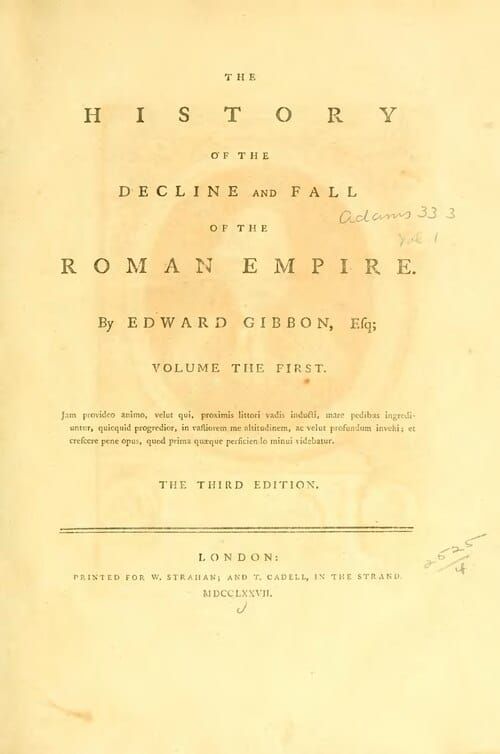
I presume most readers have heard of (if not read) Edward Gibbon and his book, The History of the Decline and Fall of the Roman Empire.
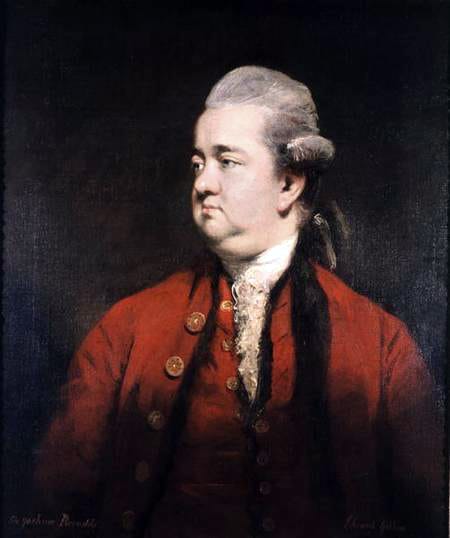
“Edward Gibbon (1737–1794) was a British essayist, historian and minor politician. His most important and influential work, The History of the Decline and Fall of the Roman Empire, was published in six volumes between 1776 and 1789, to critical and commercial success.” (Wikipedia)
That work catapulted him to fame in England. He took advantage of his fame by disparaging the Bible, claiming that the church fathers had contaminated the Holy Scriptures. Well, he was correct, except that he claimed the wrong “fathers” were contaminating it. He focused his attack, interestingly, on one passage. Let’s read it.
KJV 1 John 5:7 For there are three that bear record in heaven, the Father, the Word, and the Holy Ghost: and these three are one.
If you are reading anything other than the King James, you will probably find a marginal note to indicate that, “the oldest and best manuscripts” do not have this verse.
Gibbon asserted that this verse was inserted later in order to fraudulently defend the doctrine of the Trinity, and thus to defend its corollary that Jesus is fully God as well as fully man.
When he did that, vast numbers of Christians were outraged, and the clergy instantly attacked Gibbon. But to Gibbon’s defense came one vile individual named Richard Porson.
Now, I want to quote to you concerning Porson from Bentley’s book, The Secrets of Mount Sinai. Emphases are mine as are comments within [brackets]. QUOTE:
A. E. Houseman, the Cambridge classicist and poet, held that Porson was Britain’s second greatest classical scholar. Yet Porson’s career ended in failure. Although he had been born into a poor Norfolk family, the young Porson’s precocious brilliance led him to an education at Eton and Trinity College, Cambridge.
But two things prevented greater success. One was drink. The other was Porson’s refusal to take Holy Orders, which effectively barred him from university preferment.
[“Holy Orders,” of course, is speaking of becoming a priest in the Church of England.]
After leaving Cambridge, Porson was once found drunk in a turnip field and forced to give up his job as tutor to the son of a rich family in the Isle of Wight. Byron described him as the most bestial of all the disgusting brutes that he knew.
Porson, he wrote, was sulky, abusive, and intolerable, adding, “in private parties he was always drunk or brutal and generally both.”
He became librarian to the London Institution, but scarcely attended to any of his duties, frequently coming home dead drunk long after midnight.
But for his early death, (asserted his successor as librarian) the directors of the institution would certainly have dismissed him.
A. E. Houseman once made a brilliant after-dinner speech in the Great Hall of Trinity College, Cambridge, alluding to Porson’s tragic affliction. “This great college of this ancient university,” said Houseman, “has seen some strange sights. It has seen Wordsworth drunk and Porson sober. And here am I, a better poet than Porson and better speller than Wordsworth.”
For all his drunkenness, Porson’s brain was formidable. Along with Edward Gibbon, this depraved Englishman brought into the open the dubious authenticity of parts of the Christian Bible.
Porson greatly admired Gibbon. He considered The Decline and Fall incomparably the greatest literary work of the 18th century. He loved to quote long passages from it. To admire a skeptic like Gibbon and also to enter the 18th century church was scarcely possible.
At any rate, when faced with the decision whether or not to seek ordination, Porson said, [Listen to this!] “I found that I should require about 50 years reading to make myself thoroughly acquainted with divinity—to satisfy my mind on all points.”
In any case, his doubts about orthodoxy—and especially about the doctrine of the Trinity—were all too obvious.
Faced with such doubts and aware of the great intellectual problems confronting the Christian faith, Porson was appalled at the cocksure incompetence of Archdeacon Travis’s defense of the three heavenly witnesses of 1 John chapter 5, verse 7. He [Porson], published a brilliant and devastating reply.
Porson’s technique reveals a breakthrough for which he was in large part responsible in the textual criticism of the Bible. It was the technique later used by Tischendorf and every other [so-called] competent textual scholar.
Porson faced the question of how to decide, out of many different manuscripts of the Bible, which gave the correct text. His answer was to group them in “families.” All the texts that shared common errors, misreadings, misspellings, alterations, and so forth, belonged to the same family, he decided.
This enabled him to eliminate later manuscripts, which were obvious copies of earlier ones. He found it possible to build up a family tree of any text, discovering the various stages at which the text had undergone change or alteration.
Porson used this technique to destroy the claim to authenticity of the proof of the three heavenly witnesses in the first epistle of John. He showed that none of the extant oldest Greek manuscripts of the Bible contained it. The spurious text first appeared in Latin manuscripts around the year A.D. 400.
Not one of the earlier church fathers ever quoted or cited the text. END QUOTE from Bentley, Secrets of Mt. Sinai.
Now, once again, I ask you to use your common sense in your knowledge of the Scriptures. Did Isaiah or did Jeremiah or did Ezra or did John, the beloved apostle, or did Peter or did Paul…
Tell me, dear reader, which of the human Bible authors, or which of the God-fearing, early church fathers had their brain cells permanently soaked and embalmed in alcohol while they wrote the inspired Scriptures, or wrote about it.
But yet Richard Porson supposedly discovered these great techniques and is attempting to destroy the reliability of the Bible while being a drunkard all his life!
Did you catch the very telling quote which Mr. Bentley gives us from Richard Porson when he was asked to become an ordained minister? Porson answered that he needed to satisfy his mind first on all the questions that he had. And that would take about 50 years, he thought.
In other words, Porson chose to desire head knowledge and to have that satisfactorily answered before he would believe. Now, let me re-read those last couple of sentences before I go on. Porson supposedly showed that none of the extant oldest Greek manuscripts of the Bible contained 1 John 5:7.
QUOTE: The spurious text first appeared in Latin manuscripts around the year A.D. 400. Not one of the early church fathers ever quoted or cited that text. END QUOTE
Well, according to Dr. Peter Ruckman, who is president of Pensacola Bible Institute, these are all lies. Now, if one can judge a personality by one’s writing, then Ruckman is a very colorful character.
He answers this charge in his 500-page book called Problem Texts. Allow me to quote to you from that book. QUOTE:
“For there are three that bear record in heaven: the Father, the Word, and the Holy Ghost; and these three are one; and there are three that bear witness in earth: the Spirit, the water, and the blood; and these three agree in one.” 1 John 5:7 and 8.
Since the New American Standard Version has not only altered the words in the verse, but changed the numbering of the verses, you cannot hope to find much truth there. What passes for verse 7 in the New American Standard Version is not verse 7. What passes for verse 6 in the New American Standard Version is not verse 6.
Thirteen words have been removed from verse 6 to make you think that you’re going to get a square count. And then these thirteen words have been substituted in verse 7 for another 17 words, which have been removed from that verse.
So when you get a corrupt New American Standard Version [which is recommended by Bob Jones University and its graduates… You can see that Dr. Ruckman has got it in for Bob Jones University here, although he’s a graduate of it.] Continuing…
QUOTE So when you get a corrupt New American Standard Version, you are reading a version that has deleted half of verse 6, three-fourths of verse 7, and then put thirteen words into verse 7 that were never there.
Now, Ruckman is often very sarcastic, so he says…] typical honest translating by good, prayerful men if you ever split your britches, buster. The Johannine Comma,” [Johannine simply means having to do with John. Comma, that’s a textual criticism term, not one of those little punctuation marks in the middle of a sentence. This means the part of a manuscript that they are studying, and trying to determine whether that verse was inserted or not. They call it the Johannine Comma. Ruckman says…]
The Johannine Comma is found in two Greek manuscripts, contrary to the lying that goes on in the classroom: Codex Ravianus and [Codex] Number 61. [The Codex Ravianus is a handwritten transcript of the Complutensian Polyglot (printed 1514), taking its name from Christian Rave or his brother Johannes Rave. It contains a complete text of the New Testament in two volumes.]
It is also found in the marginal notes on Greek manuscripts 88 and 629. It is also quoted by Cyprian more than 60 years before Vaticanus and Sinaiticus cut it out. It is also cited in 380 A.D. by a Spanish bishop. It is cited numerous times by African Christians, from 430 to 534 A.D. Cassiodorus quotes it, 480 to 570.
And it is also found in the old Latin manuscript, manuscript R, written more than 100 years before Vaticanus and Sinaiticus cut it out.
Furthermore, without the “Comma,” the gender of the nouns do not match in the New American Standard Version text, [which is] the mongrel, Nestle, Hort, Aland, Metzger, eclectic, wet dog of apostate Christendom. END QUOTE
And he goes on, but now, what is this “Nestle, Hort, etc. that Ruckman is mentioning? Well, these are all men who were Bible critics. Eberhard Nestle Eberhard Nestle (1851–1913) was a German biblical scholar, textual critic, orientalist, editor of the Novum Testamentum Graece, wrote a Greek text. (Wikipedia)
We will have much to say about F.J.A. Hort, and his influence on modern Bible versions in coming chapters.
“Kurt Aland (1915–1994) was a German theologian and biblical scholar who specialized in New Testament textual criticism. He founded the Institut für neutestamentliche Textforschung (Institute for New Testament Textual Research) in Münster and served as its first director from 1959 to 1983.
“He was one of the principal editors of Nestle–Aland – Novum Testamentum Graece for the Deutsche Bibelgesellschaft and The Greek New Testament for the United Bible Societies. Kurt Aland is another Greek text writer.” (Wikipedia)
Bruce Metzger (1914–2007) “was an influential American biblical scholar and historian who spent his career at Princeton Theological Seminary, where he specialized in textual criticism and the New Testament canon.” (Wikipedia)
So all these scholars’ works are essentially derivatives of the work of Westcott and Hort. Ruckman has nothing but contempt for the whole lot. Hence, he calls them, the “Nestle, Hort, Aland, Metzger, eclectic, wet dog of apostate Christendom.”
Let us for a minute discuss about the word bias. According to Webster’s 1828 Dictionary, it means, (2), “a leaning of the mind, an inclination.” It is often confused with the word prejudice.
But if we look at the root of the word prejudice, we find that it means to pre-judge, in other words, to judge before the facts are known. And thus I say this: I am not prejudiced on the matter of Bible versions, but I am certainly biased. That is to say, I lean towards a particular position.
However, as I have mentioned before, my position, or my bias, is a result of nearly four years of fairly intensive study on this subject. Now, back when I was in the Journalism School at the Ohio State University, we did not see a video, because they did not have them in those days, but we were shown a 15-minute film clip, I think it was that long, made by David Brinkley, specifically for advanced journalism students.
So this was probably in my last semester in Journalism School at OSU. For those in Carthagena, Ohio, David Brinkley was one of the icons of broadcast journalism. “David McClure Brinkley (July 10, 1920 – June 11, 2003) was an American newscaster for NBC and ABC in a career lasting from 1943 to 1997. From 1956 through 1970, he co-anchored NBC's top-rated nightly news program, The Huntley–Brinkley Report, with Chet Huntley.” (Wikipedia)
In this talk to J-students, David Brinkley said something to this effect: In the news business, there’s no such thing as objectivity. Everybody comes at a particular question or issue from a certain position and is going to be subjective to an extent. Nobody is objective, in other words, nobody is unbiased. Everyone has one.
Well, I condemn prejudice, but I do not condemn bias in the sense I have been speaking of here. Everyone who has studied the issue has a bias. But, if one has a position before studying the issue, then one is prejudiced. Mr. Bentley wrote The Secrets of Mount Sinai. He has a bias, and I do not condemn him for having it; however, I simply think that he is wrong, dreadfully wrong.
I had mentioned to you that Mr. Bentley comes down strongly on the side of Westcott and Hort and he is against the defenders of the Received Text (Textus Receptus)… Bentley is against such stalwart defenders of the TR as Dean John Burgon. John William Burgon was a contemporary of Westcott and Hort. (Much more on Burgon when we discuss Westcott and Hort.)
Listen now to this excerpt from The Secrets of Mount Sinai, which reveals not only James Bentley’s bias, but also reveals a very telling fact about Westcott and Hort. This all begins to set the stage for our detailed look at these two Englishmen who have had such a baneful and destructive influence on virtually all modern Bible versions. Consequently, many modern Bible versions are “eclectic, wet dog(s) of apostate Christendom.”
(To be continued.)
~END~